The United States has repeatedly failed to break the Iranian blockade in the Strait of Hormuz despite explicit declarations to do so. This tactical gridlock stems from Iran relying heavily on strategic maneuvering rather than brute military force. Naval mines deployed across this vital maritime corridor have played a definitive role in maintaining Iranian control over the channel. Locating and neutralising these submerged hazards has proved to be a highly strenuous and complex challenge for the United States military.
Every time the US Armed Forces have launched operations to locate and clear these explosive devices, they have encountered severe operational and technical obstacles. The deployment of these naval mines has effectively emerged as a critical turning point in the wider geopolitical friction involving Iran.
Classification of Maritime Mines
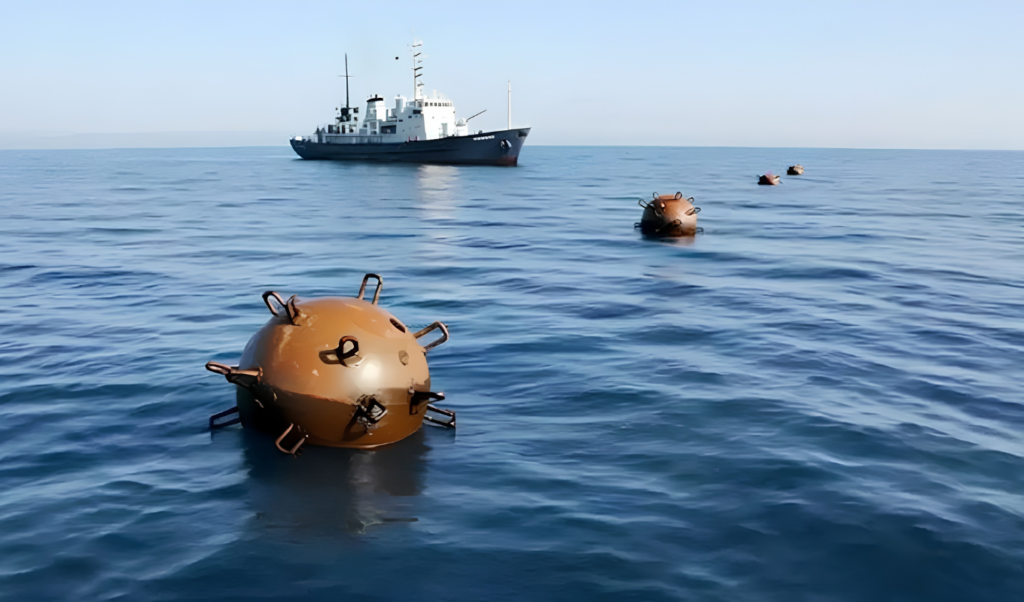
Naval mines are specialized explosive devices submerged in marine environments designed to damage or destroy transiting vessels and warships. The naval mines deployed within the Strait of Hormuz primarily fall into three distinct categories based on their design and triggering mechanisms:
| Mine Type | Operational Mechanism | Target Risks |
| Moored Mine | Secured at a specific depth beneath the surface using an anchor. | Detonates upon direct physical contact with a ship’s hull. |
| Bottom Mine | Deposited directly onto the seabed or buried in shallow waters. | Extremely difficult to detect visually or via standard sonar. |
| Influence Mine | Triggered without physical contact by sensing environmental anomalies. | Activates by detecting magnetic fields, acoustic signatures, or water pressure shifts caused by passing vessels. |
US Presidential Conditions and Diplomatic Demands
The strategic anxiety gripping Washington regarding the mine threat has been explicitly corroborated by senior leadership. US President Donald Trump has directly conditioned the lifting of the naval blockade imposed against Iranian ports on the immediate removal of these maritime hazards from the Strait of Hormuz. Addressing Iran, the US President stated that advanced American mine countermeasures and specialized mine sweepers have already successfully neutralized a substantial number of these explosives. However, he insisted that Iran must swiftly deactivate or remove all remaining naval mines currently active within the channel.
The US administration has formally declared that if these specific terms are met, the American naval blockade enforced against Iranian ports will be dismantled. Concurrently, the Strait of Hormuz would be completely reopened from both directions to ensure unhindered international maritime transit. These stipulations were officially disclosed on Friday by the US President in a post on his social media platform, Truth Social, detailing the core pre-conditions required for any potential bilateral agreement between the United States and Iran.
Maritime Warnings and Heightened Emergency Protocols
In tandem with these political declarations, the United States Navy Central Command issued an urgent maritime security advisory on Friday. The directive warned shipowners, operators, and maritime crews regarding highly hazardous military activities occurring within the northern sector of the Strait of Hormuz, specifically situated north of Oman’s Musandam Peninsula.
According to an emergency alert broadcasted late Friday night by the Joint Maritime Information Centre, the regional threat assessment has escalated to a “critical” level. The center reported that Iran is attempting to consolidate control over this strategic international waterway by unlawfully deploying hazardous naval mines, thereby introducing severe risks to commercial shipping and seafarers.
Consequently, all maritime operators have been strictly instructed to circumvent the standard Traffic Separation Scheme within the Strait of Hormuz. Vessels navigating the broader region are required to maintain continuous radio contact with relevant naval authorities and must comply immediately with all tactical directives issued by US forces.