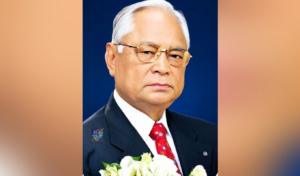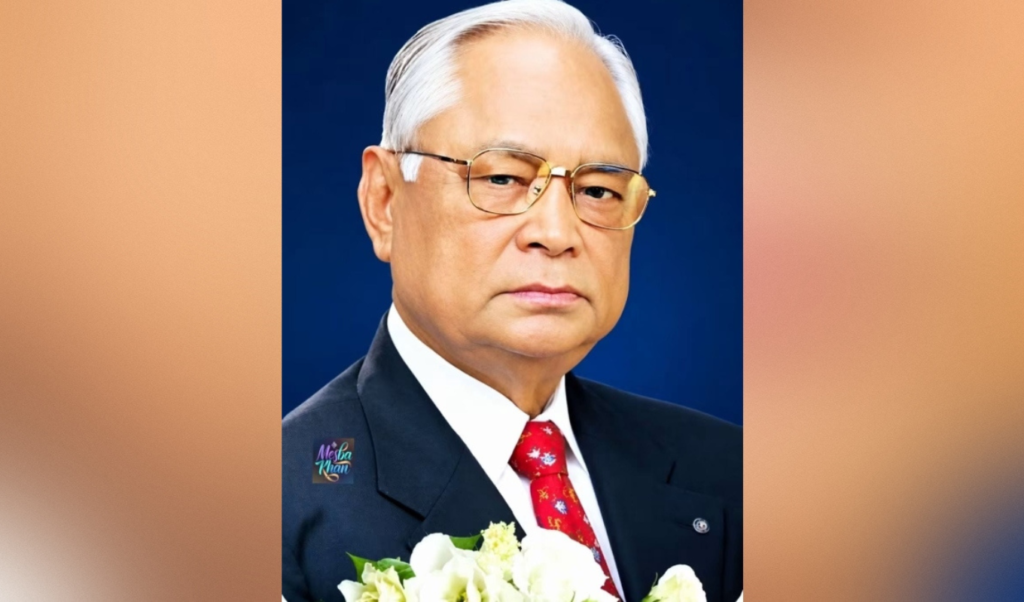
Starting from zero and turning a dream into reality—that was Samson H. Chowdhury.
He was the son of a physician. Owing to his father’s profession, he grew up surrounded by medicine, healthcare, and the ailments of people from an early age. That early exposure eventually sparked a dream in his mind—the dream of manufacturing essential medicines within his own country.
After completing his education, he worked for a brief period. Later, in 1952, he embarked on his entrepreneurial journey by opening a small pharmacy in Ataikula, Pabna, using capital borrowed from his father. As he sold medicines, a question frequently crossed his mind—instead of selling drugs made by others, why couldn’t we produce them ourselves?
A thought led to an initiative, and that initiative eventually created history.
In 1958, alongside three friends—Dr. Kazi Harun-ur-Rashid, Dr. P. K. Saha, and Radhabinod Roy—he founded Square. The name ‘Square’ was born out of the equal partnership and shared vision of the four friends, symbolizing equality, accuracy, and quality.
Square began its journey with very limited resources. Various reliable accounts suggest the initial capital ranged between 17,000 and 20,000 Taka. A small tin-roofed house, a handful of workers, modest machinery, and infinite self-belief—this was all they started with. Among their earliest manufactured medicines was ‘Easton’s Syrup’. For the first few years, the enterprise yielded no profit; instead, the partners had to invest additional funds. By the third year, the total investment rose to around 80,000 Taka, and in its fourth year, the company finally turned a profit.
That marked the beginning of an extraordinary odyssey.
What started as a tiny pharmaceutical factory in remote Ataikula, Pabna, gradually evolved into the foundation of one of Bangladesh’s largest industrial conglomerates. Beginning with pharmaceuticals, Square later expanded its footprint into healthcare, consumer goods, textiles, agriculture, information technology, media, and various other sectors.
Yet, the success story of Samson H. Chowdhury is not merely about the expansion of a commercial enterprise. It is a chronicle of honesty, ethics, discipline, perseverance, punctuality, and responsibility toward humanity.
He firmly believed that business was not solely for generating profit; fulfilling human needs and serving society were equally fundamental duties of an entrepreneur. His business philosophy placed paramount importance on quality and ethics—values that earned him a distinct identity across the business landscape of Bangladesh.
He was born on 25 September 1925 in Aruakandi village of Gopalganj, within the greater Faridpur district. His father, Yakub Hossain Chowdhury, was a physician. Due to his father’s transferable job, a part of his childhood was spent in various places. He studied in educational institutions near Mymensingh and Kolkata. Later, after acquiring higher education and professional experience, he returned to the then East Pakistan and chose Ataikula as his workstation.
His bond with Pabna was deep and soulful. He never forgot the locality of Ataikula, where the tiny pharmacy had first nurtured his dreams. Through supporting educational and social institutions, extending help to those in need, and working for the underprivileged, he continually strove to give back a portion of his success to society. His initiative to establish an orphanage for poor and orphaned children in Ataikula in 1985 stands as a prominent example of his humanitarian outlook.
In addition to leading trade and industry domestically, he was actively associated with various national and international institutions. The American Chamber of Commerce in Bangladesh honored him with the ‘Business Executive of the Year’ award in 1998. In 2000, he received the ‘Business Person of the Year’ award conferred by DHL Worldwide Express and a leading national publication. Over time, numerous other honors recognized his life and achievements.
Yet, far above all accolades and awards stood the genuine affection of the people.
He reached the pinnacle of success, yet he never lost touch with his roots. His sense of duty toward the soil that taught him to dream—and the people whose needs inspired him to manufacture medicines—remained steadfast until his final days.
Behind the long journey from a modest village pharmacy to a giant industrial enterprise lay one man’s vision, courage, and relentless hard work.
He demonstrated that:
Capital may be modest,
but dreams must never be small.
He proved that it is entirely possible to reach the heights of success while maintaining absolute integrity in business. And when human welfare is woven into the definition of success, an entrepreneur’s life becomes a beacon of inspiration not just for themselves, but for an entire society and nation.
On 5 January 2012, at the age of 86, Samson H. Chowdhury passed away while undergoing medical treatment in Singapore. With his passing, the industrial and business arena of Bangladesh lost a visionary trailblazer.
Though some individuals depart, their deeds endure.
Their dreams, values, and noble contributions remain behind.
Samson H. Chowdhury was one such towering icon.
The light that emerged from that small pharmacy in Ataikula continues to illuminate the vast expanse of Bangladesh’s industry and economy today.
Hence, he is not merely the founder of Square—
he stands as an inspiring chapter in the entrepreneurial history of Bangladesh.
May Samson H. Chowdhury remain immortal in our memories.
Profound respects and humble tributes.