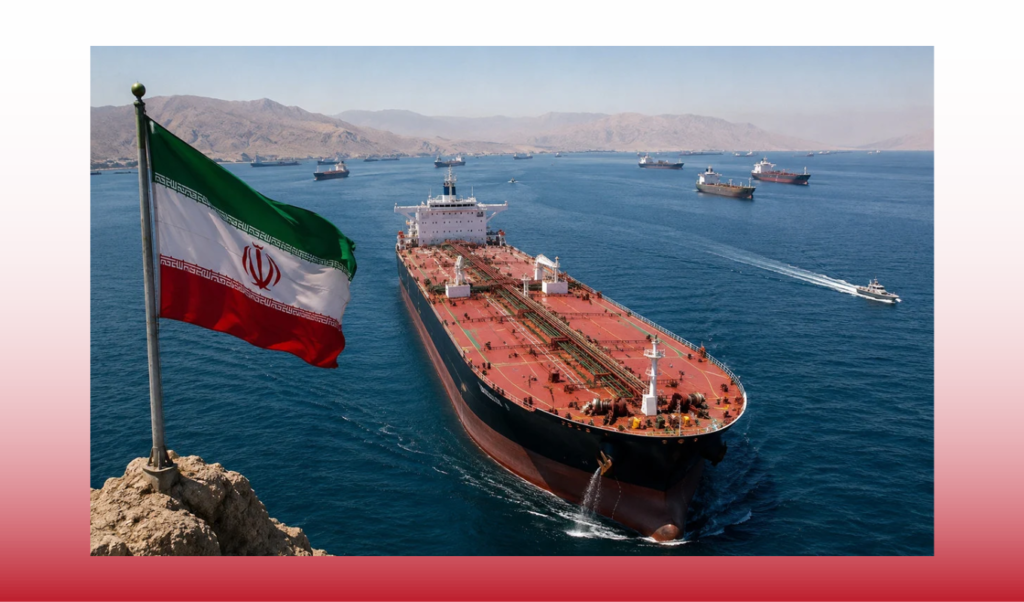
Tehran has placed 45 crude oil, liquefied natural gas, and refined fuel tankers from nations including Saudi Arabia and the United Arab Emirates on a maritime blacklist, accusing them of violating navigational regulations in the Strait of Hormuz. The warning extends beyond the vessels themselves, with Iranian officials cautioning that any third-party ships engaging in ship-to-ship cargo transfers with the targeted fleet will face equivalent enforcement measures.
The directive was announced on social media platform X by Iran’s newly formed Persian Gulf Strait Authority, an administrative entity recently established by the Islamic Republic to regulate maritime traffic through the vital chokepoint. The agency warned that non-compliant vessels risk substantial financial penalties, boarding operations, and the potential seizure of both ships and their cargo upon entering waters under Iranian jurisdiction.
The retaliatory measure follows escalating rhetoric between Tehran and Washington, coming shortly after the United States threatened sweeping economic sanctions against Iranian trade networks. In response, Iranian military and political officials warned that any further aggression or economic pressure would be met with severe countermeasures along key maritime corridors.
The blacklist encompasses a broad spectrum of commercial tonnage, ranging from Very Large Crude Carriers (VLCCs) to specialised LNG, LPG, and refined petroleum product vessels. Among the named fleets are tankers operated by the UAE’s state-backed ADNOC Logistics & Services, its subsidiary Navig8 Tankers, and the National Shipping Company of Saudi Arabia, Bahri. Several European and Asian shipping firms have also been swept into the list, including Norway’s Klaveness Ship Management and Stolt Tankers, as well as South Korea’s Sinokor Merchant Marine.
While the Iranian authority did not detail the exact nature of the infractions leading to the designations, Tehran previously signalled that commercial operators must obtain prior transit authorisation and pay levies for security escorts and navigation services in the waterway. Shipowners wishing to contest their blacklisting must lodge formal appeals alongside extensive documentation with Iranian maritime authorities. Cargo owners and charterers operating across the Persian Gulf have been urged to scrutinise the register before finalising voyages.
The confrontation comes amidst heightened naval posturing in the region. Before the latest cycle of hostilities, the Strait of Hormuz accommodated roughly 20 per cent of the world’s daily petroleum and LNG consumption. Heightened geopolitical friction has led the United States Navy to escort commercial vessels and coordinate off-coast transhipments outside the strait to stabilise energy flows. US Energy Secretary Chris Wright noted that seven-day average crude exports through the strait had recovered past eight million barrels per day, attributing the movement to international naval protection. Tehran’s latest blacklisting, however, threatens to introduce fresh volatility into global energy supply chains and maritime insurance rates.