The Islamic Revolutionary Guard Corps (IRGC) naval forces have announced that the Strait of Hormuz has been closed, warning that any vessel attempting to pass through the waterway will be targeted. The declaration marks a rapid and significant reversal, coming less than 24 hours after indications that the strategically vital shipping route had been reopened.
In a statement published on Saturday by Iran’s Student News Agency, the IRGC Navy said the closure would remain in force until the United States lifted what it described as a naval blockade imposed on Iranian ships and ports. The statement characterised the restrictions as a breach of an ongoing ceasefire in what it referred to as a conflict involving the United States and Israel.
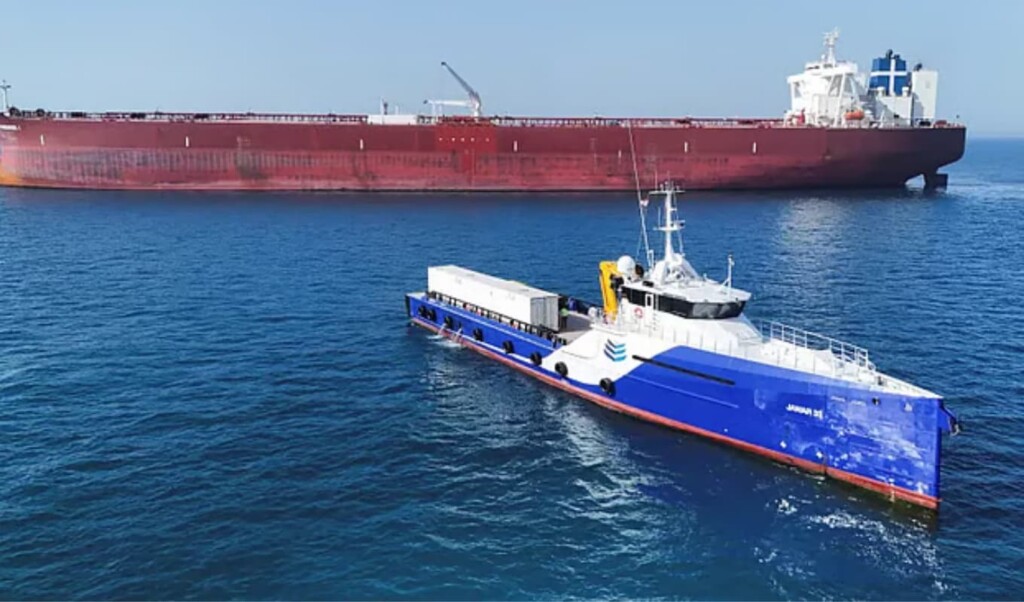
The IRGC further issued a broad warning to maritime traffic in the region. It stated that all vessels anchored in the Persian Gulf and the Sea of Oman should remain stationary, adding that any movement towards the Strait of Hormuz would be considered hostile. According to the statement, failure to comply would result in vessels being treated as legitimate targets.
Separately, Iran’s Parliament Speaker and chief negotiator in ceasefire discussions, Mohammad Bagher Ghalibaf, said in a televised interview that the Strait of Hormuz remained under the control of the Islamic Republic. He also criticised recent US policy statements, describing them as uninformed and ineffective.
Earlier developments had suggested a temporary easing of restrictions. In line with a 10-day ceasefire between Israel and Lebanon, Iran had briefly reopened the strait. Iran’s Foreign Minister Abbas Araghchi had declared on Friday that the waterway was “fully open to all commercial vessels”, a statement that contributed to a fall in global oil prices.
However, within hours of that announcement, Iranian authorities effectively reasserted control over the passage. Reports indicated that more than a dozen commercial ships had already transited the strait during the short window before the reversal.
According to the United Kingdom Maritime Trade Operations (UKMTO), Iranian fast boats reportedly fired upon two commercial vessels during the incident period. Both ships were identified as flying the Indian flag. India’s Ministry of External Affairs later confirmed that gunfire had taken place involving two Indian-flagged vessels operating in the region.
| Event | Detail |
|---|---|
| Temporary reopening | Strait declared open to commercial shipping |
| Reversal of decision | IRGC reimposed control within hours |
| Maritime movement | Over a dozen vessels transited during open window |
| Reported incident | UKMTO recorded firing on two Indian-flagged ships |
| Official warning | Vessels told to remain stationary in regional waters |
Commercial vessels operating in the area also received radio communications from IRGC naval units warning that transit through the Strait of Hormuz was prohibited.
In response to the escalating tensions, former United States President Donald Trump stated that Iran could not use the strait as a means of political pressure against Washington. He warned that unless an agreement was reached before the expiry of a ceasefire deadline, military hostilities could resume, while insisting that maritime restrictions on Iran would remain fully enforced.
Meanwhile, Iran’s senior political leadership, including Mojtaba Khamenei, indicated that Iranian naval forces were prepared to impose further setbacks on adversaries, underscoring the continued strategic importance of the Strait of Hormuz in regional tensions.