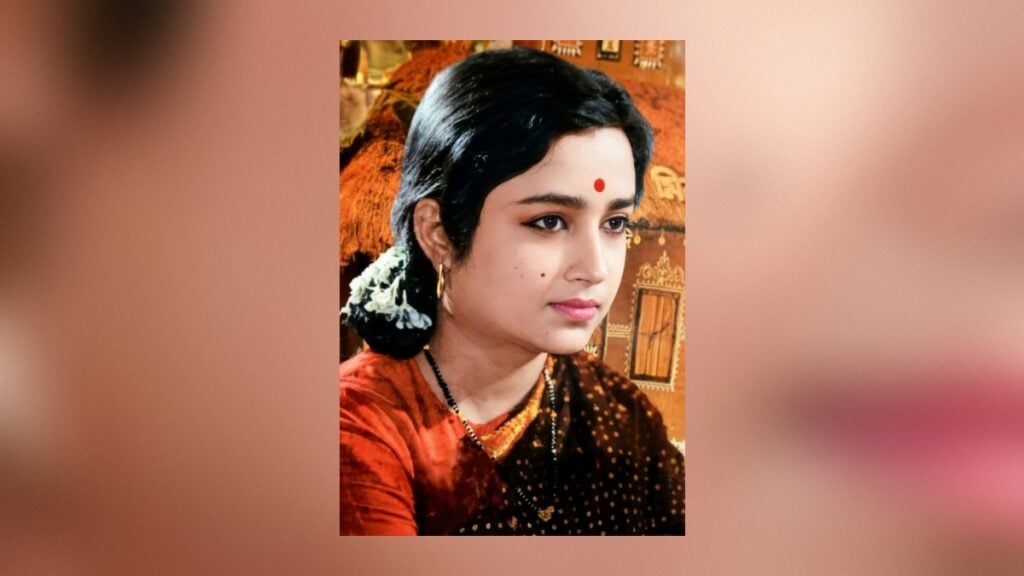
“Oi Malatilata Dole, Dole Piyal Tarur Kole”
Some voices do more than sing; they awaken emotions that words alone cannot express. Through their music, they make nature feel more intimate, love more profound and sorrow more poignant. Kanika Banerjee, one of the most distinguished exponents of Rabindra Sangeet, possessed precisely such a voice. Her interpretations of Rabindranath Tagore’s songs captured the essence of love, nature, devotion and separation, establishing her as an enduring figure in Bengali musical heritage.
Born on 12 October 1924 in Sonamukhi, in West Bengal’s Bankura district, Banerjee was originally named Anima Mukhopadhyay. Her nickname was ‘Mohor’, by which she remained affectionately known among those close to her. Her father, Satyacharan Mukhopadhyay, worked at the Visva-Bharati library, while her mother, Anila Devi, was associated with the residential community of Santiniketan. Tagore later gave her the name Kanika, under which she would become widely celebrated.
Her early childhood included a period spent with her maternal relatives in Bishnupur. She subsequently moved to Santiniketan, where her father worked, and enrolled at the Brahmacharyashram school. The natural beauty of the surroundings, the distinctive atmosphere of the ashram and the close relationship between education and the arts at Santiniketan helped shape her artistic sensibilities.
Music became an integral part of her life from an early age. She initially learnt songs by listening carefully to their melodies and words before receiving formal musical training at Santiniketan. Her development as a singer was closely connected with the cultural environment created by Tagore, whose compositions demanded not merely vocal skill but also a deep understanding of poetry, emotion and musical expression.
Her association with Tagore was among the most formative experiences of her life. She regularly visited the poet to learn new songs, and he was impressed by her natural musicality and the sweetness of her voice. Their relationship helped nurture the artistic qualities that would later distinguish her from other performers of Rabindra Sangeet. Rather than treating the songs as exercises in vocal technique, she sought to convey their underlying emotions and literary meaning.
Banerjee made her first stage appearance as a child performer at Santiniketan’s Sharadotsav celebrations in 1935. Two years later, she shared the stage with Tagore at a Barshamangal festival held at Chhaya Cinema Hall in Calcutta, now Kolkata. Together, they performed Chhaya Ghanaichhe Bone Bone. For a young singer, the opportunity to perform alongside the poet whose compositions would define her career was an extraordinary experience.
Her recording career also began early. In 1937, Hindustan Records released a record featuring two songs sung by her: Ore Oi Bandha Holo Dwar and O Gaan Niye Mor Khela. Both were written by Niharbindu Sen and composed by Haripada Chattopadhyay. The record, numbered H 584, marked an important step in her emergence as a recording artist.
In 1939, she released her second record of Rabindra Sangeet, featuring Oi Malatilata Dole and Gharete Bhramar Elo. The former became particularly associated with her musical identity. Its delicate imagery and lyrical portrayal of nature found a memorable expression in her voice, which conveyed the tenderness and rhythmic grace of Tagore’s poetry.
Another significant milestone came on 24 July 1940, when she performed Ogo Tumi Panchadashi at the inauguration of the Bolpur telephone exchange. The programme was broadcast on the radio, extending the reach of her singing beyond the immediate Santiniketan community.
Tagore’s death in 1941 marked a profound moment for the cultural world he had shaped. Banerjee was among the singers who participated in the collective rendition of Samukhe Shantiparabar, performed in accordance with the poet’s instructions. Her participation connected her musical journey with the memory of the man whose work had profoundly influenced her life.
In 1943, Banerjee joined Santiniketan’s Sangeet Bhavana as a teacher, reportedly earning a monthly salary of 40 rupees. Her contribution to music therefore extended beyond the concert stage and recording studio. Through teaching, she helped preserve and transmit the traditions of Rabindra Sangeet to subsequent generations.
She also became involved in film music from 1950 onwards. Her musical contributions are associated with films including Tathapi, Nimantran, Bigalita Karuna, Jahnabi Jamuna and Ahwan. These engagements reflected the breadth of her artistic activity, although her lasting reputation remained firmly rooted in her interpretations of Tagore’s songs.
What distinguished Banerjee was her restraint, emotional depth and ability to communicate without excessive ornamentation. Her singing placed the words and the feelings behind them at the centre of the performance. She understood that Rabindra Sangeet draws much of its power from the relationship between poetry and melody, and her interpretations allowed both elements to retain their individuality while working together.
In her voice, songs about nature evoked the red-earth paths of Santiniketan, the shade of sal and piyal trees, the arrival of spring and the gathering clouds of the monsoon. Songs of love carried an understated intimacy, while those expressing separation or sorrow conveyed a quiet intensity. Devotional compositions, meanwhile, acquired the character of personal prayer.
This distinctive approach made her performances deeply affecting. Listeners could appreciate the technical discipline of her singing, but its greatest strength lay in the emotional world she created. Her interpretations did not impose a single meaning on Tagore’s compositions. Instead, they allowed the poetry to unfold naturally, inviting audiences to discover their own feelings within the music.
Banerjee’s legacy is inseparable from Santiniketan, where her artistic identity developed and where the philosophy of Tagore’s educational and cultural movement continued to influence her work. Rabindra Sangeet is more than a collection of songs; it represents a rich meeting point of literature, music, nature and human experience. Artists such as Banerjee played a crucial role in keeping that tradition alive while making it accessible to listeners across generations.
She died on 5 April 2000, leaving behind a remarkable musical legacy. Her passing deprived Bengali music of one of its most cherished voices, but her recordings continue to preserve the subtlety and emotional richness that made her performances distinctive.
The enduring appeal of Oi Malatilata Dole captures much of what made her special. Its gentle imagery, graceful melody and evocation of nature reflect the qualities that listeners continue to associate with her singing. Through such performances, Banerjee remains present in the cultural memory of Bengal, even decades after her death.
Her contribution cannot be measured solely by the number of recordings she made or the stages on which she performed. It lies equally in the way she helped generations of listeners experience Tagore’s songs as living expressions of human emotion.
Kanika Banerjee remains an enduring presence in the history of Rabindra Sangeet. Her voice continues to resonate through Bengal’s musical heritage, carrying the poetry of Tagore into new generations of listeners. Her memory deserves not only admiration but also a lasting place in the cultural tradition she served with such devotion.