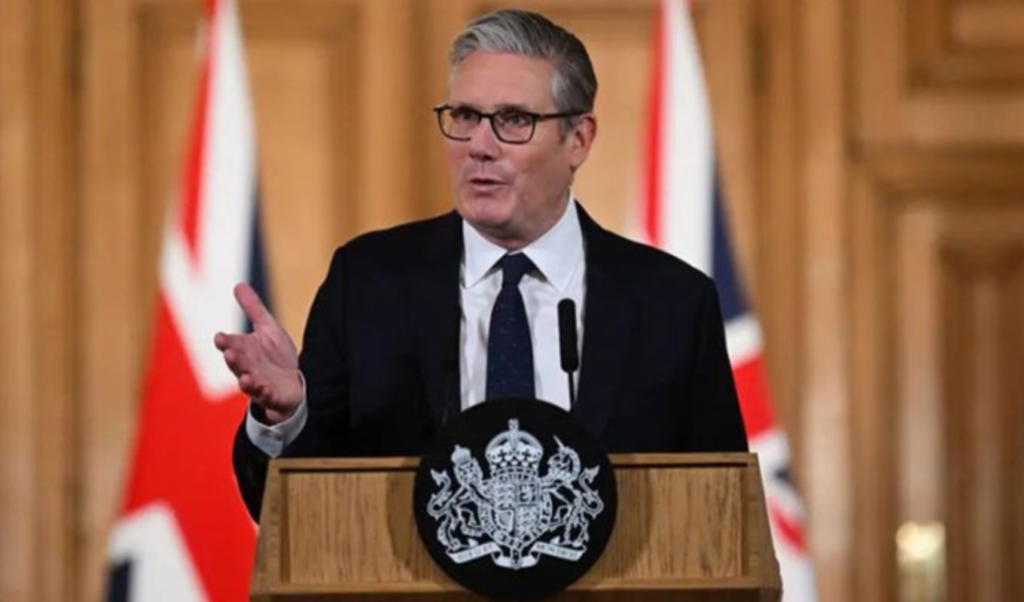
The Prime Minister of the United Kingdom, Keir Starmer, has formally announced his resignation from office, bringing a definitive end to his Labour Party government’s tenure after approximately 23 months in power. This highly significant political development means that the United Kingdom is now on course to appoint its seventh prime minister within the span of a single decade.
Delivering his resignation speech publicly outside 10 Downing Street whilst accompanied by his wife, Starmer confirmed that he will also step down from his position as the leader of the Labour Party. During his address to the nation, he stated: “I will remain in the post of Prime Minister until the leadership election is completed, and I will do everything within my power to ensure a smooth and orderly transfer of authority.” Following his statement, the gathered supporters bids him farewell with a round of applause. Starmer’s decision effectively paves a structured pathway for a peaceful transition of power to his primary party rival, Andy Burnham.
Internal Pressure and Key Factors Behind the Resignation
Starmer’s departure follows days of intense political uncertainty and mounting pressure from Labour Party Members of Parliament (MPs) and senior cabinet ministers. Prior to this announcement, the Prime Minister had expressed a firm determination to withstand the challenges against his leadership. Despite his position being systematically weakened by various controversies and a succession of high-profile resignations from senior officials, he had previously vowed to remain at the helm. However, the internal pressure ultimately forced his hand.
The ultimate catalyst for Starmer’s resignation arrived with the definitive outcome of the Makerfield by-election, where Andy Burnham secured a substantial victory. This electoral outcome delivered a conclusive blow to Starmer’s leadership authority, prompting his immediate resignation announcement.
The Historical Backdrop of Brexit and Two-Party Weakness
The roots of the current political volatility in British governance can be traced back to the 2016 European Union (EU) referendum, where voters narrowly opted for Brexit. This decision initiated a massive realignment within the country’s political sphere, the consequences of which remain visible today.
At that time, the Conservative Party had been in power for six years under Prime Minister David Cameron. During the 2015 general election campaign, Cameron had pledged to hold an EU referendum if re-elected. Although the Conservatives won the election, the referendum outcome did not align with Cameron’s expectations. Having campaigned actively for the “Remain” camp, Cameron resigned in July 2016 following the victory of the Brexit movement.
This shift fundamentally altered the traditional base of the Conservative Party, as many business-oriented and pro-EU supporters gravitated towards populist, Eurosceptic politics. Concurrently, many working-class Labour Party voters also backed the Brexit movement. According to political analysts, the frequent changes in prime ministers over the last ten years signal a weakening of traditional political loyalties and the conventional two-party system.
Cumulative Disputes and Local Election Failures
The collapse of Starmer’s administration was driven by several accumulating internal factors. Although he secured a landslide victory in July 2024, a series of controversies led to a rapid decline in the government’s public popularity. Labour lawmakers grew increasingly anxious as liberal-leaning voters began shifting their support toward the Green Party. Furthermore, many MPs feared that the rise of Nigel Farage’s party could pose a severe threat in the next general election.
Starmer’s government also faced fierce criticism over policy reversals, internal friction, and a perceived lack of clear strategic direction. A major controversy centered around the appointment of Peter Mandelson as the British Ambassador to the United States. Mandelson’s past association with the convicted sex offender Jeffrey Epstein raised serious parliamentary questions regarding what Starmer knew, and when he knew it. Additionally, external geopolitical friction added to the pressure, with US President Donald Trump publicly citing Starmer’s policy stances on immigration and renewable energy as contributing factors to his eventual downfall. Despite these heavy domestic criticisms, Starmer had previously earned international recognition for his efforts in gathering European support for Ukraine against Russia and mitigating tensions surrounding the conflict in Iran.
Ultimately, the results of the local council and regional assembly elections proved to be the final challenge to Starmer’s authority. Labour’s poor performance in these elections—frequently viewed as an indicator of national public opinion similar to mid-term elections in the United States—prompted several senior politicians to resign and openly demand Starmer’s departure. While Starmer initially resisted these demands, at least two influential party rivals made it clear they would challenge his leadership. Meanwhile, Nigel Farage, an architect of Brexit and ideological ally of Donald Trump, capitalised on the political instability. Presenting his party, Reform UK, as a viable alternative for voters disillusioned by both major parties, Farage achieved significant success in recent elections, moving his party from the political fringes to the centre of mainstream British politics.
Commenting on the situation, Luke Tryl, the UK Director of the public opinion research organisation More in Common, observed: “Since the 2016 Brexit referendum, every election has essentially been a vote for change. The public has consistently expressed deep dissatisfaction with the existing political structure and system, but the expected change has not materialised. This is precisely why the political instability continues to persist.”
The Succession Process and the Decade of Prime Ministers
Following Starmer’s resignation, the Labour Party must now select its next leader, who will subsequently assume the role of Prime Minister, given that Labour retains its parliamentary majority until the next general election. Andy Burnham is currently considered the leading candidate to succeed Starmer. Burnham recently stepped down from his mayoral responsibilities to contest and win the by-election for the Makerfield constituency in North-West England, thereby securing his seat in the House of Commons and establishing his path to challenge for the premiership.
Additionally, Wes Streeting is anticipated to enter the leadership contest. To formally launch a candidacy, any prospective contender must secure the official nomination and backing of at least 81 Labour Members of Parliament. Following the nomination phase, a full ballot of the party membership will determine the next leader, though a swift transition could occur if a consensus candidate emerges early.
The rapid turnover of British leadership since 2016 highlights an unprecedented era of political transition, which can be viewed through the tenures of the following six prime ministers:
| Prime Minister | Year of Departure | Primary Context and Reason for Exit |
| David Cameron | 2016 | Resigned immediately after the public voted against his “Remain” campaign in the EU referendum. |
| Theresa May | 2019 | Stepped down after repeatedly failing to secure parliamentary approval for her negotiated Brexit withdrawal agreement. |
| Boris Johnson | 2022 | Forced to resign following intense political pressure stemming from multiple ethics scandals and cabinet resignations. |
| Liz Truss | 2022 | Resigned after just 49 days in office following widespread economic and financial market instability. |
| Rishi Sunak | 2024 | Vacated office following a landslide defeat for the Conservative Party in the national general election. |
| Keir Starmer | 2026 | Announced his resignation following severe internal party pressure, controversial appointments, and poor local election results. |