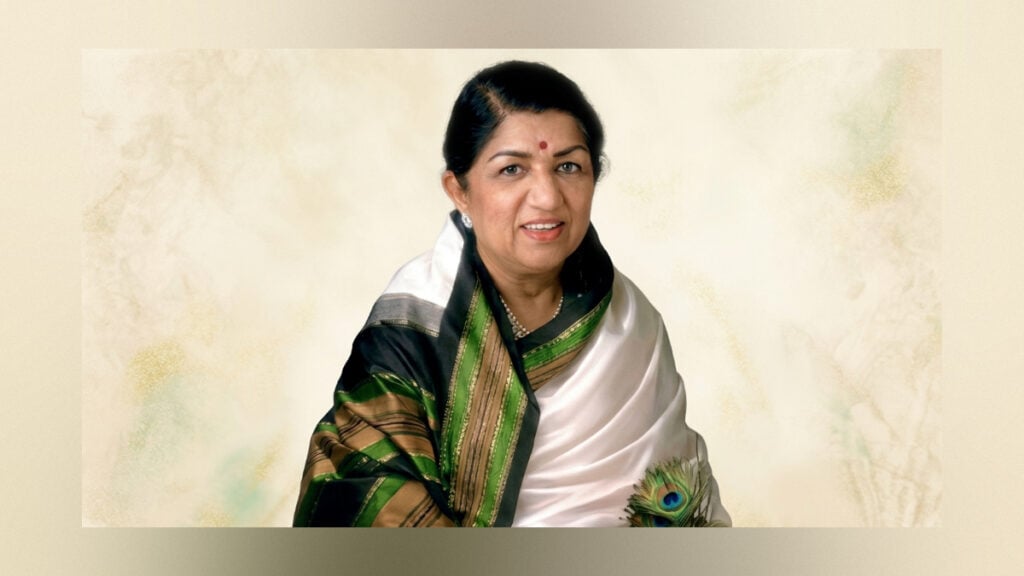
Some voices do more than carry a melody. They become part of people’s memories, accompanying generations through moments of love, separation, joy, sorrow and remembrance. Lata Mangeshkar was one such extraordinary voice. Across the Indian subcontinent, her singing became closely associated with some of the most enduring emotions and musical memories of modern Indian cinema.
Born on 28 September 1929 in Indore, India, Lata Mangeshkar was originally named Hema. Her father, Pandit Deenanath Mangeshkar, was a respected classical singer and theatre personality. She grew up surrounded by music and received her early training from her father. Singing and acting on stage from childhood, she entered the world of performance at an age when most children were still far from considering a professional artistic career.
At the age of 13, in 1942, she recorded her first song for the Marathi film Kiti Hasaal. The song, “Naachu Yaa Gade, Khelu Saari Mani Haus Bhaari”, was ultimately left out of the final film. The same year, she appeared in Pahili Mangalaa-gaur, both acting and singing. In 1943, she recorded her first Hindi song for Gajaabhaau, marking an early step towards the career that would eventually make her one of the most recognisable voices in Indian music.
Her early life was not without hardship. The death of her father placed significant responsibilities on the young Lata and her family. Although acting formed part of her initial career, singing gradually became her principal means of expression. Years of disciplined practice, classical musical training and an extraordinary commitment to her craft helped shape the distinctive voice that would later define an era of Indian playback singing.
A major breakthrough came in 1949 with the film Mahal. Her rendition of “Aayega Aanewala” attracted widespread attention and established her as a significant new voice in Hindi cinema. From that point, her career expanded rapidly. She went on to work with some of the leading composers, lyricists and filmmakers of successive generations, becoming an integral part of the sound of Indian films for decades.
Her repertoire encompassed a remarkable range of emotions. Love and longing, happiness and grief, devotion and patriotism all found a place in her singing. Songs such as “Lag Ja Gale”, “Ajeeb Dastan Hai Yeh”, “Pyar Kiya To Darna Kya” and “Ae Mere Watan Ke Logon” remain among the recordings most closely associated with her legacy.
What distinguished Mangeshkar was not simply the sweetness of her voice. Her precise pronunciation, control over pitch, musical discipline and ability to convey emotion without excessive theatricality gave her performances a particular quality. She could adapt her voice to the mood of a character and the demands of a composition, making the playback voice feel inseparable from the story unfolding on screen.
Over a career spanning more than seven decades, Mangeshkar recorded songs in Hindi, Bengali, Marathi and several other Indian languages. Various figures have been cited over the years for the total number of songs she recorded, with no universally agreed final figure. The scale of her contribution, however, is clear from the breadth of her work and the number of generations that grew up listening to her recordings.
Her contribution to Indian music received some of the country’s highest honours. She was awarded the Padma Bhushan in 1969, the Dadasaheb Phalke Award in 1989 and the Padma Vibhushan in 1999. In 2001, she received the Bharat Ratna, India’s highest civilian honour. She was also awarded the National Film Award three times, alongside numerous other distinctions during her career.
Yet her influence extended beyond awards and professional recognition. Her songs became woven into the everyday lives of millions of listeners. A particular melody could evoke a lost relationship, a cherished memory or a significant period in someone’s life. Her voice accompanied films, radio broadcasts and family gatherings, while many of her recordings continued to reach younger listeners long after their original release.
Mangeshkar was also regarded as a dedicated practitioner of music. Her grounding in classical traditions provided a strong foundation, while her sensitivity to lyrics allowed her to bring different shades of meaning to a song. The combination of technical discipline and emotional restraint became one of the defining characteristics of her singing.
Lata Mangeshkar died in Mumbai on 6 February 2022 at the age of 92. Her death marked the end of one of the longest and most influential careers in Indian playback music. Her passing came during the period of Saraswati Puja, creating a poignant coincidence for many admirers who associated her life so closely with music.
She may no longer be present in recording studios or on the stage, but her voice continues to be heard. Her songs remain part of films, radio broadcasts, personal playlists and family memories. They continue to introduce new generations to an artist whose career stretched across enormous changes in Indian cinema and popular music.
A singer’s life may come to an end, but music can carry a voice far beyond its creator’s lifetime. That has been particularly true of Lata Mangeshkar. Her recordings continue to give words to feelings that people have often struggled to express themselves.
“Hum bhool gaye re har baat,
magar tera pyaar nahi bhule…”
Lata Mangeshkar is no longer with us, but the musical legacy she created remains alive. As long as people listen to her songs, remember their own stories through her melodies and discover her voice anew, her place in the history of Indian music will endure.
A legendary voice has fallen silent, but its echo remains.