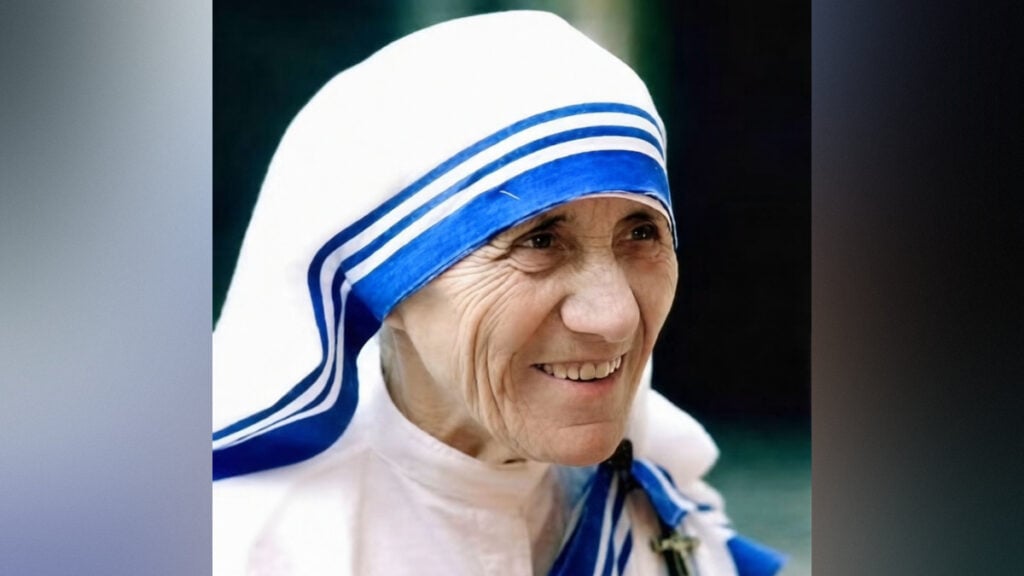
Some lives leave an imprint that extends far beyond national, religious and cultural boundaries. Mother Teresa was one such figure. For decades, she devoted herself to people living in poverty, the sick, abandoned children, the homeless and those approaching the end of life. Her work in Kolkata brought her international recognition, while her simple way of living and commitment to serving vulnerable people made her one of the most recognisable humanitarian figures of the 20th century.
Mother Teresa was born Agnes Gonxhe Bojaxhiu on 26 August 1910 in Skopje, then part of the Ottoman Empire and now the capital of North Macedonia. She came from an ethnic Albanian Catholic family. Her early years were shaped by religious faith and a strong sense of compassion for people in need.
Agnes lost her father when she was eight. Her mother, Dranafile Bojaxhiu, played an important role in raising the family and encouraged her children to show generosity and concern for those who were less fortunate. These early experiences influenced Agnes’s decision to dedicate her life to religious service.
At the age of 18, in 1928, Agnes left home and travelled to Ireland, where she joined the Sisters of Loreto. She adopted the name Teresa and began her religious training. In 1929, she travelled to India, where she started teaching at a Loreto school in Kolkata. She later became a headmistress.
Although she spent years working in education, the poverty she encountered beyond the school grounds increasingly affected her. On 10 September 1946, while travelling by train to Darjeeling, she experienced what she described as a profound spiritual calling to work directly among the poorest people. The experience became a turning point in her life.
In 1948, after receiving permission to leave her convent life, she began working among poor communities in Kolkata. She wore a simple white sari with a blue border and devoted herself to people who had little access to care or support. Her work gradually attracted volunteers and supporters.
On 7 October 1950, Mother Teresa established the Missionaries of Charity in Kolkata. The organisation began with a small group of members and later expanded internationally. Its work focused on people facing extreme poverty, illness, abandonment and homelessness, as well as children without family care and those nearing death.
One of the best-known centres associated with her work was Nirmal Hriday, a home for people who were terminally ill and had nowhere else to go. The institution reflected her belief that people nearing death should be treated with dignity, compassion and care.
Mother Teresa became an Indian citizen in 1948, and India remained the centre of her life’s work. Kolkata, in particular, became closely associated with her humanitarian activities and the Missionaries of Charity.
Her work brought numerous international honours. She received the Ramon Magsaysay Award in 1962 and the Templeton Prize in 1973. In 1979, she was awarded the Nobel Peace Prize for her work with poor and suffering people. The following year, in 1980, she received the Bharat Ratna, India’s highest civilian honour.
Her public reputation, however, was not without controversy. Questions were raised over aspects of medical care and living conditions in some facilities associated with her organisation, as well as over her approach to poverty and the management of donations. These criticisms became part of the wider debate surrounding her legacy. At the same time, her supporters pointed to the large network of volunteers and institutions that emerged from her work and to the attention she brought to people living on the margins of society.
Mother Teresa continued to be associated with the Missionaries of Charity during the later years of her life, despite declining health. She died on 5 September 1997 at the organisation’s headquarters, the Mother House, in Kolkata.
Her death marked the end of a life that had been almost entirely devoted to service. The organisation she founded continued its work after her death, while her name remained closely linked with charitable service and care for vulnerable people.
Mother Teresa’s legacy is viewed in different ways. Admirers remember her as a woman who gave up a conventional life to serve people who were often ignored by society. Critics have questioned aspects of her methods and institutions. Yet there is little doubt that she became a major figure in the global conversation about poverty, compassion and humanitarian service.
Born Agnes Gonxhe Bojaxhiu in Skopje, she ultimately made Kolkata the centre of her life’s mission. Her simple sari, the homes established by her organisation and her lifelong presence among some of society’s most vulnerable people became enduring symbols of her work.
Mother Teresa’s story remains a reminder of the powerful impact that one person’s sustained commitment to service can have. Her life continues to be remembered with respect by millions who associate her name with compassion, sacrifice and care for people in need.