Following the September war in 1965, Pakistan’s then-Foreign Minister Zulfikar Ali Bhutto made an emotional and historic declaration: “If India builds an atomic bomb, we will eat grass or leaves if necessary, but we will build our own atomic bomb.” Pakistan’s military-bureaucratic ruling class ultimately chose this self-destructive stubbornness as their state philosophy. Pakistan did become a nuclear-armed nation, but looking at the realistic World Bank and IMF indicators of 2023–2024, it is clear that Pakistan turned out precisely as foretold. Today, its people literally stand in long lines for flour and fight for survival, while nuclear warheads adorn its arsenals.
A nation’s true strength lies in the living standards of its citizens, economic self-reliance, and technological excellence—not in weapons of mass destruction. By sacrificing its economy and the basic needs of its people (food, clothing, shelter) to maintain a permanent artificial state of war with neighboring India, Pakistan earned a global reputation as a nation with “a gun in one hand and a begging bowl in the other.” Its passport ranks near the bottom globally, and incidents of Pakistani nationals being detained abroad for begging have become regular international news. This reality proves that when geopolitical stubbornness overrides economic reality, even an atomic bomb cannot save a state from destitution.
One Hand a Gun, the Other Hand a Begging Bowl: The Mirage of the Pakistan Model
Historically, when Bangladesh began its journey as an independent nation following a bloody war in 1971, many in the global arena expressed skepticism about its survival. Because the then-West Pakistan emptied East Pakistan’s treasury and siphoned off all resources westward, Bangladesh’s GDP immediately after independence was a mere $8.75 billion USD, whereas Pakistan’s GDP stood at $10.67 billion USD. Pakistan’s economy was not only stronger than ours, but it also boasted robust military infrastructure and strong international lobbying support. However, over the following five and a half decades, contrasting trajectories born of opposing philosophies—military frenzy versus economic pragmatism—have completely altered the paths of the two nations. Official IMF, World Bank, and UNDP data for the 2023–2024 fiscal year translates this historical gap into a grim reality:
-
Nominal GDP per Capita: According to official IMF data for the 2023–2024 fiscal year, Bangladesh’s nominal GDP per capita reached approximately $2,520 USD. In contrast, Pakistan’s nominal GDP per capita contracted to just $1,471 USD. Statistically, an average Bangladeshi citizen’s economic productivity and capability are roughly 71% higher than those of a Pakistani citizen.
-
Currency Sovereignty and Inflationary Shock: While the exchange rate of the Bangladeshi Taka against the US Dollar remained relatively stable, acquiring a US Dollar required a record-high amount of Pakistani Rupees. Beyond currency devaluation, Pakistan faced staggering inflation. With average inflation hovering near a quarter of consumer prices in certain periods, the purchasing power and savings of ordinary citizens were completely devastated. Conversely, Bangladesh managed to keep inflation under single digits despite global crises.
-
Foreign Trade and Reserve Resilience: While Pakistan’s export earnings stagnated, Bangladesh’s total export earnings surged past $55 billion USD, heavily driven by the ready-made garment sector and remittances. At the same time Pakistan begged friendly nations (such as Saudi Arabia, China, and the UAE) for costly debt rollovers to avert bankruptcy, Bangladesh sustained funding for its mega-projects using domestic capacity.
-
Social Indicators and Human Development (HDI): Pakistan’s systemic failure as a state is most evident in its human development index. In the UNDP’s latest HDI rankings, Bangladesh occupies the ‘Medium Human Development’ tier, significantly outperforming Pakistan. Bangladesh’s average life expectancy is notably higher, while Pakistan lags in child survival and female labor participation.
These statistics are no accident; they are the inevitable outcome of a state’s misplaced priorities. While Pakistan squandered the lion’s share of its budget on maintaining nuclear assets and proxy wars against India, Bangladesh quietly invested in primary education, grassroots healthcare, women’s empowerment, and rural infrastructure.
Today, as Pakistan groans under the stringent conditions of a $3 billion IMF bailout package to stave off bankruptcy, turning into an international aid-dependent state, neighboring India commands a $3.7 trillion GDP, ranking as a top global economy leading in space and deep-tech technologies. This historic contrast proves that military madness or the threat of atomic bombs cannot sustainably transform any nation unless its economic foundation and modern technological bedrock are robust.
Domestic Pseudo-Intellectual Madness and the 4,156-Kilometer Realist Border
Regrettably, certain zealous factions and opportunistic circles within our society still wish to ingest this opium of the Pakistan model. They indulge in geopolitical inferiority complexes, delusional fantasies, and war-mongering. This frenzied mob often rejoices in the streets upon hearing rumors of America’s defeat or retreat in distant Afghanistan or Iran. Yet they lack the fundamental common sense or intellectual depth to understand that Afghanistan or Iran’s geographic scale, geopolitical location, and underground mineral wealth bear no resemblance whatsoever to the reality of Bangladesh.
Could a densely mountainous Afghanistan or oil-rich Iran endure years of warfare and survive? Absolutely, but does Bangladesh possess that capacity? These religious zealots lack the foresight to evaluate the severe destitution, hunger, poverty, and international isolation inflicted on ordinary citizens in those post-war nations. They obsessively dream of an imaginary, jihadist war. Yet it escapes their comprehension that a country as densely packed, geographically flat, and economically fragile as ours cannot withstand even a minor military conflict. All the economic ground we have laboriously gained over the past few decades—our remittances, apparel sector, and emerging economy—would vanish into thin air in an instant.
This faction actually desires that Bangladesh completely abandons the historic, visionary foreign policy gifted by the Father of the Nation Bangabandhu Sheikh Mujibur Rahman: “Friendship to all, malice towards none.” They urge us to cast aside our non-aligned, independent posture and blindly emulate Pakistan—essentially pawning our sovereignty to serve as a geopolitical chess piece or military proxy for global superpowers. They harbor no hesitation in steering the country toward ruin via state-sponsored mercenary systems or ‘mullah-military’ alliances akin to Pakistan’s model.
Who will explain to these fanatics that for a nation sharing a massive, complex, and three-sided land border spanning roughly 4,156 kilometers, maintaining a state of permanent hostility or war is entirely untenable? The India-Pakistan border is roughly 3,323 kilometers long—consisting largely of barren deserts, mountains, and flat terrain, patrolling which has brought Pakistan’s economy to its knees. In contrast, Bangladesh is surrounded on three sides and interwoven with complex riverine geography. Maintaining high-alert military deterrence across 4,156 kilometers of continuous border would consume the lion’s share of our national budget on unproductive military overheads. Cutting back budgets for health, education, and social safety would ultimately leave citizens holding a begging bowl identical to Pakistan’s.
Standing in this geography ringed by India on three sides, the only unassailable axiom of practical geopolitics (Realpolitik) is maintaining sound relations with India based on mutual respect and parity. Rather than conflict, we must leverage our strategic geographic location as an engine for regional and global trade. Instead of transforming this 4,156-kilometer border into an eternal military wound, it should serve as a regional economic corridor, transit route, and connector to Southeast Asia. Securing duty-free access to India’s massive internal market through economic connectivity is far superior diplomacy than brandishing rifle barrels along a guarded frontier.
Retaining this primitive 20th-century mindset of military supremacy will inevitably ruin us in the 21st century of artificial intelligence and quantum computing. Today, national security no longer depends on the tonnage of nuclear warheads, fighter jets, or long-range tanks—tools that can destroy territory but generate zero economic growth. The true guarantee of national security is building a robust, knowledge-based, and technologically unassailable economic foundation. If any foreign military contemplates casting an eye on our borders, they must know that touching our economic and quantum data architecture will instantly collapse their own commercial and digital supply chains. Building this tier of computational and economic deterrence is true sovereignty—not becoming a gun-toting beggar like Pakistan.
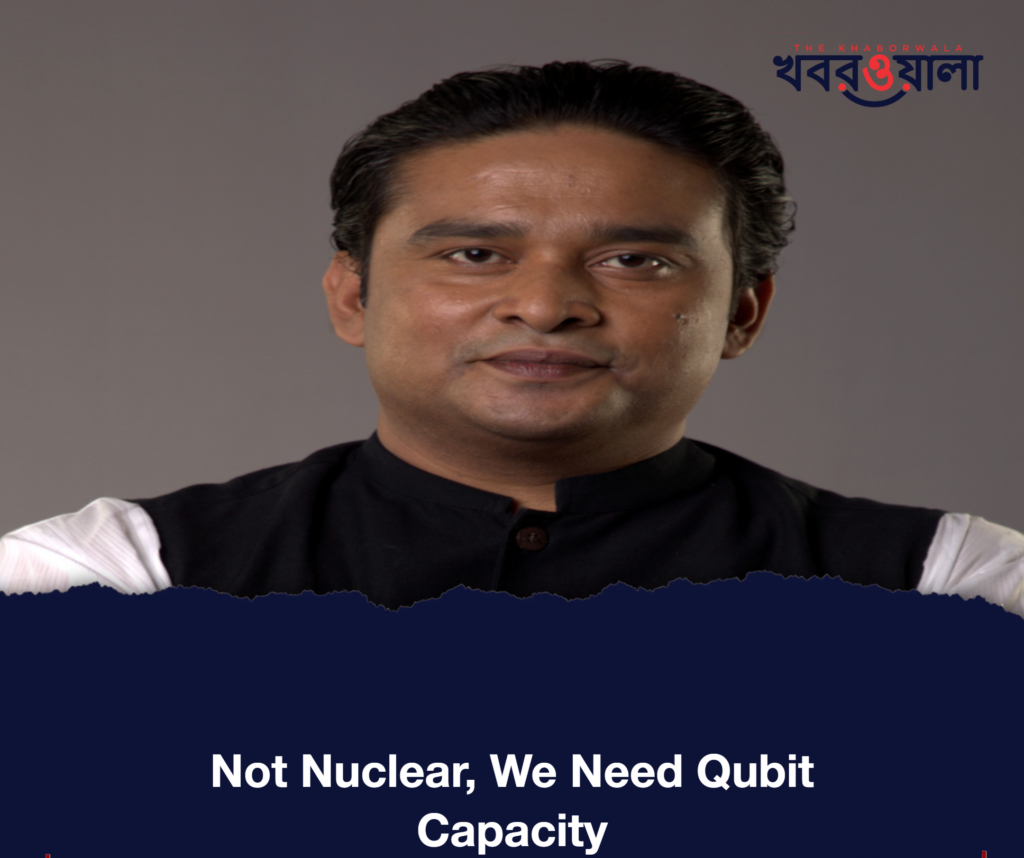
Nuclear vs. Qubit Capacity: The New Equation of Power
We must realize that the eternal definition of power has fundamentally changed. When we speak of qubit capacity instead of atomic bombs, people are often surprised. But a moment of cool reflection reveals that the entire concept of a nuclear bomb is inherently destructive and two-dimensional. An atomic bomb can turn a specific territory to ashes and take millions of lives, but it creates no new value, wealth, or means of sustenance for human life. Its terminus is absolute ruin.
Conversely, the fundamental unit of quantum computing—the ‘qubit’—possesses a completely contrasting energy: it is creative and multi-dimensional. While traditional computers operate linearly using binary bits (0 or 1), quantum computers leverage complex physics principles like superposition and entanglement to evaluate millions of mathematical and scientific probabilities simultaneously. Calculations that would take standard supercomputers thousands of years are resolved by quantum computers in mere seconds.
In the 20th century, global balances of power were determined by the size of a nation’s nuclear arsenal, long-range missiles, or underground oil reserves. But in the reality of the contemporary global landscape, that archaic equation of power has become obsolete. Power is no longer trapped within the barbed wire of maps and territorial boundaries; the game has shifted from conference tables down to the microscopic atomic realm of silicon chips and qubits. The model behind Pakistan’s bankruptcy—chasing primitive military illusions—is a global laughingstock. A country’s sovereignty, prestige, and geopolitical leverage are no longer measured by the weight of cannonballs; they are determined by computational supremacy and processing capacity.
Consider how policymakers in Washington, Beijing, or New Delhi worry less about counting nuclear warheads today than about semiconductor chip supply chains and quantum computing superiority. In international relations, this is dubbed ‘Chiplomacy’. The core doctrine of this new cold war is clear: the nation that establishes control over ultra-advanced semiconductor lithography technology and quantum processing will write the economic and security grammar of tomorrow’s world.
Future global economics will not run on crude oil, coal, or brute force, but on pure computational capacity. Nations armed with robust qubit capacity will synthesize advanced nanomaterials at unprecedented speeds, discover life-saving drugs, predict financial market trends to insulate their economies, and neutralize adversary cyber-defenses or banking encryptions in seconds without firing a single bullet.
While a nuclear bomb’s destructive footprint is geographically limited, quantum computational capability can remodel or paralyze global digital and financial infrastructure remotely. This economic and geostrategic power is exponentially more sustainable and potent than any atomic weapon. Equipping our youth for this ultimate weapon of the fourth industrial revolution—quantum technology—rather than inciting them to war, is our true defensive shield. Becoming a qubit-rich, self-respecting nation outweighs becoming an armed beggar.
Chip-Politics and the Transformation of the Asian Axis: The New Monopoly of Hardware
A pervasive misconception holds that Silicon Valley is the alpha and omega of information technology. The underlying truth, however, is that regardless of Silicon Valley’s dazzling software, generative AI, or trillion-parameter language models, their physical existence, vitality, and processing power depend entirely on the Asian axis. The West can code algorithms, but it lacks the physical infrastructure and hardware manufacturing base to actualize them.
Looking at contemporary chip-politics, while the designs and blueprints for the world’s most complex, microscopic, and advanced processors (like 3nm or 2nm chips) originate in the West, their physical manufacturing does not happen in America—it occurs within the laboratories of Taiwan’s TSMC. Furthermore, if South Korean tech giants cut off supplies of specialized High-Bandwidth Memory (HBM) chips, all Western AI and cloud computing systems would grind to a halt overnight, turning Silicon Valley into an obsolete playground.
Crucially, Asia’s monopoly over hardware and physical infrastructure was not won through bloodshed, military aggression, or coercion. It was forged over two to three decades through long-term strategic planning, educational modernization, and economic foresight.
While neighboring Pakistan squandered state funds on bloated military budgets driven by border skirmishes, Asia’s true powerhouses quietly cultivated semiconductor, lithography, and computational infrastructures, prioritizing silicon over gun barrels. Chiplomacy proves that Mao Zedong’s 20th-century axiom—”political power grows out of the barrel of a gun”—is obsolete. In the 21st century, power has shifted to the microscopic transistors of silicon wafers, and whoever controls them rules tomorrow’s world.
The Rise of China and India’s Indigenous Ecosystems and the Asian Model
In this computational arms race, the trajectories of our neighbors China and India offer instructive case studies. They demonstrate how genuine intent and foresight enable a nation to stand tall globally.
Despite severe US technological sanctions, chip boycotts, and economic blockades, China rebounded like a phoenix, disrupting global tech power balances. Believing that withholding lithography machines would eliminate China from the tech race, the West was proven wrong when China leveraged domestic collaboration between Huawei and SMIC to independently manufacture high-performance processors. Today, China stands as America’s sole primary competitor in achieving quantum supremacy.
Meanwhile, India transformed a massive workforce from low-end IT outsourcing into advanced Digital Public Infrastructure (DPI). Systems like India’s UPI (Unified Payments Interface) and India Stack serve as global models for digital governance and fintech revolutions. Moving past being a mere consumer of Western tech, India launched its National Quantum Mission, committing billions in state funds to expand qubit capacity.
The rise of China and India demonstrates unequivocally that national survival and sovereignty derive from economic and technological self-reliance—not from artificial hostilities with neighbors. Embracing this new Asian model of merit and technology is Bangladesh’s sole viable path forward.
Southeast Asia’s Strategic Jump and the Quantum Economy
Concurrently, Southeast Asian nations like Vietnam and Indonesia avoided geopolitical petty squabbles and ideological bickering, seamlessly integrating their economies into global semiconductor and green-tech value chains.
When global giants pursued ‘China Plus One’ supply chain diversification, Vietnam seized the opportunity. Slashing bureaucratic red tape overnight, it transformed into a major electronics and chip-assembly hub. Crucially, it reformed its education system, shifting youth away from low-value freelancing toward advanced hardware engineering and semiconductor architecture.
These emerging nations recognize that survival in tomorrow’s global economy requires readiness for the ‘Quantum Economy’. When commercialized quantum computers arrive, legacy logistics, banking encryption, cybersecurity, and global supply chains will be instantly upended, crippling nations wedded to obsolete technology.
If Bangladesh remains lethargic, clinging to outdated military models or the destructive ‘Pakistan model’ advocated by radical factions, it will vanish from this emerging Asian economic axis. To uplift our densely populated nation, our goal must be clear: avoid conflict with India, build an equitable, respectful partnership, and become a vital stakeholder in the quantum era rather than chasing cheap, border-generated applause.
Bangladesh’s Current Weakness and Structural Crisis
Where does Bangladesh stand amidst this global silicon and qubit revolution? Stripping away self-delusion and political rhetoric, we must face facts objectively.
Over the past decade and a half, the ‘Digital Bangladesh’ vision brought visible improvements to everyday lives—expanding fiber-optic cabling to unions, popularizing mobile financial services like bKash and Nagad, and digitizing public services. However, our historical lag means that despite these leaps, we still trail advanced Asian nations.
Why this enduring gap? Because our strategic blind spot has been building a robust ‘consumer society’ rather than an ‘innovation economy’. Our IT model rests heavily on fragile, low-wage labor. While Asian peers tackle high-value semiconductors, supercomputing, and quantum defense, we remain consumers of Western tech.
The Limits of Traditional Freelancing
Though we pride ourselves as major digital labor exporters, our freelancers primarily handle low-to-medium skill tasks—data entry, WordPress customization, basic graphic design, or basic SEO. With advanced coding agents and automated AI tools rapidly eroding demand for these tasks, our IT remittance stream is vulnerable. While Vietnamese and Indian youths upskill into cloud architecture, data science, and semiconductor design, our workforce remains trapped in legacy frameworks, keeping hourly rates low. Without a giant leap into the fourth industrial revolution, our cheap labor market collapse is a matter of time.
Infrastructure Bottlenecks
Our hi-tech parks and data centers were a starting point, but they lack the physical capacity required for high-level computation, AI model training, or quantum-ready data processing. Modern IT hubs demand megawatt-scale uninterrupted power grids and ultra-low latency international connectivity. Due to power and connectivity instabilities, global tech giants bypass Bangladesh for Singapore or India.
The Academia-Industry Disconnect
A nation’s technological spine is its higher education system. Though thousands of computer science graduates graduate annually, universities lack organic ties to industry. While global labs emphasize linear algebra, multivariate calculus, stochastic processes, and hardware architecture—essential for AI and quantum computing—our university syllabi remain stuck in decade-old programming languages and theoretical databases.
Pathways toward an “Innovation Economy”
Escaping the trap of traditional outsourcing requires embedding high-value technology across key domestic sectors, shifting from a ‘cheap outsourcing destination’ to a ‘quantum and innovation economy’.
-
Digital Public Infrastructure (DPI) and Fintech Revolution: Upgrading interoperable transaction platforms like ‘Binimoy’ and MFS to integrate directly with Asian payment gateways (like India’s UPI or Singapore’s PayNow) will reduce remittance costs to near-zero. Furthermore, centralizing citizen databases via secure Open API architectures will empower startups to build local credit-scoring, logistics, and insurance solutions.
-
Agri-Tech and Food Security Optimization: Deploying IoT and data-driven supply chain networks will eliminate market syndicates and waste. Real-time cold storage tracking and predictive demand modeling can cut crop wastage by 30%, while precision agriculture optimizes fertilizer and irrigation.
-
Marginal Semiconductor and Manufacturing Ecosystem: While building multi-billion-dollar fabrication plants (fabs) is premature, Bangladesh can capture a niche in Integrated Circuit (IC) design and testing. Providing local labs and companies with EDA tool licenses (Synopsys/Cadence) and high-performance computing support could transform Bangladesh into a major VLSI/chip design outsourcing hub.
-
Smart Governance and Judicial Management: Automating judicial backlogs via dynamic digital case management systems will drastically reduce administrative burdens on judges, accelerating case resolutions and instilling institutional transparency.
Policy Bottlenecks and the Risk of Digital Colonialism
If Bangladesh remains passive during this tech power shift, it risks falling victim to a new form of ‘Digital Colonialism’—where foreign entities control a nation’s data, payment ecosystems, and digital infrastructure.
Our primary hurdle is bureaucratic inertia. While technology grows exponentially, policy moves linearly. Complex banking regulations still complicate capital repatriation and foreign venture capital investments in deep-tech startups. Simultaneously, as Asian nations race toward quantum computing, our banking and national security frameworks remain reliant on vulnerable RSA encryption. Without adopting Post-Quantum Cryptography (PQC) standards immediately, our financial ecosystem faces an existential sovereignty crisis.
Specific Predictions for the Next 10 Years
-
Dominance of AI Agents (2028): Within three years, AI agents will absorb basic data entry, QA testing, and UI/UX development, endangering roughly 60% of current Bangladeshi IT freelancing revenues for those failing to upskill into cloud architecture and AI model fine-tuning.
-
Asian Semiconductor Monopoly (2030): Roughly 80% of global computational power and specialized AI silicon chips will concentrate within the Asian axis (Taiwan, South Korea, China, Japan, India).
-
Bangladesh’s First Indigenous Foundational Model (2031): Driven by data sovereignty needs, Bangladesh will build an indigenous Bengali-context large foundational model to power public services and education.
-
Rise of Quantum Cloud Infrastructure (2033): Quantum computing will transition from labs to commercial cloud services, utilized by domestic mega-corps and fintech sectors for logistics and fraud detection.
-
IP-Driven Startup Ecosystem (2036): A decade hence, Bangladesh’s IT revenues will no longer stem from hourly labor, but from intellectual property (IP) and Software-as-a-Service (SaaS) models, particularly in agri-tech and fintech exports.
Our Roadmap for the Next Decade
Transforming Bangladesh requires a clear, aggressive action plan:
-
Transition from ‘Service Model’ to ‘IP-Driven Innovation’: Shift IT policy from counting freelancers to evaluating intellectual property. Provide tax incentives and patent-filing funds for domestic software and fintech solutions.
-
Human Resource Development in Advanced Math and Chip Design: Overhaul computer science curricula to mandate linear algebra, advanced data analytics, and VLSI chip design, turning top talent into deep-tech architects.
-
Post-Quantum Cryptography and Data Sovereignty: Establish a National Quantum Security Taskforce to upgrade encryption protocols to PQC standards and enforce strict data sovereignty laws.
-
Modernizing Bureaucratic and Financial Regulations: Streamline cross-border payment regulations and banking rules to welcome foreign venture capital seamlessly, mirroring Vietnam or Singapore.
We stand at a critical juncture where past successes do not guarantee future survival. While our mobile financial and fiber networks created a strong front-end, the center of gravity has shifted to physical hardware, advanced computation, and Asian semiconductor monopolies.
The window opened by Silicon Valley’s relative decline and Asia’s rise will not remain open forever. The choice is ours: remain lulled by cheap-labor freelancing into a digital colony, or leverage visionary policies, mathematical rigor, and home-grown innovation to secure our rightful place in the new Asian tech-equation. The journey begins today.
Author: Sufi Faruq Ibne Abubakar
ICT Consultant & Entrepreneur