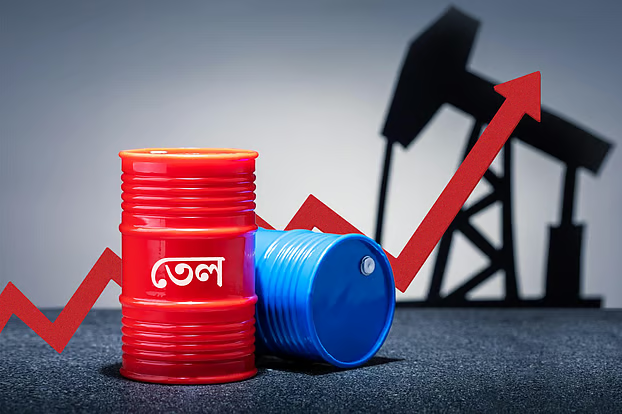
Crude oil prices advanced in Asian markets on Monday morning following the suspension of the second round of diplomatic negotiations between the United States and Iran. The stalling of peace talks has reignited concerns regarding global energy security and supply stability.
Market Reaction and Price Indicators
The international benchmark, Brent crude, rose by 2.2% to reach $107.70 per barrel. Simultaneously, the US standard, West Texas Intermediate (WTI), saw an increase of 2.1%, trading at $96.40 per barrel. These price hikes follow a volatile period; after the US announced a ceasefire extension last week and requested a “comprehensive proposal” from Tehran, Brent prices had initially dipped below $90. However, they have since climbed by more than 10%.
The following table outlines the current market shifts:
| Oil Benchmark | Percentage Increase | Current Price (USD) |
| Brent Crude | 2.2% | $107.70 |
| WTI Crude | 2.1% | $96.40 |
Diplomatic Breakdown
The market volatility was triggered by an announcement from US President Donald Trump on Saturday, stating that Washington had abandoned plans to dispatch a delegation to Pakistan for talks with Iranian representatives. President Trump cited a lack of administrative efficiency and internal instability within the Iranian leadership as primary reasons for the withdrawal.
Writing on the social media platform Truth Social, President Trump claimed that sending a delegation was a “waste of time” and suggested that the Iranian administration was suffering from “intense internal conflict and confusion.” He asserted that the United States holds a dominant negotiating position and concluded that if Tehran wishes to engage, they should initiate contact via telephone.
Geopolitical Pressures and Maritime Security
The ongoing conflict involving Iran, the United States, and Israel has placed unprecedented pressure on global energy corridors. Following airstrikes by US and Israeli forces, Iran issued threats against maritime vessels, effectively creating a blockade in the Strait of Hormuz.
This waterway is a critical chokepoint for the global economy, as it facilitates the transport of approximately one-fifth of the world’s total crude oil and liquefied natural gas (LNG). Data provided by the United Nations Trade and Development (UNCTAD) highlights the severity of the disruption:
-
Pre-conflict average: 129 commercial vessels per day.
-
Recent activity (Saturday): 19 commercial vessels per day.
Iranian Foreign Minister Abbas Araghchi stated that “important discussions” are ongoing with Oman regarding regional stability. He emphasised that ensuring the safety of maritime navigation remains a priority for Iran, its neighbours, and the wider international community.
Economic Implications
The escalation in oil prices carries significant macroeconomic consequences, particularly for import-dependent developing nations. Rising fuel costs lead to increased expenditure on irrigation for agriculture and higher overheads for small businesses.
As transportation and production costs rise, inflationary pressures intensify, reducing the purchasing power of the general public. For governments, higher import bills often result in depleted foreign exchange reserves, currency devaluation, and widening budget deficits due to fuel subsidies. This cycle typically culminates in slower economic growth and increased financial hardship for the citizenry.