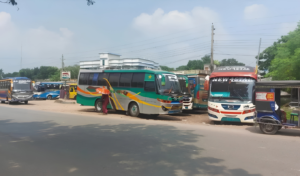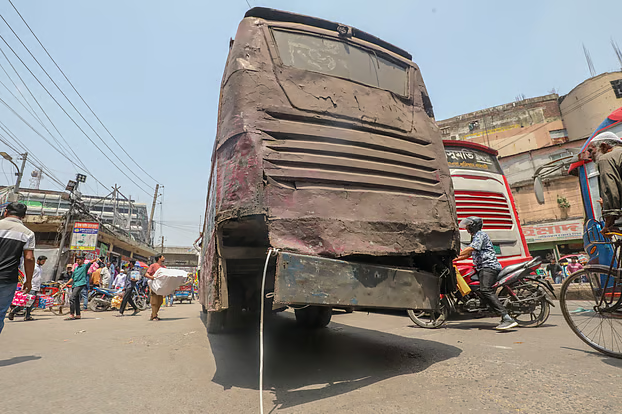
A visibly ageing bus was travelling through Karwan Bazar on 15 March 2026. Its worn-out exterior—peeling paint, rusted bodywork, and uneven structure—reflected a broader pattern in the capital’s public transport system. Upon boarding, passengers encountered cramped conditions: 46 seats installed in a space designed for 41, leaving no room to sit and forcing many to stand.
The driver’s assistant, Saddam Hossain, explained that the daily rental for the bus is approximately Tk 4,500. After covering fuel and operational costs, the remaining income is shared among the driver, assistant, and fare collector. This arrangement indicates that, regardless of a vehicle’s condition, owners maintain consistent earnings.
According to the Bangladesh Road Transport Authority, the bus—registered as Dhaka Metro-B-11-3335—operates on the Mirpur–Jatrabari route under Shikor Paribahan. However, both its route permit and fitness certificate have expired. Manufactured in 2006, the vehicle has exceeded the 20-year operational threshold and, under regulations, should have been retired.
Key Data on Bus Conditions in Dhaka
| Indicator | Figure |
|---|---|
| Total registered buses/minibuses in Dhaka | approximately 54,000 |
| Expired vehicles | 16,198 (about 30%) |
| Total buses/minibuses nationwide | 86,338 |
| Vehicles without valid fitness certificates | 41,168 (about 50%) |
Despite regulatory oversight by the Bangladesh Road Transport Authority and traffic police, a significant number of unfit vehicles continue operating. Allegations suggest that regular informal payments enable these vehicles to run without obstruction.
A March 2024 study by Transparency International Bangladesh reported that approximately Tk 1,059 crore is collected annually as informal payments from privately operated buses. These funds are reportedly distributed among politically affiliated individuals, law enforcement personnel, regulatory officials, and others. The study also found that nearly 92% of major bus companies have links to political figures.
Following the political transition on 5 August 2024, when the Awami League government fell, expectations arose for reform. However, although control structures shifted, long-standing issues remain unresolved. Many transport operations are now reportedly under individuals associated with the Bangladesh Nationalist Party.
The city’s bus system largely operates informally. Owners lease buses for fixed daily payments, while workers depend on passenger fares for income. In many cases, unfit buses are operated under influential groups to avoid enforcement actions.
Efforts to remove outdated vehicles date back to 2010, when authorities declared that buses older than 20 years would be banned. Subsequent directives, including a 2015 executive order and a nationwide age limit set in May 2023, were not effectively enforced due to resistance from transport owners and workers.
A major safety concern emerged after the Airport Road bus accident 2018 Dhaka, when two students from Shaheed Ramiz Uddin Cantonment College were killed. The incident triggered nationwide student protests demanding stricter enforcement of road safety laws, including banning unfit vehicles and unlicensed drivers.
Experts identify three primary problems: passenger insecurity, environmental pollution, and accidents. According to a 2019 study under the CASE project, vehicles contribute 10.4% of Dhaka’s air pollution, with 84% of buses and minibuses emitting excessive black smoke. Additionally, competitive driving and rule violations increase accident risks.
There are also inconsistencies in fare determination. Authorities calculate fares based on the cost of a new bus (Tk 3.5 million) and a 10-year lifespan, including periodic maintenance. However, in reality, most buses do not meet these standards, yet fares remain unchanged even for vehicles aged 11–20 years.
Transport specialists argue that a franchise-based route system—where a single company operates buses on designated routes with uniform standards—could restore discipline. However, implementation requires political commitment and financial support.
Officials from the Bangladesh Road Transport Authority acknowledge ongoing enforcement challenges, noting that removing all expired buses without replacement would disrupt commuter mobility. As a result, despite repeated initiatives, Dhaka’s bus system remains largely unregulated and inefficient.