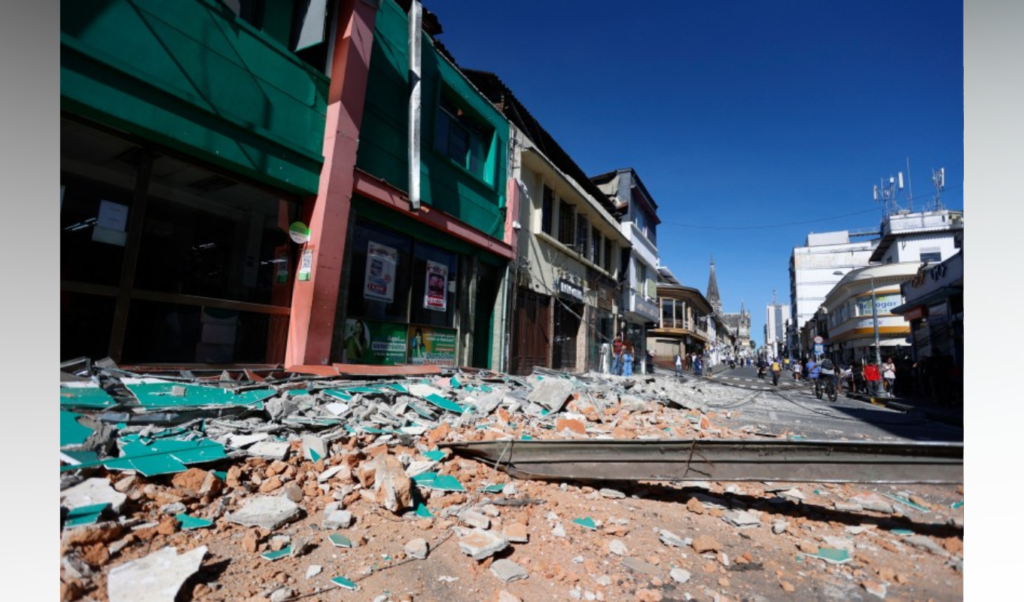
A powerful 7.4-magnitude earthquake struck Colombia’s Pacific coastal region on Monday, leaving several people injured, causing extensive structural damage to buildings and infrastructure, and sending tremors vibrating across vast swathes of the South American nation.
According to the Colombian Geological Survey, the seismic event occurred at 07:34 local time (12:34 GMT). The quake originated at a depth of approximately 96 kilometres below the surface, a depth that allowed the kinetic energy to radiate over hundreds of kilometres, rattling coastal hamlets, mountain cities, and the capital alike.
Regional Impact and Structural Collapse
Data supplied by the United States Geological Survey (USGS) placed the epicentre roughly five kilometres east of the village of San José del Palmar. While the USGS recorded the focal depth slightly deeper at 110 kilometres, the sheer intensity of the shockwave caused widespread alarm across multiple administrative departments.
Nubia Carolina Córdoba, the Governor of Chocó Province, confirmed that multiple injuries had been reported across the affected territories, though exact casualty figures remain difficult to establish as emergency teams navigate disrupted terrain. Expressing grave concern over the potential for high-magnitude aftershocks, Governor Córdoba urged local residents to remain on high alert.
The destruction proved particularly acute in Manizales, a major city situated in the country’s main coffee-growing region. Video footage verified by the national daily newspaper El Tiempo captured the dramatic structural failure of a multi-storey building as it collapsed into dust, with onlookers shouting desperately to warn anyone trapped beneath the debris. Subsequent recordings circulating from Manizales showed the fallen spire of a local church lying shattered on the ground, whilst severe vertical fissures fractured the façades of numerous high-rise blocks.
       EPICENTRE LOCATION           SEISMIC INTENSITY & MAGNITUDE
   5 km East of San José del Palmar             Magnitude 7.4
   Chocó Department, Colombia               Depth: 96–110 km
Capital Shaken and Air Transport Disrupted
Even in the capital city of Bogotá, located hundreds of kilometres from the epicentre, the force of the earthquake caused widespread panic. Municipal authorities ordered the immediate evacuation of numerous high-rise office towers and residential complexes. Journalists broadcasting live from the studios of Caracol Radio described furniture swaying dramatically during their transmission, capturing the immediate shock on air.
Transport networks also suffered immediate disruption. Colombia’s Special Administrative Unit of Civil Aeronautics reported damage to key operational and terminal infrastructure across several regional aviation hubs. The airports affected by the tremor include:
-
Pereira Airport
-
Manizales Airport
-
Quibdó Airport
-
Armenia Airport
-
Cartago Airport
-
Buenaventura Airport
Technical assessments are currently underway to ascertain the structural integrity of runways and air traffic control facilities before flight operations can safely resume.
Broader Context and Regional Vulnerability
This severe seismic event strikes a region already reeling from natural disasters. Less than two months ago, neighboring Venezuela was battered by two devastating earthquakes in its northern provinces, which claimed the lives of more than 6,100 people and left critical infrastructure in ruins. The proximity of that recent catastrophe has heightened anxiety among Colombian citizens and disaster management agencies, who fear that potential aftershocks could exacerbate the current destruction.
Emergency search and rescue teams, accompanied by sniffer dogs and heavy lifting gear, have deployed to the worst-hit areas in Chocó and the coffee-growing belt. Their priority remains locating survivors potentially trapped within collapsed structures, clearing blocked roadways, and evaluating whether damaged public buildings are safe for re-entry. Local authorities continue to urge citizens across western and central Colombia to follow emergency protocols as technical teams monitor seismic activity for further disruptions.