khaborwala online desk
Published: 29 Mar 2026, 05:13 pm
A recent report by the Washington-based research organisation Global Financial Integrity (GFI) has raised serious concerns over the scale of illicit financial outflows from Bangladesh, highlighting that approximately US$68.3 billion has been siphoned out of the country over the past decade through trade-related channels.
According to the study, the average annual illicit outflow stands at more than US$6.83 billion, equivalent to roughly 16 per cent of Bangladesh’s total external trade. When converted at the prevailing exchange rate of Tk 122 per US dollar, the cumulative amount exceeds Tk 833,000 crore, underscoring the magnitude of the financial leakage from the economy.
The report attributes the majority of these outflows to trade misinvoicing—an illicit practice involving the deliberate misrepresentation of the value, quantity, or quality of goods in import and export declarations. Such techniques are widely used to shift capital across borders while avoiding regulatory scrutiny.
| Indicator | Value |
|---|---|
| Total illicit outflows | US$68.3 billion |
| Average annual outflow | US$6.83 billion |
| Share of total trade | ~16% |
| Converted value (approx.) | Tk 833,000 crore |
The GFI report also notes that Bangladesh remains among ten developing Asian economies most vulnerable to trade-based illicit financial flows. A significant proportion of the diverted funds is believed to have been channelled into advanced economies, where regulatory frameworks and financial secrecy provisions can facilitate concealment.
Of the total estimated illicit flows from developing Asia, approximately US$328 billion is believed to have been absorbed by advanced economies, reflecting the global nature of the issue and the complexity of tracking cross-border capital movements.
Beyond the GFI findings, a separate government-commissioned white paper on the economy, released in December 2024, provides a broader historical context. It estimates that between 2009 and 2023, as much as US$234 billion may have been illicitly transferred abroad. At the exchange rate prevailing during that period, this amounts to nearly Tk 28 lakh crore, or an average annual outflow of around Tk 180,000 crore.
The white paper links these outflows to a network of actors, including politically connected business figures, financial intermediaries, and certain individuals within bureaucratic and commercial sectors. It suggests that weak oversight, regulatory loopholes, and institutional vulnerabilities have enabled sustained capital flight over many years.
Economists warn that such large-scale illicit financial flows severely undermine macroeconomic stability. They reduce the domestic tax base, weaken public revenue collection, and constrain government spending on essential services such as infrastructure, healthcare, and education. Over time, this can erode growth potential and deepen structural inequalities.
Globally, the report highlights that larger economies tend to record higher absolute levels of illicit financial flows due to the scale of their trade. For instance, China is estimated to have experienced US$6.96 trillion in such flows over a decade, while India and Thailand recorded approximately US$1.06 trillion and US$1.18 trillion respectively. In relative terms, illicit flows are estimated to account for around 25 per cent of China’s trade and 22 per cent of India’s trade.
To address these challenges, GFI recommends stronger customs enforcement, enhanced international data-sharing mechanisms, improved transparency in free trade zones, and greater cross-border cooperation among regulatory authorities. Without such coordinated measures, experts caution that trade-based financial crimes are likely to remain a persistent vulnerability for developing economies such as Bangladesh.

> Allocation of Tk 6.04 billion for measles vaccine procurement: Health Minister
> Shibchar OC Withdrawn Just Four Days In
> Controversial wording about women prompts strict police action against Badshah.
> Severed Head Found Two Kilometres Away
> Border Guard Deployed to Secure Fuel in Rajshahi
> Sudden Measles Surge: Causes and Precautions
> Data Centre Insurance Risks Surge Globally
> Russia Plans Petrol Export Halt
> Education Minister’s Stern Warning Against Cheating
> Gold Prices Surge Again Within Hours
> In memory of writer, playwright Maxim Gorky
> Bengali Music Shines on UK Stage
> Insurance Industry Sees Partnerships Growth Hiring Stability And Technology Surge

The Health Minister, Sardar Md. Sakhawat Hossain, has announced that the government has allocated Tk...

In a surprising administrative move, Md. Amir Hossain Serniabat, the Officer-in-Charge (OC) of Shibc...

Authorities in Manikganj Sadar Upazila have recovered a human head in a grisly development that has...

In a proactive move to prevent fuel smuggling and safeguard domestic reserves, the Border Guard Bang...
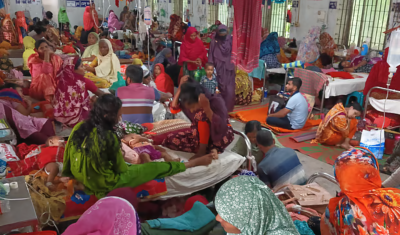
Bangladesh is currently witnessing a notable surge in measles cases, prompting concern among healthc...

In a significant administrative reshuffle, the Government has appointed new Deputy Commissioners (DC...

Nearly half a million customers of Lloyds Banking Group had personal information potentially exposed...
Bangladesh’s growing engagement in global trade and expanding international transactions have made f...

Partha Barua has made a notable return to the music scene with a fresh release titled Shohojlovvo No...

A tragic fire caused by a leaking gas cylinder in Gazipur’s Sripur upazila has claimed the life of a...

A tragic railway accident in the city of Narsingdi has claimed the life of an unidentified young man...

In a move aimed at stabilising fuel supply and ensuring orderly distribution, the district administr...


Availabe for iphone & ipads

Available in google play
 বাংলা
বাংলা