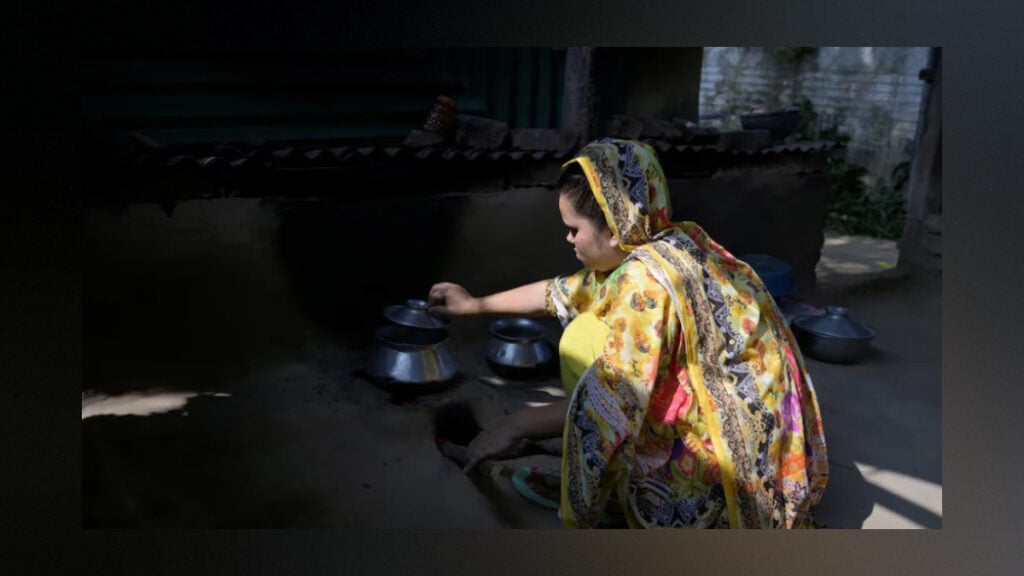
Every day, before dawn breaks, 27-year-old garment worker Shilpi Khatun lights a makeshift clay stove with firewood to prepare meals for her family. They cannot afford to buy a gas cylinder. Once the cooking is done, she leaves home for a garment factory in Gazipur, an industrial hub on the outskirts of Dhaka.
Shilpi is the sole breadwinner for her household. Her husband is unemployed, while she also shoulders the responsibility of supporting her elderly parents and parents-in-law. Despite working long hours in one of Bangladesh’s most important export industries, she struggles to provide even the basic necessities for her family.
Her experience reflects the growing financial difficulties faced by thousands of workers in Bangladesh’s ready-made garment (RMG) sector, where rising living costs have intensified demands for higher wages.
After five years in the industry, Shilpi says her earnings are no longer sufficient to cover the family’s basic expenses. Thousands of garment workers took to the streets last week, demanding that the minimum monthly wage be increased from Tk 12,500 to Tk 30,000.
While collecting wild greens from outside her home to eat with rice at lunchtime, Shilpi described how rising prices have made everyday life increasingly difficult.
“Everything is expensive now. Our house rent has doubled, and food prices have also gone up. Whatever I earn is spent before the end of the month,” she said.
The demonstrations brought parts of the garment industry to a standstill, with several hundred factories shutting down amid the unrest. Police fired tear gas and sound grenades to disperse protesting workers as tensions escalated.
Amid mounting dissatisfaction, the government’s wage board decided on 4 November that a revised wage structure would come into effect in December. Workers are expected to receive their first salaries under the new scale in January. However, the authorities had yet to announce the precise amount of the increase, leaving workers uncertain about how much their financial circumstances might improve.
An industry vital to Bangladesh’s economy
Bangladesh is the world’s second-largest garment exporter after China, benefiting from relatively low labour costs and its extensive manufacturing capacity. The country has become an important sourcing destination for major international brands, including H&M, Zara, Gap, Primark and Walmart.
The garment industry accounts for more than 80 per cent of Bangladesh’s total export earnings and provides employment to more than four million people. Its contribution makes the sector central to the country’s economy, foreign exchange earnings and employment generation.
However, factory owners argue that a substantial increase in wages could undermine Bangladesh’s competitive position against rival manufacturing destinations such as India and Vietnam. They are also facing higher energy costs, which have placed additional pressure on production expenses and profit margins.
Employers point out that workers receive an annual increment of nine per cent, along with two festival bonuses, in addition to their basic salaries. They argue that the scope for a significant wage increase is limited under current business conditions.
Workers, however, say these benefits have failed to keep pace with the rising cost of living. For many families, even regular overtime earnings are no longer enough to meet monthly expenses.
Food and healthcare becoming unaffordable
When Shilpi first joined the garment industry five years ago, her monthly salary was Tk 9,000. Her basic salary has since risen to Tk 13,500, while overtime takes her total monthly earnings to approximately Tk 16,000.
Despite the increase, she struggles to make ends meet. By the time the next payday approaches, almost all her earnings have been spent on household necessities.
The pressure has also affected her health. Sitting inside her small home with a tin roof, Shilpi said she had been unable to consult a doctor for the past three years, despite her physical condition deteriorating. Medical treatment has become an expense she cannot afford while trying to feed and support her family.
On particularly difficult days, the entire household has to survive on puffed rice. Such compromises illustrate how financial hardship is affecting not only workers’ comfort but also their nutrition and access to healthcare.
The wider economic situation has added to these difficulties. Since 2022, Bangladesh has experienced sustained inflationary pressure, with average inflation hovering around nine per cent. Food prices rose first, followed by continued increases in non-food expenses, including housing and other essential services. For workers earning fixed monthly salaries, these increases have steadily reduced their purchasing power.
A mother forced to sacrifice her daughter’s education
Shilpi is not alone in facing such challenges. Rokeya Parvin, a 29-year-old sewing machine operator at a garment factory in Ashulia, on the outskirts of Dhaka, is also struggling to support her family.
She has two daughters and says even buying food requires careful consideration.
“I think twice before buying anything, even food. I know my daughters should have nutritious meals, but I simply cannot afford to provide them,” she said.
Rokeya and her two daughters frequently have to make do with rice and vegetables. Fish and meat, once ordinary components of family meals, have become luxuries they can rarely afford.
The financial strain has forced her to make an even more painful decision. In an effort to reduce household expenses, she has had to stop one of her daughters from continuing her education.
Her experience highlights how the rising cost of living is affecting children’s opportunities as well as the immediate welfare of working families. When household income is insufficient to cover food, rent and other essential expenses, education can become one of the first casualties.
The accounts of Shilpi and Rokeya reveal the difficult reality behind Bangladesh’s garment export success. While the industry continues to play a leading role in the country’s economy and provides livelihoods for millions, many of its workers remain unable to afford adequate food, healthcare and education for their families.
The wage dispute has therefore become about more than a demand for higher salaries. For workers struggling to cope with rising prices, the issue is whether their earnings can provide a basic standard of living. For the industry, the challenge is to maintain its international competitiveness while ensuring that the people responsible for its success can afford to live with dignity.