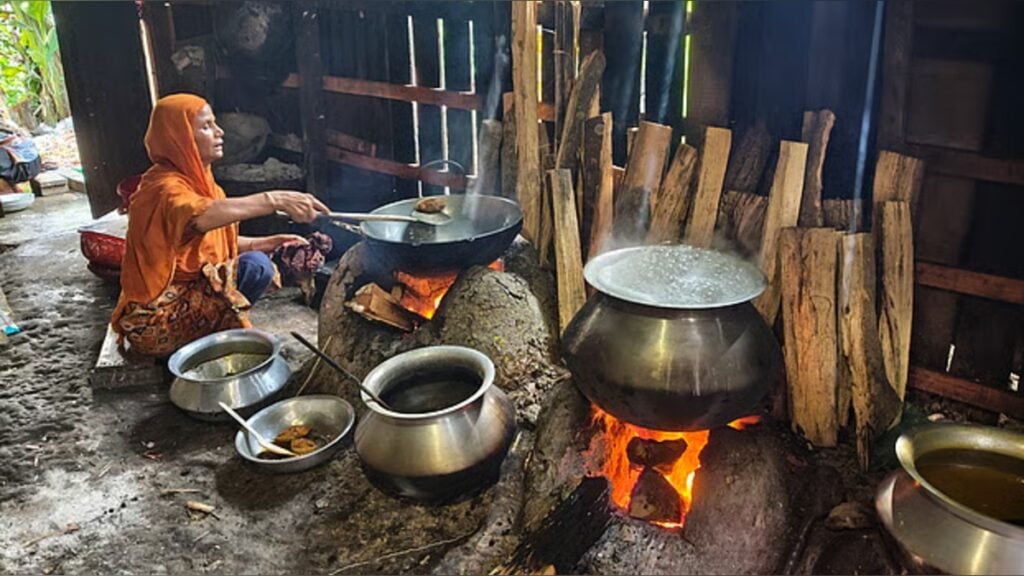
For Murshida Dina, a resident of Mollapara in Khulna city, cooking has once again become a physically exhausting task. Smoke from her traditional clay stove irritates her eyes and causes her nose to run. She repeatedly wipes her face before blowing into the stove to keep the fire burning. The process leaves her breathless, but she has little choice but to continue until the meal is ready.
Her family normally uses around one and a half 12kg LPG cylinders each month. Previously, cooking with LPG cost her approximately Tk 2,500 a month. However, following the latest price increase on 2 November, she has been unable to afford a replacement cylinder.
According to Murshida, local retailers are asking between Tk 2,100 and Tk 2,200 for a 12kg cylinder. Purchasing gas at that price would increase her monthly household expenditure by more than Tk 700. With her husband’s limited income already stretched across essential expenses, she has been forced to return to firewood. She has purchased five maunds of wood to manage the family’s cooking needs.
The situation is not confined to Khulna. Households in Kurigram, Narayanganj, Gazipur, Sylhet, Chattogram and Barishal are facing similar difficulties. While some have returned to traditional wood-burning stoves, others are considering electric cookers. In certain areas, the increased demand for firewood has also driven up its price.
Sultana Begum, who lives in the same neighbourhood as Murshida, has been using a wood-fired stove since October. Her six-member family requires approximately one and a half LPG cylinders every month. She recently bought five maunds of damp firewood for Tk 750, which she expects to last around 20 days.
LPG prices rise by more than 53 per cent
Official LPG prices have increased by approximately 53.6 per cent over the nine months from March to November this year. The Bangladesh Energy Regulatory Commission (BERC) has set the price of a 12kg cylinder at Tk 2,060 for November.
Despite the official rate, cylinders are reportedly selling for between Tk 2,200 and Tk 2,600 in retail markets across the country.
Although the commission has adjusted costs at different stages of production and distribution this month, consumers continue to face difficulties purchasing cylinders at the announced price. The problem is compounded by uncertainty over supplies, with some customers reporting that they cannot obtain cylinders when needed.
The gap between official and retail prices has increased the financial burden on households already struggling with the rising cost of essential goods. For families with limited incomes, cooking fuel is becoming an increasingly difficult expense to manage.
LPG sales decline in Khulna
A visit to eight LPG shops in Khulna city found that 12kg cylinders were being sold for between Tk 2,100 and Tk 2,200. Retailers said customer numbers had fallen as consumers became increasingly reluctant to pay the higher prices.
Tobarok Hossain Tupu, president of the Khulna District LPG Shop Owners’ Association, said shops that previously sold eight to 10 cylinders a day had experienced a sharp decline in sales.
According to him, only two cylinders had been sold over the previous three days. The slowdown has left traders struggling with financial losses as their working capital remains tied up in unsold stock.
The decline in demand highlights how rising fuel prices are affecting not only household budgets but also small businesses involved in the LPG retail market.
Customers in Kurigram pay advance money for cylinders
In Kurigram, consumers are facing both steep prices and uncertainty over availability.
Ruma Rani, a homemaker from the Old Thana Para neighbourhood, said a 12kg LPG cylinder that previously cost less than Tk 1,600 now requires an expenditure of up to Tk 2,500. Unable to manage the additional cost, she has returned to cooking with firewood.
Another city resident, Abdur Razzak, said he had to pay a shopkeeper Tk 1,000 in advance to secure a cylinder.
His experience reflects the difficulties some consumers face in obtaining cooking gas, even when they are prepared to pay the increased price. For households dependent on LPG, uncertainty over supply makes planning everyday cooking arrangements particularly challenging.
Narayanganj faces LPG and pipeline gas shortages
Residents of Narayanganj are dealing with an additional problem: unreliable pipeline gas supplies alongside rising LPG prices.
Rokon Uddin, a banker living in Paikpara, said his household had been experiencing inadequate gas supplies through the Titas network for the past five to six months.
Gas is unavailable for most of the day, he said, and sometimes arrives only briefly in the middle of the night. As a result, his joint family of 15 people has been forced to rely on both LPG cylinders and firewood to prepare meals.
Previously, a 12kg cylinder could be purchased for around Tk 2,000. Now, the family has to pay approximately Tk 2,500.
Residents in other parts of the city have reported similar problems. The combination of irregular pipeline supplies and expensive LPG has left many families struggling to find a dependable source of cooking fuel.
Gazipur families return to locally available firewood
In Gazipur, rising LPG prices are pushing households back towards traditional wood-burning stoves, particularly in areas where firewood can be collected from nearby woodland.
Laili Begum, a garment worker from the Mawna area, earns Tk 13,300 a month. Her husband has a physical disability, while the family also has to cover the educational expenses of their two sons, rent and food costs.
After meeting these essential expenses, she cannot afford to purchase LPG at current market prices. She now cooks on a traditional clay stove in her rented home, while her husband collects wood from nearby forested areas.
Similar changes are being seen in Mawna, Fulbaria in Kaliakair, Mouchak, Cha Bagan, Bhabanipur and Hotapara. The presence of Garjan and other woodland areas makes collecting firewood relatively easier in these locations.
Afroza, a homemaker from Bhabanipur, said she preferred cooking with firewood because she believed it gave food a better taste while keeping expenses lower. She intends to continue using wood for the foreseeable future.
However, LPG prices in Gazipur are also considerably higher than the official rate. A 12kg cylinder is reportedly selling for between Tk 2,350 and Tk 2,500 in different areas.
Consumers have also alleged that 45kg cylinders are being sold at prices Tk 1,200 to Tk 1,400 above the applicable rate, adding to concerns about pricing practices across the distribution network.
Firewood becomes a cheaper option for Sylhet households
In Sylhet city, residents are also turning to traditional cooking methods to reduce their monthly expenses.
Sirajam Munira, who lives in the Chamelibag area of Major Tila, has been using LPG cylinders for around eight to 10 years. During the first few months of this year, she could purchase a 12kg cylinder for less than Tk 1,600.
Recently, however, she had to pay Tk 2,300 for the same quantity of gas. Unable to absorb the increase, she has started relying on firewood.
There are also allegations of additional charges at different stages of LPG distribution in Sylhet.
Shahin Ahmed, a resident of Khadimpara, said distributors charged Tk 100 to Tk 150 more than dealers’ prices. Retailers then added further costs before selling the cylinders to consumers.
Such practices have widened the gap between official prices and what households actually pay at the point of purchase.
Limited alternatives for high-rise residents in Chattogram
The situation is particularly difficult for residents of high-rise buildings in Chattogram, where switching to traditional wood-fired stoves is often impractical.
One residential building in the city has 50 units, 49 of which use LPG cylinders for cooking.
Rabiul Hossain, a security guard at the building, said residents could not regularly obtain cylinders at the government-fixed price. When a cylinder runs out, households sometimes have to wait for hours before a replacement arrives.
Unlike families living in houses with outdoor cooking facilities, residents of high-rise buildings have little opportunity to use firewood as an alternative. Their dependence on LPG therefore leaves them particularly vulnerable to price increases and supply disruptions.
Meanwhile, the situation is equally difficult for low-income households elsewhere in the city.
Nur Islam and his wife, Samala Begum, have lived for more than three decades in a makeshift home made of bamboo and tarpaulin on land belonging to someone else in the Shyamoli residential area of Chattogram. They support themselves by growing vegetables.
Samala, who is 80, said managing the rising prices of everyday essentials was already difficult. The additional cost of purchasing a 12kg LPG cylinder, now around Tk 2,300, has made matters worse.
She has stopped buying cylinders altogether and built a traditional clay stove instead. The couple now collect firewood from nearby areas to prepare their meals.
Firewood prices rise as electric cooker sales triple in Barishal
In Barishal, the growing demand for firewood has also pushed up prices, while electric cookers are becoming increasingly popular as an alternative.
Abdur Razzak, a long-time firewood trader at Kashipur Bazar in the city’s Ward No 29, said the range of wood available at his shop had narrowed. He now sells only rain tree firewood, whereas he previously stocked several varieties, including Chambal wood.
According to him, the price of different types of firewood has increased by at least Tk 50 per maund over the past 15 days.
The start of the brick-burning season has increased demand for wood from brick kilns, putting additional pressure on supplies.
Rain tree firewood, which previously sold for Tk 200 per maund, now costs Tk 250. Chambal wood is selling for Tk 350 per maund.
Despite the higher cost of firewood, electric cookers are attracting more customers in the city.
Tuhin, an electronics retailer at Kashipur Bazar, said sales of electric cookers had tripled over the past few months. Different models are available for between Tk 3,000 and Tk 5,000.
He also expressed concern that prices could rise further in the near future.
The increase in cooking fuel costs is affecting food businesses as well. Nuru Mridha, a hotel owner on Parara Road in Barishal, said he had been forced to increase food prices because both gas and firewood had become more expensive.
The additional operating costs are therefore being passed on to customers, creating another layer of pressure on consumers already dealing with higher household expenses.
Experts warn of environmental consequences
Energy expert M Tamim said the expansion of LPG use had helped reduce dependence on firewood for household cooking. This had also eased pressure on natural resources and contributed to environmental protection.
However, he warned that a widespread return to wood-burning stoves could reverse some of those gains.
If households increasingly rely on firewood because LPG becomes unaffordable, demand for wood could place additional pressure on forests and the natural environment. The consequences could be particularly serious in areas where families collect fuel directly from nearby woodland.
The growing use of traditional stoves also raises concerns about household exposure to smoke. Unlike modern cooking appliances, wood-burning stoves can release substantial smoke indoors, particularly where ventilation is inadequate. This can cause eye irritation and respiratory discomfort, as experienced by many of the households now using them.
Electric cookers offer another alternative, but their affordability depends on the initial purchase cost, electricity bills and the reliability of power supplies. For low-income households, switching to electric cooking may not always be financially practical.
The situation across the seven districts illustrates how rising LPG prices and supply difficulties are reshaping everyday cooking habits. Families are having to reconsider their fuel choices, small retailers are reporting falling sales, and businesses are adjusting food prices to cope with higher operating costs.
Ensuring that LPG cylinders are available at officially announced prices, addressing irregularities in the distribution system and making affordable alternative energy sources accessible will be essential to easing the pressure on households.
Without effective measures, the growing return to firewood could deepen both the economic difficulties facing ordinary families and the environmental challenges associated with increased dependence on wood as a cooking fuel.