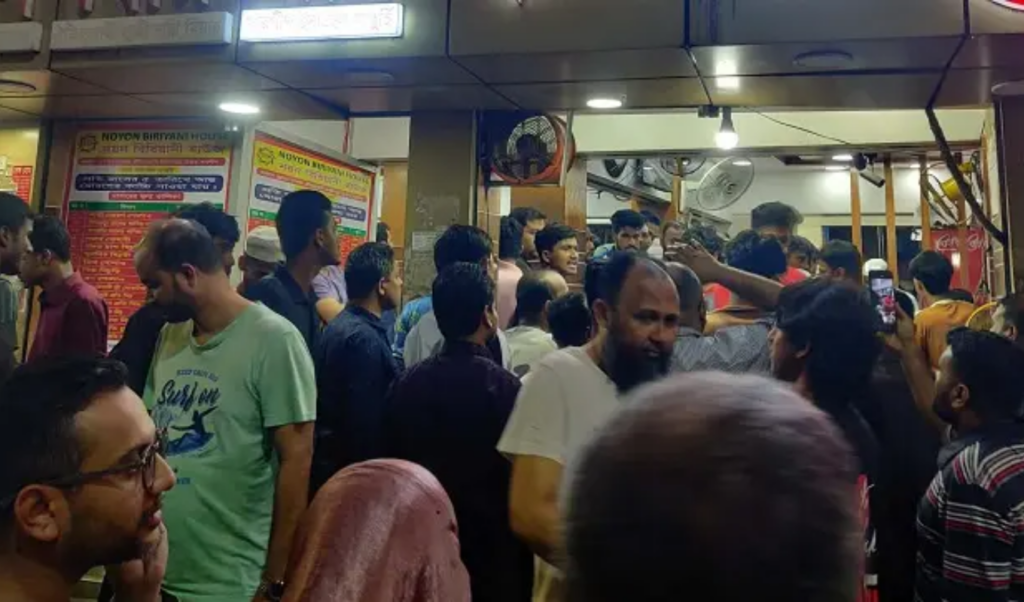
A significant failure in Dhaka’s utility infrastructure resulted in a widespread domestic crisis on Sunday, 3 May 2026, as thousands of residents across Gulshan, Banani, Baridhara, and Badda were left without gas for cooking. The outage, caused by a ruptured Titas Gas transmission pipe, forced a mass exodus of families into the streets in a desperate search for prepared meals, leading to chaotic scenes and a near-total exhaustion of food supplies in local eateries.
Origin of the Utility Failure
The disruption originated on Sunday morning in the Gulshan-1 Circle area. According to technical reports, a major gas pipeline was accidentally breached during excavation work conducted by an unidentified contractor. To prevent a potential explosion or further leakage, Titas Gas authorities were compelled to suspend supply across several high-density residential and commercial zones.
By 10:30 pm, gas supply had not yet been restored to the Badda and link road areas. For the vast majority of residents who rely on piped natural gas rather than Liquefied Petroleum Gas (LPG) cylinders, this meant that domestic stoves remained cold throughout the day, leaving families unable to prepare essential meals.
Scenes of Domestic Distress: The Struggle of Parents
The impact of the outage was most acutely felt by marginal and middle-income families. Seema Akter, a resident of the Moynarbagh area in Madhya Badda, exemplified the plight of many. With her husband away on business, she was forced to navigate the overcrowded streets with her six-year-old daughter and four-year-old son.
“I managed to prepare breakfast in the morning before the supply failed,” Seema explained while standing outside Maa Biryani House in Badda. “By lunchtime, I had prepared the vegetables and washed the rice, but the gas never arrived. My children had to survive on bread and bananas for lunch. Now it is nearly 10:00 pm, and they are crying for rice, but the crowds at the hotels are so immense that I cannot even enter with the children.”
Her account was mirrored by numerous parents across the Hossein Market and Link Road areas, where the suddenness of the supply cut left no room for contingency planning.
Market Collapse: Hotels Overwhelmed by Demand
Local restaurants and hotels, normally equipped to handle a steady flow of evening customers, found their capacities stretched to breaking point. Establishments such as Nayan Biryani House on the Gulshan-Badda Link Road reported a surge in patronage that was described as “unprecedented.”
The following observations were noted across the affected areas:
-
Supply Exhaustion: Most small-scale eateries had completely sold out of food by 8:00 pm, hours earlier than their usual closing times.
-
Logistical Improv: At several outlets, desperate customers were seen assisting staff in packaging food just to expedite their departure.
-
Wait Times: Some restaurants began secondary cooking cycles at off-site kitchens to meet the demand, forcing hungry citizens to wait for hours on the pavement.
Abdus Samad, a distributor for Nanna Biryani, noted that while they usually remain open until midnight with surplus stock, their entire inventory was depleted by early evening. Similarly, vendors in Adarshanagar reported that even after increasing their cooking volume by three additional large vats (dekshis), they were unable to satisfy the queue of waiting customers.
Infrastructure Vulnerability and Response
The incident highlights the ongoing vulnerability of Dhaka’s underground utility networks to uncoordinated urban excavation. Residents like Mohammad Azam, who had brought his wife to the link road in hopes of finding dinner, described the situation as “unmanageable.”
“We thought we would eat out since we couldn’t cook at home,” Azam stated. “But we cannot even get near the shops. The situation is so chaotic that it is better to stand at a distance.”
As the night progressed, many residents were forced to return home without food or resort to dry rations. Titas Gas officials have indicated that repair work is underway, but the incident has sparked renewed criticism regarding the lack of a centralised utility map to prevent such accidents during roadworks. For the thousands of families in Badda and Gulshan, the day served as a stark reminder of their absolute dependence on a fragile energy grid.