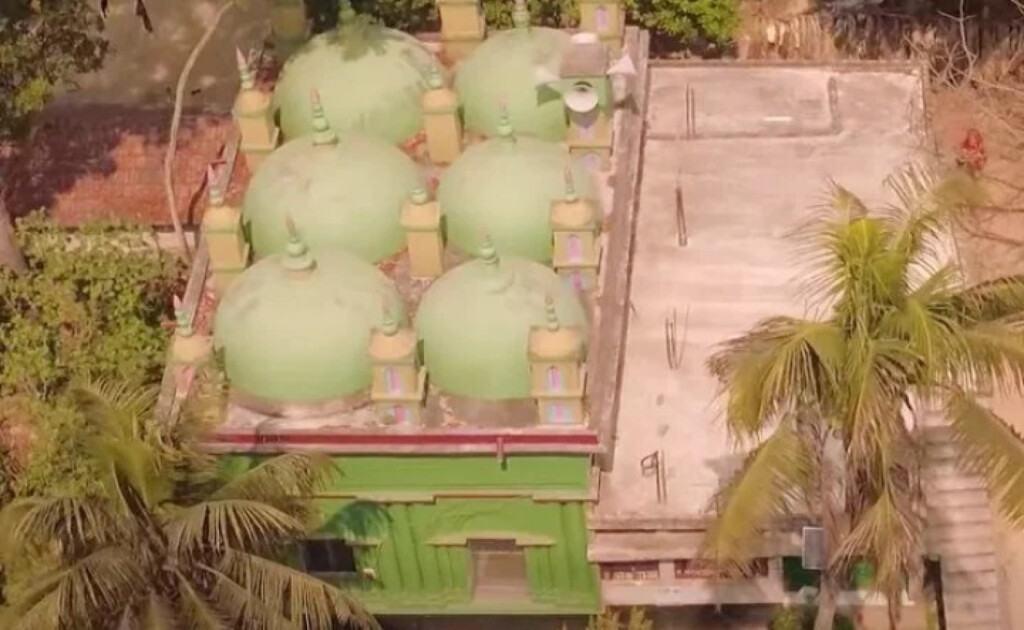
Standing as a silent testament to history, the Six-Domed Mosque of Cherraghat in Kaliganj Upazila, Satkhira, remains one of the region’s oldest and most distinguished architectural landmarks. Known locally as the ‘Khayem Biswas Mosque’, this heritage site lies just four kilometres from the Upazila headquarters, beside the tranquil waters of Dumdum Canal, enveloped by serene and verdant surroundings.
Constructed in Bengali year 1269 (1862 AD), the mosque has witnessed over 160 years of history. It exemplifies a unique blend of traditional Muslim architectural style in southern Bangladesh. Built with slender bricks and lime-mortar masonry, the structure occupies approximately 12 decimal plots of land.
Architectural Features
| Feature | Details |
|---|---|
| Total domes | 6 |
| Doors | 7 |
| Pillars supporting roof | 10 |
| Minarets | 10 |
| Height | Approx. 15 feet |
| Capacity | 100+ worshippers simultaneously |
The mosque’s roof, supported by ten robust pillars, and its six domes combined with ten minarets, reflect both aesthetic elegance and structural ingenuity. The mosque has recently undergone expansion; a new staircase has been added, connecting the original structure to the extended area, thereby aiding in preservation efforts.
Historical Background
Local accounts reveal that Khayem Biswas, a prominent landlord of his era, commissioned the mosque. During a dispute with Durga Prasad Chowdhury, a zamindar from Murshidabad, India, Biswas faced a threat to his life. To seek reconciliation, he complied with the zamindar’s condition to construct a mosque. Sourcing labourers and materials from Kolkata, he successfully established the mosque in his native Cherraghat. The event is documented in Professor Md. Abu Nasar’s historical work, ‘History of Kaliganj Upazila’.
Community Efforts and Preservation
For local residents, the mosque is not merely a place of worship; it embodies cultural heritage and historical identity. Community members have undertaken restoration and preservation using personal funds. They emphasise that with government support, the mosque could be sustainably maintained and protected for future generations.
Call for Action
Local stakeholders urge that, given its archaeological and historical significance, the mosque receives prompt governmental attention. Preservation could transform it into a prominent attraction for both domestic and international visitors, reinforcing Kaliganj’s cultural landscape. Protecting this two-century-old monument is vital to safeguarding the legacy of the region for posterity.