What began as an isolated student demonstration demanding comprehensive educational reform in New Delhi has rapidly evolved into a broader public movement, uniting widespread frustration over youth unemployment, rising inflation, and executive accountability. According to an analytical report published by BBC Bangla on Tuesday, the grassroots movement spearheaded by the Cockroach Janata Party (CJP) is increasingly viewed by political analysts as a potential bellwether of rising political resistance against Prime Minister Narendra Modi’s administration.
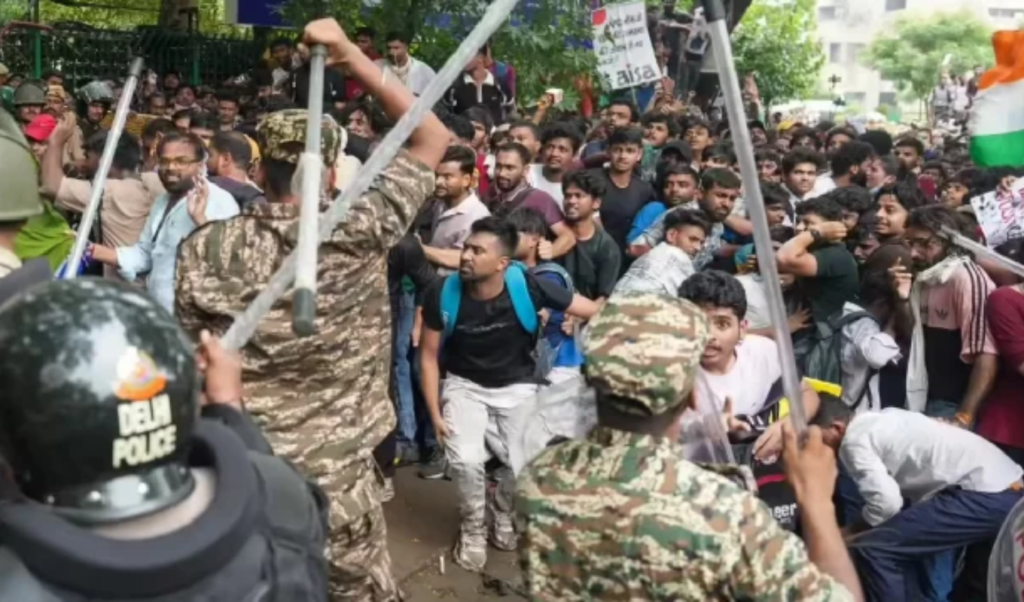
High tension gripped the capital’s iconic Jantar Mantar area on Monday as thousands of young protesters attempted to march towards Parliament. Despite heavy police blockades, baton charges, tear gas canisters, and the preventive closure of several metro stations, demonstrators repeatedly bypassed security cordons to gather near the designated protest zone. The confrontation marks a pivotal escalation after nearly a month of sustained sit-ins at Jantar Mantar, where CJP organizers have consistently demanded structural overhauls of the national education framework and the immediate resignation of Union Education Minister Dharmendra Pradhan.
Despite incorporating the word “Party” within its nomenclature, the Cockroach Janata Party operates not as a formally registered political entity, but as a decentralized, youth-driven civic initiative. While earlier discussions surrounding the group focused heavily on its online viral presence, Monday’s massive physical turnout demonstrated substantial real-world mobilization across university students, recent graduates, and prospective job seekers.
Independent journalist Smita Sharma, who has been documenting the movement since its inception, observed that the demonstrations convey a clear message from India’s younger demographic. She noted that student anxieties extend beyond academic infrastructure to encompass systemic economic challenges, including chronic job scarcity and eroding purchasing power.
The standoff has triggered diplomatic and political maneuvers from both sides. Following the attempted march toward Parliament, CJP representatives indicated that government officials had invited them for formal talks. Conversely, Union Health Minister J.P. Nadda stated via social media that the protesters had initiated the dialogue. According to Nadda, senior officials held lengthy discussions with a delegation of protest leaders, who subsequently submitted a formal memorandum outlining their grievances. Nadda publicly urged the organizers to call off the demonstrations and restore order in the capital.
However, with the central government offering no firm commitments to meet the primary demands, CJP leadership affirmed that their civil disobedience campaign will continue unabated.
Social activist Yogendra Yadav emphasized that the movement transcends traditional student union politics. He remarked that the younger generation is actively demanding an education system aligned with modern employment realities, alongside a political culture grounded in transparency and government responsiveness.
Analytic observers highlight the organizational resilience shown by the youth despite severe logistical hurdles, including targeted internet disruptions and transport blockades. Veteran journalist Hemant Aatree noted that the widespread participation reflects a fundamental democratic reality: public grievances concerning livelihood, education, and economic stability cannot be indefinitely sidelined. He cautioned that failure to address these core domestic issues constructively could expose the ruling administration to far greater political volatility in the future.