A prominent student political figure from the Bangladesh Nationalist Party (BNP) has triggered widespread debate on social media after publishing a self-critical piece regarding nationwide electricity shortages and public suffering under the current administration.
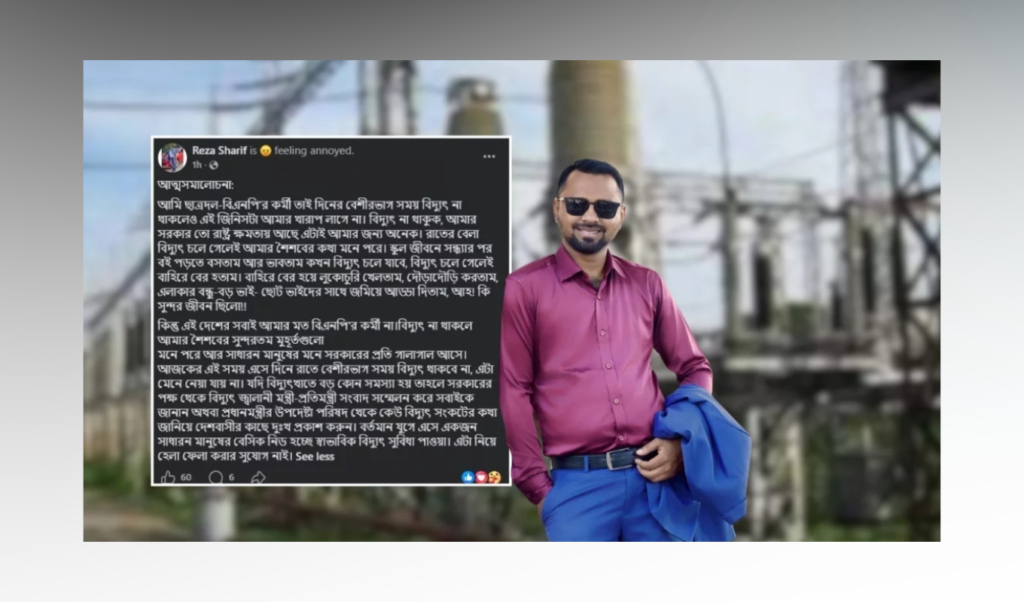
Reza Sharif, former president of the Barishal University chapter of the Jatiyatabadi Chhatra Dal (JCD)—the student wing of the BNP—shared his candid reflections on Facebook on Wednesday, 12 August. While noting that his personal allegiance to the governing party makes load-shedding easier to endure individually, he acknowledged that ordinary citizens face immense hardship and called on ministers to issue a formal apology to the nation.
Nostalgia Versus Everyday Public Suffering
In his online post, Sharif drew a contrast between his personal political loyalty and the daily reality experienced by the general public. He reflected on how power cuts evoke memories of his childhood, when evening blackouts meant putting books aside to play outside with neighborhood friends.
“I am a activist of Chhatra Dal and BNP, so even if there is no electricity for most of the day, it does not bother me much. Even if the power is off, my government is in power, and that is enough for me. When the lights go out at night, it reminds me of my childhood… But not everyone in this country is a BNP activist like me. When the power goes out, I remember the beautiful moments of my childhood, while ordinary people curse the government.”
— Reza Sharif, Former President, Barishal University JCD
Sharif stressed that in the modern era, uninterrupted access to electricity is no longer a luxury but a fundamental necessity for every citizen. He highlighted that enduring long hours without electricity during both day and night remains entirely unacceptable for the public.
Call for Governmental Accountability
Expressing deep dissatisfaction with the current state of power distribution, the former student leader urged the administration to address the crisis directly through official channels rather than downplaying its impact.
He proposed that if the energy sector is grappling with major operational challenges, the Minister or Minister of State for Power, Energy and Mineral Resources—or a member of the Prime Minister’s Advisory Council—should convene a press conference. According to Sharif, officials ought to explain the precise causes behind the ongoing power deficit and offer a public apology to the nation.
His post concluded with an emphatic warning that access to reliable electricity constitutes a basic human need that cannot be treated with negligence or casual indifference by those in authority.
Online Debate and Public Reaction
Public commentary surrounding energy policy typically flows along strict party lines in Bangladesh. As a result, Sharif’s decision to publish an open critique while explicitly identifying himself as a pro-government political activist generated swift engagement across social platforms.
Commentators and social media users widely noted the rarity of a party worker openly acknowledging public grievances caused by power cuts. His statement has reignited discussions on utility management, state accountability, and the impact of frequent load-shedding on domestic life and commerce.