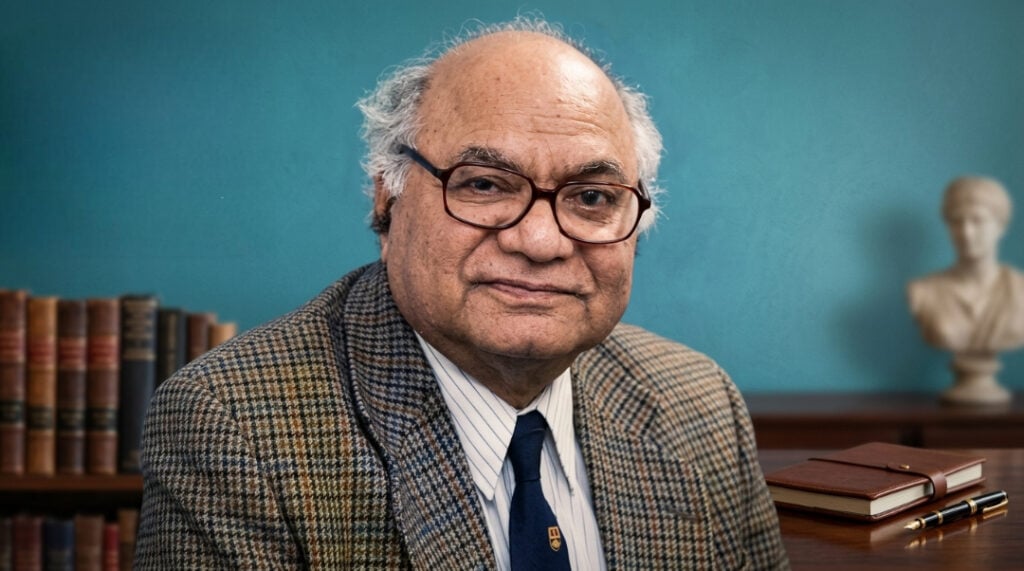
“Books never make anyone bankrupt.”
Some names in Bengali literature are too distinguished to be described simply as writers. They were scholars, linguists, travellers, humorists and keen observers of human life, all at once. Syed Mujtaba Ali was one such rare literary figure. Through his writing, scholarship acquired warmth and wit, travel became a means of understanding people, and humour developed into an art of observing life with intelligence and compassion.
As Bangladesh marks his birth anniversary on 13 September, readers continue to remember the remarkable contribution he made to Bengali literature and intellectual life.
Early life and education
Syed Mujtaba Ali was born on 13 September 1904 in Karimganj, then part of the Sylhet district. His father, Syed Sikandar Ali, was a government official, while his mother was Syed Ayatul Mannan Khatun. He was the third of four children.
From an early age, Ali developed a strong interest in learning and languages. His later experiences across different countries and cultures broadened that curiosity and shaped him into a distinctly cosmopolitan Bengali intellectual. His outlook was never confined by geographical or cultural boundaries.
His years at Santiniketan were particularly significant. He studied in an environment strongly influenced by Rabindranath Tagore’s ideas of universal humanism and cultural exchange. His education later took him beyond the Indian subcontinent, including to Europe and the Middle East.
Ali studied comparative religion at the universities of Berlin and Bonn in Germany and earned a Doctor of Philosophy degree in 1932. He also studied Islamic theology at Al-Azhar University in Egypt.
His command of languages was extraordinary. Alongside Bengali and English, he was proficient in several languages, including Sanskrit, Arabic, Persian, Urdu, Hindi, Gujarati, French, German and Italian. For him, languages were not merely tools of communication. They provided access to different cultures, histories and ways of thinking.
A remarkably varied career
His professional life was as diverse as his intellectual interests. He began his career as a lecturer in French and English at the Agricultural College in Kabul. He later worked at institutions including Baroda College, Bogura Azizul Haque College and the University of Calcutta. He was also associated with the Indian Council for Cultural Relations and All India Radio.
He subsequently joined Visva-Bharati as a Reader in the Department of Islamic History and eventually retired from there.
Such experiences gave Ali a rare perspective. He encountered people from different social, linguistic and cultural backgrounds, and those encounters became an important source of material for his literary work.
‘Deshe Bideshe’ and the world of Kabul
Ali’s arrival in Bengali literature introduced a distinctive new voice. His celebrated travelogue Deshe Bideshe brought him widespread recognition. Based on his experiences in Kabul, the book presents Afghan society, culture, politics and everyday life through vivid descriptions and memorable characters.
Yet Deshe Bideshe is much more than a conventional travel account. Ali used travel as a way of exploring people. His observations of Afghan life are interwoven with humour, conversation, cultural encounters and reflections on human behaviour.
Characters such as Abdur Rahman, Professor Benoit, Ahmad Ali, Khudabaksh, Bogdanoff and Muin-us-Sultan remain memorable to generations of Bengali readers.
One of the book’s greatest strengths is its ability to make unfamiliar places feel accessible and unfamiliar people feel remarkably close to the reader.
Humour with a deeper purpose
Ali is often remembered primarily as a humourist, but reducing him to that description would overlook much of his literary significance. His humour was rarely intended simply to make readers laugh. Behind the jokes were observations about society, human nature and the contradictions of everyday life.
Works such as Panchatantra, Mayurkanthi, Chacha-Kahini, Tuni Mem, Dhupchhaya and Bhoboghure O Onyanno demonstrate his distinctive command of humour and language.
His writing could be gentle one moment and sharply satirical the next. A seemingly simple anecdote could gradually reveal a serious observation about society or human behaviour. That combination allowed readers to enjoy the immediate pleasure of his prose while also discovering deeper meanings beneath it.
His greatest achievement as a humourist was perhaps his ability to remain intellectually sophisticated without becoming inaccessible. His scholarship never overwhelmed his storytelling.
Novels, stories and essays
Ali’s literary output extended well beyond humorous writing and travel literature. He wrote novels, short stories, essays and books dealing with language, society and culture.
Among his notable novels are Abishwasya, Shabnam, Shahriyar and Tulanahina. Shabnam, set against the backdrop of Afghan society, explores love and human relationships through a deeply affecting narrative.
His storytelling talent is also evident in works such as Chacha-Kahini, Rasgolla, Tirthahina, Padatika and Rakshasi. In these writings, his distinctive narrative voice combines wit, learning and close observation of human character.
His other works, including Jole-Dangay and Purba-Pakistaner Rastrabhasha, reflect his intellectual engagement with language, society and contemporary issues.
A Bengali intellectual with a universal outlook
Perhaps one of the most enduring aspects of Ali’s legacy is his broad humanistic outlook.
He possessed deep knowledge of religion, particularly Islamic theology, but his intellectual world was never defined by religious narrowness. He explored Eastern and Western traditions, India and Europe, Islam and other cultural and intellectual traditions with curiosity and an open mind.
That breadth is reflected throughout his literature. His books move across geographical and cultural boundaries, but their central concern repeatedly returns to people and their relationships.
He understood that cultures could be different without being incomprehensible. His writing often created a bridge between the familiar and the unfamiliar, allowing Bengali readers to encounter distant societies through a distinctly human perspective.
When scholarship speaks through wit
Ali’s extraordinary learning became almost legendary. His knowledge extended across religious studies, Sanskrit literature, European thought, languages and cultural history. Yet he rarely displayed that learning in a way that made his prose heavy.
Instead, he brought scholarship into ordinary storytelling. Readers could encounter a historical reference, a linguistic observation or a philosophical idea within a humorous conversation or an engaging anecdote.
That quality helped establish his unique position in Bengali literature. He was not simply a learned writer who happened to be humorous; he was a storyteller capable of turning learning itself into entertainment.
His prose was lively, precise and intelligent. It carried the influence of several cultures while remaining firmly rooted in Bengali literary expression.
Why Syed Mujtaba Ali became a legend
Literary critic Syed Manzurul Islam has described the essence of Ali’s stature by noting that he had already become a legend during his lifetime.
His reputation rested not only on the number of books he wrote, but on the distinctive experience his writing offered. His narratives often feel like conversations with a gifted storyteller sitting across from the reader. His characters appear recognisable, his observations feel immediate, and his humour often carries the rhythm of everyday human interaction.
He also possessed a rare ability to combine erudition with accessibility. Readers did not have to be scholars to appreciate his work. A person could simply begin reading for the humour and gradually discover history, culture, philosophy and social observation woven into the narrative.
His enduring words
Several statements associated with Syed Mujtaba Ali continue to be widely remembered, including:
“Knowledge is greater than wealth.”
“Books never make anyone bankrupt.”
Another frequently quoted reflection on books expresses the lasting value he placed on reading and intellectual life. Its central idea is that material pleasures and even human youth eventually fade, while a good book can retain its freshness and continue to offer something new to successive generations.
These sentiments capture an important aspect of Ali’s literary philosophy. For him, books were not merely objects to be collected. They were a means of preserving knowledge, imagination and human experience.
Awards and recognition
Ali received several honours for his contribution to Bengali literature, including the Ananda Puraskar. He was also awarded the Ekushey Padak posthumously in recognition of his literary contribution.
Yet his most lasting recognition has arguably come from readers themselves. His books have continued to be read across generations, allowing new audiences to encounter his humour, scholarship, travel experiences and distinctive prose.
That continuing readership is particularly significant for a writer whose work spans so many cultures and intellectual traditions. His books have retained their appeal because the human qualities at the centre of them remain familiar.
A legacy that continues
Syed Mujtaba Ali died on 11 February 1974. His life came to an end, but his literary presence did not.
He remains alive in the Kabul of Deshe Bideshe, in the humour of Chacha-Kahini, in the emotional world of Shabnam and in the wit and learning scattered throughout his many works.
He showed Bengali readers that travel could be a form of education, that humour could carry serious ideas and that scholarship did not have to be separated from entertainment. He brought the experience of many languages and cultures into Bengali prose without losing the warmth and character of the language itself.
His writing also demonstrated the value of looking beyond familiar boundaries. Countries, religions, languages and cultures may differ, but curiosity and empathy can bring people closer.
That is perhaps why his work continues to matter.
As long as Bengali remains a living literary language, as long as readers continue to discover the pleasure of books, and as long as humour can lead people towards a deeper understanding of life, Syed Mujtaba Ali’s voice will retain its place in Bengali culture.
On his birth anniversary, readers remember a writer who travelled widely but remained deeply connected to people; a scholar who never allowed learning to become a burden; and a humourist whose laughter often contained a serious truth.
Syed Mujtaba Ali was not merely a celebrated author of Bengali literature. He was one of its most distinctive storytellers—cosmopolitan in experience, Bengali in expression and universal in his understanding of humanity.