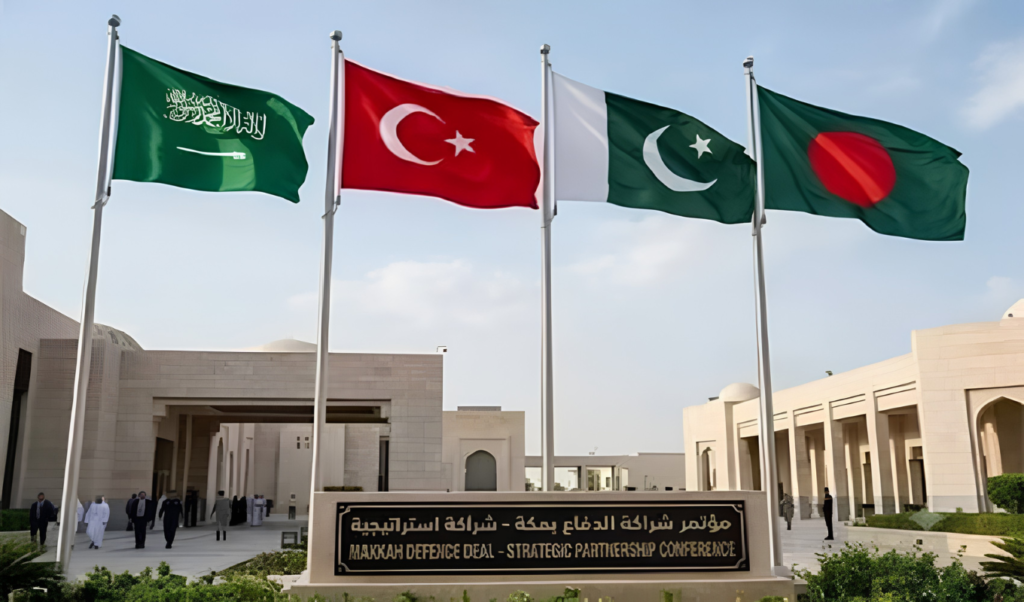
Special Correspondent:The Mecca Pact has emerged as a major geopolitical issue currently under intense scrutiny across global diplomatic circles. The military alignment of three key regional nations—Saudi Arabia, Turkey, and Pakistan—has sparked widespread international debate. Even before the full operational framework of the alliance has crystallised, signals indicating Bangladesh’s preliminary interest in joining the coalition have raised significant concern among domestic experts and foreign policy analysts.
Following recent remarks by Minister of State for Foreign Affairs Humayun Kabir confirming Bangladesh’s interest in the “Mecca Joint Defence Agreement” (MJDA)—signed on August 7 between Saudi Arabia, Turkey, and Pakistan—experts have strongly urged the government to thoroughly evaluate the strategic, security, economic, and diplomatic ramifications before taking any binding decisions.
Former diplomats, researchers, academics, and national security analysts have warned that any executive decision must not undermine Bangladesh’s long-standing foreign policy of maintaining balanced relations with major regional and global powers, nor should it draw the country into external conflicts disconnected from its sovereign national interests.
When foreign and defence policy decisions carry long-term implications for national security, regional stability, and economic resilience, potential strategic gains must be weighed equally against prospective risks. In addressing a nation’s participation in a formal military bloc, national interest, regional neighbourly relations, and public opinion cannot be overlooked.
Humayun Kabir, President of the Bangladesh Enterprise Institute and former ambassador, noted that discussions surrounding Bangladesh’s prospective participation remain at a preliminary stage. Reports indicate that Saudi Arabia, Turkey, and Pakistan have invited Iran to join the platform, suggesting that formal invitations play a crucial role in shaping the bloc. Consequently, establishing whether Bangladesh has received an official invitation remains an essential first step before formal deliberations begin.
A central element of the pact is its mutual defence clause, stipulating that an armed attack on any single signatory will be treated as an attack against all three member states—a provision comparable to NATO’s Article 5. However, independent researcher Altaf Parvez highlighted that it remains unclear whether the alliance will establish an integrated command structure similar to NATO. He observed that signatory nations may eventually attempt to bring Bangladesh under this collective security umbrella.
Parvez added that following recent US-Iran confrontations, Tehran’s stance has enhanced its standing within the Muslim world. As a result, Saudi Arabia and Turkey may actively compete for leadership positions among Muslim-majority nations, making Bangladesh’s alignment strategically valuable to both. Turkey, in particular, has demonstrated growing interest over the past two to three years in strengthening military cooperation with Bangladesh.
Security experts suggest that recent geopolitical shifts have prompted several nations to re-evaluate their defence postures, driving strategic diversification in foreign policy. The Mecca Pact reflects this broader structural shift.
However, retired Air Commodore Ishfaq Ilahi Choudhury emphasised that Bangladesh must carefully consider its historical non-aligned foreign policy before joining any military bloc. He pointed out that prominent Muslim-majority nations—including Egypt, the United Arab Emirates, Oman, Kuwait, and Qatar—have not joined the agreement. Understanding why three non-contiguous nations formed this tripartite alliance is essential for Bangladesh’s strategic assessments.
Choudhury noted that Pakistan currently faces multifaceted security challenges along its borders with Afghanistan and India, alongside domestic complexities in Khyber Pakhtunkhwa and Balochistan, whilst maintaining a large military apparatus under economic pressure. Meanwhile, Saudi Arabia remains focused on security concerns involving Iran and Houthi forces in Yemen, and Turkey navigates regional dynamics in Syria, Iraq, Kurdish issues, and maritime disputes with Greece over Cyprus.
Given these distinct security realities, Bangladeshi policymakers must examine whether the nation faces comparable threats that justify joining such a collective defence architecture solely due to geopolitical shifts.
Choudhury further cautioned that joining the pact could provoke adverse reactions from Iran and its regional allies. Additionally, India’s perspective requires careful consideration, as Bangladesh shares vital bilateral interests with New Delhi involving trade expansion, energy imports, and the renewal of the Ganges Water Sharing Treaty. Consequently, any alliance decision must incorporate economic and diplomatic dimensions alongside military factors.
Furthermore, questions remain regarding whether joining the Mecca Pact would yield practical solutions to Bangladesh’s energy and investment challenges.
Conversely, Altaf Parvez emphasised that the economic dimensions of the alliance should not be underestimated. The Gulf region represents a critical global hub for capital and investment. Following recent regional military escalations, protecting regional assets, investments, and economic stability has become a top priority for Gulf economies.
Parvez warned that the proliferation of competing military alliances could extend beyond the Middle East, impacting smaller nations such as Bangladesh, Nepal, and Sri Lanka, which already face economic pressures from global instability and may struggle to keep pace with major power militarisation.
Professor Sabbir Ahmed of the Department of Political Science at Dhaka University underscored the necessity of evaluating the underlying motives and potential outcomes of the Mecca Pact. He noted that given Bangladesh’s geographic reality and military capacity, joining a collective defence pact carries strategic risks. Decisions should only be reached after clearly mapping potential benefits against liabilities.
He advised the government to engage in comprehensive consultations with domestic stakeholders and policy experts, whilst ensuring that the rationale behind joining any military bloc and its alignment with national interests are transparently communicated to the public.
Ultimately, executive decisions on national security and foreign policy affect the entire populace. In international politics, miscalculations can yield long-term consequences for ordinary citizens—a reality demonstrated by recent global conflicts where civilian populations bear the heaviest burden of war.
As a democratic nation, Bangladesh’s security and foreign policy frameworks must reflect broad national consensus. Where potential commitments risk altering the country’s geopolitical alignment or impacting key bilateral relationships, a rigorous evaluation of national interest remains indispensable.
Deciding whether to join the Mecca Pact extends beyond immediate diplomatic manoeuvres; it touches upon Bangladesh’s future foreign policy trajectory, regional stability, economic security, and national sovereignty. Decisions must therefore be guided by empirical analysis, expert consensus, national interest, and public accountability rather than transient strategic momentum.