Zisan Shahriar
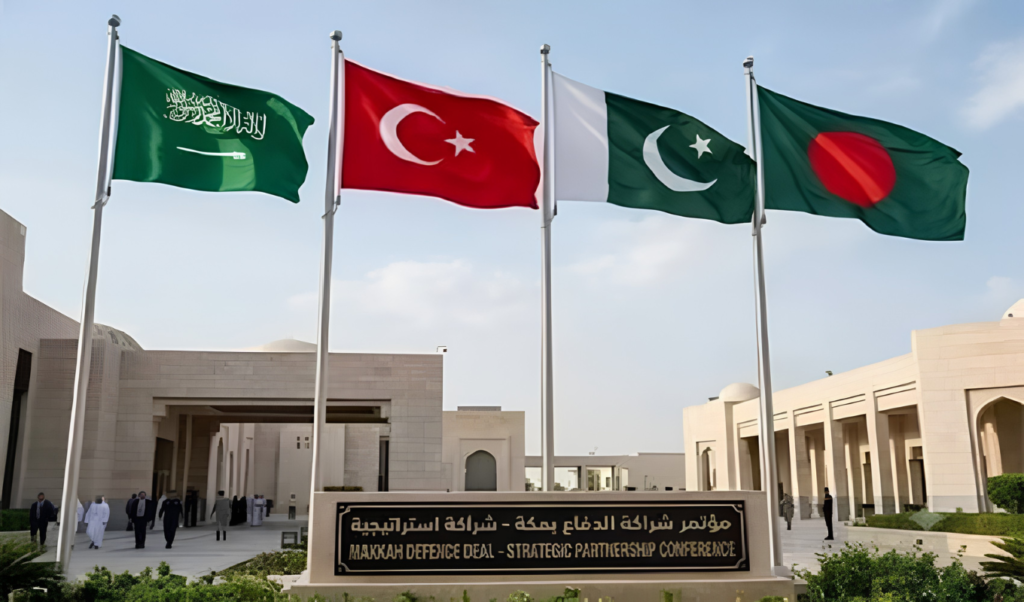
Discussions regarding Bangladesh’s potential entry into the Mecca Joint Defence Agreement (MJDA)—recently signed between Saudi Arabia, Turkey, and Pakistan—are gaining momentum. Although the government has expressed a positive stance toward the matter, Bangladesh has not yet made an official decision to join the coalition.
On August 7, Saudi Arabia, Turkey, and Pakistan signed this joint defence pact in Mecca. A defining feature of the treaty is its mutual defence clause: an armed attack against any member state will be considered an attack on all members. Turkish Foreign Minister Hakan Fidan compared this provision to NATO’s Article 5, although the structural and institutional capabilities of the MJDA are not yet on par with those of NATO.
This very clause raises the most critical question surrounding Bangladesh’s prospective accession. Joining a defence alliance entails much more than merely expanding military cooperation; in the event of a future security crisis affecting a member state, other members may be required to take a formal stand. Consequently, regional conflicts with which Bangladesh has no direct connection could eventually become embedded in Dhaka’s diplomatic and security calculations.
Potential Benefits: Defence Cooperation and Strategic Links
The primary argument in favour of Bangladesh joining the Mecca Alliance lies in the opportunity to expand defence cooperation. Saudi Arabia’s financial resources and regional influence, Turkey’s advanced military technology and defence industry, and Pakistan’s military expertise collectively render the alliance a significant regional security framework.
For Bangladesh, membership could open new avenues for military training, defence technology acquisition, intelligence sharing, counter-terrorism collaboration, and procurement of defense hardware. Bangladesh already shares active defense ties with Turkey. Furthermore, the prospect of deepening security linkages with Saudi Arabia and expanding defense communications with Pakistan holds strategic relevance for Dhaka.
From an economic perspective, Saudi Arabia remains a vital partner for Bangladesh. The Kingdom hosts a vast Bangladeshi workforce and serves as one of Dhaka’s most crucial overseas labor markets. Maintaining close political and security relations with Riyadh offers tangible economic advantages.
Government officials have not dismissed the possibility of joining. Minister of State for Foreign Affairs Humayun Kabir stated that Bangladesh has shown interest in the Mecca Defense Agreement and views the initiative positively. He noted that if Islamic nations form a security agreement, Bangladesh’s participation would not be unusual.
However, the core dilemma remains: is security cooperation identical to joining a formal military alliance? For Bangladesh, distinguishing between the two is paramount.
Where Does the Liability of War Lie?
The mutual defence clause of the Mecca Treaty presents the single largest risk factor for Bangladesh. If a member state becomes embroiled in an armed conflict in the future, political or military pressure could be exerted on other members to support that state.
Saudi Arabia’s security concerns are predominantly focused on West Asia. Tensions with Iran, the ongoing conflict with the Houthis in Yemen, Persian Gulf security, and maritime routes in the Red Sea form integral components of Riyadh’s defence strategy. Meanwhile, Turkey’s security interests are intertwined with complex regional dynamics in Syria, Iraq, Kurdish issues, and the Caucasus. Pakistan’s security priorities center on its western border, Afghanistan, and its long-standing strategic posture toward India.
Bangladesh’s geopolitical and security realities differ fundamentally from those of these nations. Dhaka maintains no direct military disputes with Iran or Yemen, nor does it possess territorial or strategic stakes in Middle Eastern conflicts.
Should Saudi Arabia become involved in a regional war in the future, the question arises as to whether Bangladesh would be expected to align with Riyadh in that conflict. Similarly, if hostilities flare between Pakistan and India, the potential diplomatic or military pressure placed on Bangladesh cannot be overlooked.
Recent analytical assessments regarding Bangladesh’s prospective entry into the Mecca Alliance emphasize that Dhaka must ensure the enemies of its prospective allies do not automatically become its own. In scenarios such as a renewed Saudi-Iranian confrontation, Bangladesh could find itself pressed to take a stance in a conflict disconnected from its core national interests.
The Indian Factor and Strategic Balance
Another significant implication of joining the Mecca Alliance involves Bangladesh’s bilateral relationship with India. While India maintains functional relations with both Saudi Arabia and Turkey, Pakistan’s presence within the alliance adds a distinct dimension for New Delhi.
Bilateral relations between Dhaka and New Delhi already face delicate negotiations over border management, trade, water-sharing agreements, and the extradition of former Prime Minister Sheikh Hasina. Under these circumstances, if Dhaka enters a formal joint defence framework alongside Islamabad and Ankara, it could alter India’s security calculations regarding Bangladesh.
According to a report by Reuters, Bangladesh’s potential accession to the Mecca Alliance could add complexity to its ties with India while potentially straining Dhaka’s historically balanced foreign policy.
Impact on Non-Aligned Foreign Policy
Bangladesh has long pursued a non-aligned, balanced foreign policy aimed at avoiding entanglement in major power rivalries. Cultivating distinct, interest-based relationships with India, China, the United States, the European Union, Japan, and Middle Eastern nations has been a cornerstone of Bangladeshi diplomacy.
A key question is how much strategic autonomy Bangladesh could preserve after joining the Mecca Alliance. Establishing defence cooperation or participating in joint training exercises with a foreign power is fundamentally different from committing to a mutual defence obligation.
Bangladesh remains a leading contributor to United Nations peacekeeping operations worldwide. However, serving under a UN mandate differs significantly from committing to a military bloc where membership carries the potential obligation of participating in a war against another sovereign state. Policymakers in Dhaka will need to weigh this distinction carefully.
Weighing Costs and Benefits Before a Decision
The Mecca Alliance offers Bangladesh opportunities to access defence technology, military training, strategic communication channels, and deeper ties with key nations like Saudi Arabia. Simultaneously, it introduces foreign security liabilities, pressure to take sides in regional conflicts, and the risk of complicating relations with India.
The mutual defence clause requires rigorous scrutiny by national security planners. An ally of Bangladesh today could become involved in a regional conflict tomorrow, placing Dhaka’s relationships with third countries at risk.
The core question extends beyond whether Bangladesh should join the Mecca Alliance. It requires evaluating how much genuine security Bangladesh stands to gain versus the extent of strategic autonomy it might surrender.
As the government emphasizes a “Bangladesh First” policy, conducting a rigorous cost-benefit analysis aligned with national interests is essential prior to entering any military pact. Bangladesh cannot afford defence commitments that risk drawing the nation into external conflicts unrelated to its own sovereign interests.
Author: Zisan Shahriar