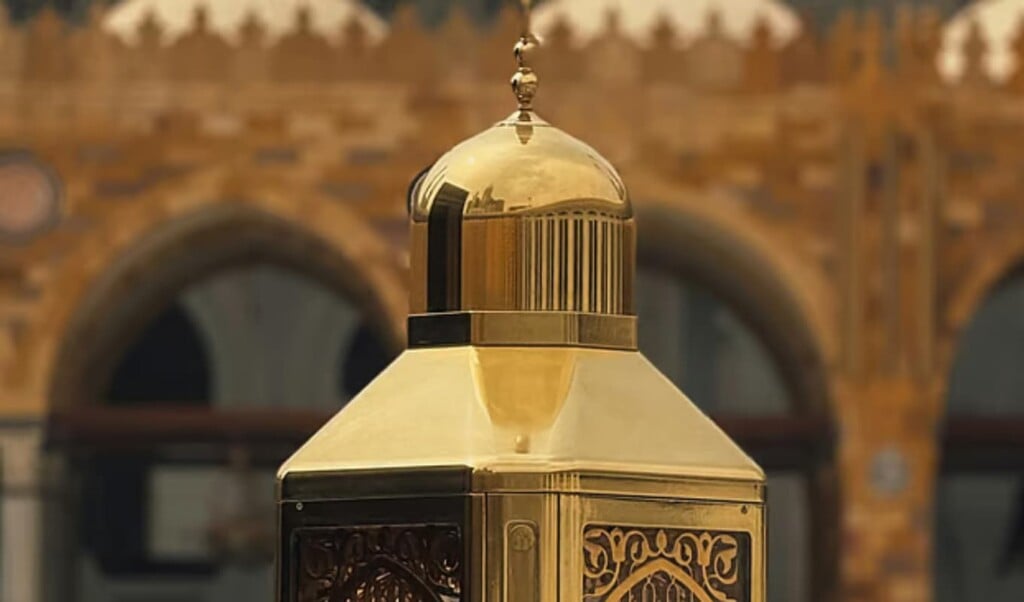
The spiritual rituals of Hajj are deeply intertwined with historical monuments that mark the foundational narrative of the Holy Kaaba. Among these, the Maqam Ibrahim (the Station of Abraham) stands as a vital sacred relic within the precincts of the Masjid al-Haram in Mecca. Islamic historical literature details that this relic is a large boulder upon which the Prophet Ibrahim stood to construct the upper masonry of the Kaaba when the walls surpassed his height. The stone exhibited extraordinary properties, adjusting its elevation vertically to facilitate the structural work, while its surface softened like clay to retain the physical imprint of the Prophet’s feet.
Scriptural Foundation and Celestial Status
The monument receives explicit validation in Islamic scripture as an enduring sign of divine intervention. The Holy Quran notes in Surah Ali ‘Imran, verse 97, that the sanctuary contains distinct, visible proofs, identifying the Station of Abraham as a primary sign.
Furthermore, authentic prophetic traditions outline the celestial origin of the stone. As recorded in Sunan al-Tirmidhi (Hadith 878), the Prophet Muhammad stated that the Hajar al-Aswad (the Black Stone) and the Maqam Ibrahim are two sapphires sent from Paradise. The narration states that their brilliant natural radiance was dimmed by divine decree, for if it had been left unaltered, their light would have illuminated the entire expanse between the East and the West.
Historical Transitions and Contemporary Architecture
The spatial positioning of the Maqam Ibrahim has shifted across different historical epochs to ensure the safety of worshippers and smooth crowd management. Initially kept within the interior walls of the Kaaba, the stone was relocated closer to the main entrance before the advent of Islam. Following the establishment of the Islamic faith and the subsequent expansion of the grand mosque, it was moved slightly further away to establish a dedicated prayer zone.
The technical dimensions, historical data, and contemporary protective frameworks of the monument are detailed in the table below:
| Architectural Property | Verified Project Specification | Scriptural / Jurisprudential Reference |
| Theological Identity | Heavenly Sapphire (Yaqut) from Paradise | Sunan al-Tirmidhi, Hadith 878 |
| Physical Imprint | Deeply embedded footprints of Prophet Ibrahim | Tafsir Ma’ariful Quran (Vol. 2, p. 103) |
| Current Distance | Positioned 10 to 11 metres from the Kaaba | Contemporary Survey Data |
| Structural Protection | Housed inside a crystal-glass dome casing | Saudi Ministry of Hajj and Umrah |
| Mandatory Ritual | Base for the two-rakah Tawaf prayer | Manasik of Mullah Ali Qari (pp. 199-200) |
The Universal Call to Pilgrimage
Following the completion of the Kaaba’s structural frame, the Prophet Ibrahim was ordered to invite humanity to perform pilgrimage. As stated in Surah Al-Hajj, verse 27: “And proclaim to the people the Hajj; they will come to you on foot and on every lean camel; they will come from every distant pass.” Standing upon this specific boulder, the Prophet delivered the call. The classical Quranic commentary of Tafsir Ibn Kathir records that this proclamation was miraculously carried across time to the souls of all future generations destined to visit the sanctuary, who spiritually responded with the traditional declaration: “Labbayk” (Here I am at Your service, O Lord).
Jurisprudential Rules and Devotional Practices
The Maqam Ibrahim remains an active focal point during the performance of Hajj and Umrah. Canonical records indicate that upon finishing his circumambulation during the Farewell Pilgrimage, the Prophet Muhammad offered his prayers facing the Kaaba with the Maqam Ibrahim positioned directly in front of him (Sahih al-Bukhari, Hadith 395).
Based on this prophetic precedent, Islamic law dictates that completing a two-rakah prayer after concluding the seven rounds of Tawaf is mandatory (Wajib). Performing this prayer behind the protective dome of the Maqam Ibrahim is an established Sunnah practice. However, if extreme crowding or security restrictions block access to the immediate area, the religious obligation can be fully discharged by performing the prayer in any other location within the wider boundary of the Masjid al-Haram.