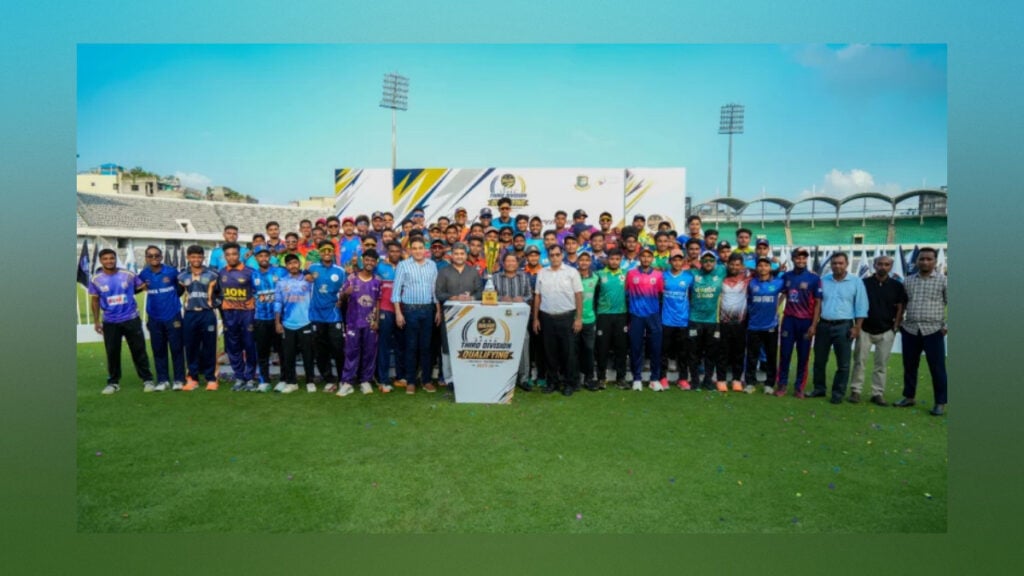
Bangladesh’s Third Division qualifying tournament has entered a new phase, with the competition switching from one-day cricket to the Twenty20 format. The latest edition, involving 70 teams and around 1,400 cricketers, was formally inaugurated on Saturday as the Bangladesh Cricket Board (BCB) introduced several changes aimed at creating a stronger platform for young players.
The move to T20 is the most notable change. Previous editions of the qualifying tournament were played in the one-day format, with matches involving the traditional red-ball setup. Under the new arrangement, players will compete with white balls in T20 matches, bringing the tournament in line with the shorter format of the game.
The change also gives the competition a different character. In T20 cricket, players have fewer deliveries in which to make an impact, placing greater emphasis on quick scoring, disciplined bowling and sharp fielding. For young cricketers competing at the lower levels of Dhaka’s club structure, the tournament therefore provides an opportunity to demonstrate their skills in a format where performances can be assessed over a shorter period.
The BCB has also introduced an age restriction for the tournament. Players must be aged 25 or below to take part. The measure is part of the board’s wider effort to identify promising cricketers from the domestic circuit and give younger players greater exposure in a competitive environment.
The tournament is also being used as an opportunity for selectors to observe players directly. BCB president Tamim Iqbal has instructed selectors of the age-group teams to attend matches and assess performances from the ground. The intention is to identify players who show sufficient potential to be considered for age-group sides.
A total of 70 teams have entered this year’s competition, providing playing opportunities to approximately 1,400 cricketers. Across the tournament, 151 matches are scheduled to be played at grounds in Dhaka and surrounding areas.
The teams have been divided into 16 groups for the opening stage. Matches in the group phase will be played on a league basis, allowing teams to compete across the initial stage before the tournament moves into its knockout phase.
The champions and runners-up from each group will progress to the last 32. That means 32 teams will remain once the group stage is completed. From there, the competition will switch to a knockout format, with 16 matches producing 16 winners for the next stage.
The matches leading to the quarter-finals will also be played on a knockout basis. The final eight teams will contest the quarter-finals, with the winners advancing to the semi-finals. The two semi-final winners will then meet in the final.
The tournament’s schedule means that the stakes will increase as the competition progresses. While teams will have more than one opportunity during the league stage, a defeat in the knockout rounds will end their campaign.
The Dhaka Cricket Committee of Metropolitan (CCDM) has said it aims to complete the qualifying tournament between 25 and 26 October. With a large number of teams and players involved, the competition will require matches to be staged across multiple grounds in Dhaka and nearby areas.
Beyond determining the teams that progress through the tournament, the new structure is intended to give younger cricketers a wider platform to perform. The presence of age-group selectors at matches adds another dimension, as players will have the opportunity to put themselves forward through performances on the field.