Seven March remains one of the most significant and memorable days in the history of the Bengali nation’s struggle for freedom. On this day in nineteen seventy one, the undisputed leader of the Bengali people, Bangabandhu Sheikh Mujibur Rahman, delivered a historic speech at the Ramna Racecourse Ground in Dhaka. The address provided clear political direction for the people of the region and laid the foundation for the subsequent war that ultimately led to the birth of Bangladesh.
Looking back, it becomes evident that the speech was far more than a conventional political address. It was a powerful declaration of national dignity, resistance, and aspiration for self determination. Through his carefully measured words, Bangabandhu succeeded in uniting millions of people under a common cause and preparing them psychologically for the struggle that would soon unfold.
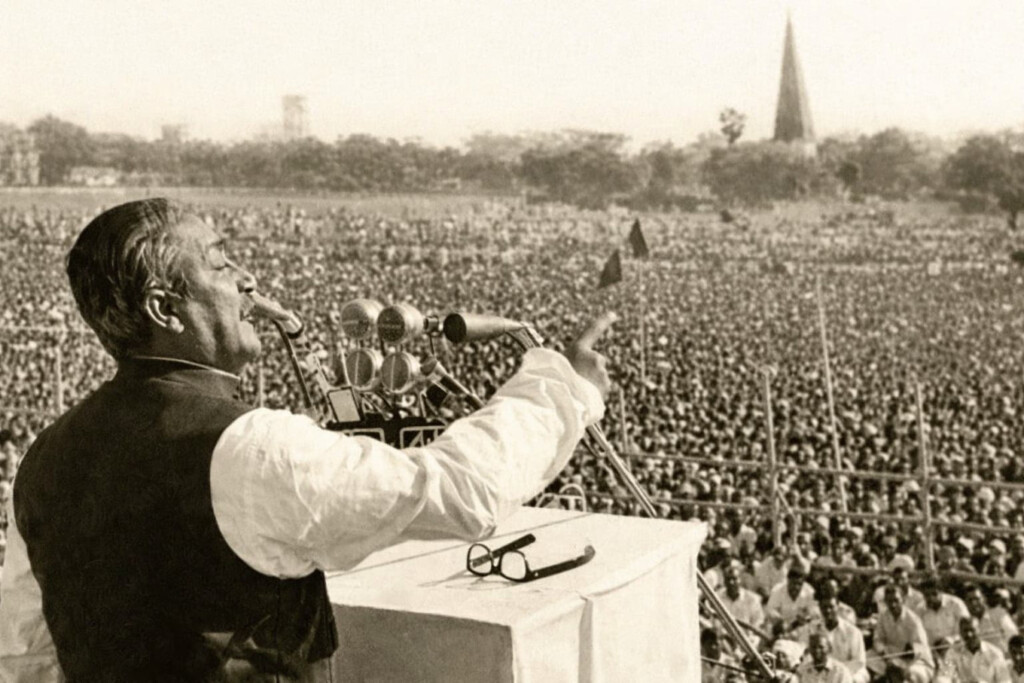
On that afternoon, the Ramna Racecourse Ground transformed into a vast sea of people. Hundreds of thousands gathered from across the country, travelling from distant towns, villages, and districts. Many walked for miles, while others arrived by river vessels, buses, and trains. The crowd represented all sections of society, including farmers, labourers, students, professionals, and political activists. Regardless of their social background or occupation, they shared a single purpose: to hear Bangabandhu’s message regarding the future of their political struggle.
At approximately three twenty in the afternoon, Bangabandhu stepped onto the stage wearing a white traditional outfit and a black sleeveless coat. His appearance immediately sparked waves of applause and enthusiastic slogans across the vast gathering. Greeting the audience with a raised hand, he began a speech that would become one of the most influential political declarations of the twentieth century.
During the eighteen minute address, Bangabandhu articulated the grievances of the Bengali population and clearly outlined the path forward. At one crucial moment, he declared in a resolute voice that the present struggle was a struggle for liberation and independence. This statement transformed the aspirations of the people into an organised national movement.
In the same speech, he also presented four key demands directed at the ruling authorities. These demands reflected the urgent political concerns of the time and reinforced the demand for democratic rights.
| Subject | Description |
|---|---|
| Date | Seven March nineteen seventy one |
| Location | Ramna Racecourse Ground, Dhaka |
| Speaker | Bangabandhu Sheikh Mujibur Rahman |
| Duration of Speech | Approximately eighteen minutes |
| Core Message | Call for liberation and independence |
| Historical Outcome | Political foundation for the Liberation War |
Although there were initial attempts to prevent the speech from being broadcast live, pressure from local broadcasting personnel and public demand eventually led to its transmission later that night. Once aired, the speech quickly spread throughout the country, strengthening the determination of the population to pursue freedom.
The impact of the address became even more apparent later that month. Following the brutal military crackdown on the night of twenty five March, the call for independence gained unstoppable momentum. A nine month armed struggle ensued, during which countless people sacrificed their lives for the cause of national liberation. Ultimately, victory was achieved on sixteen December nineteen seventy one, leading to the emergence of Bangladesh as an independent and sovereign nation.
The global significance of the speech has also been formally recognised. On thirty October two thousand seventeen, the United Nations Educational, Scientific and Cultural Organization included the speech in the Memory of the World Register, acknowledging its historical and documentary importance.
Despite the absence of a centrally organised programme by the Awami League on this occasion, commemorative activities took place in Dhaka and other districts across the country. Various groups organised rallies, poster campaigns, and public broadcasting of the historic speech through loudspeakers in different neighbourhoods. In particular, the Volunteer League conducted poster displays and arranged audio broadcasts of the speech at several locations in the capital, ensuring that the powerful message of seven March continued to resonate among the people.