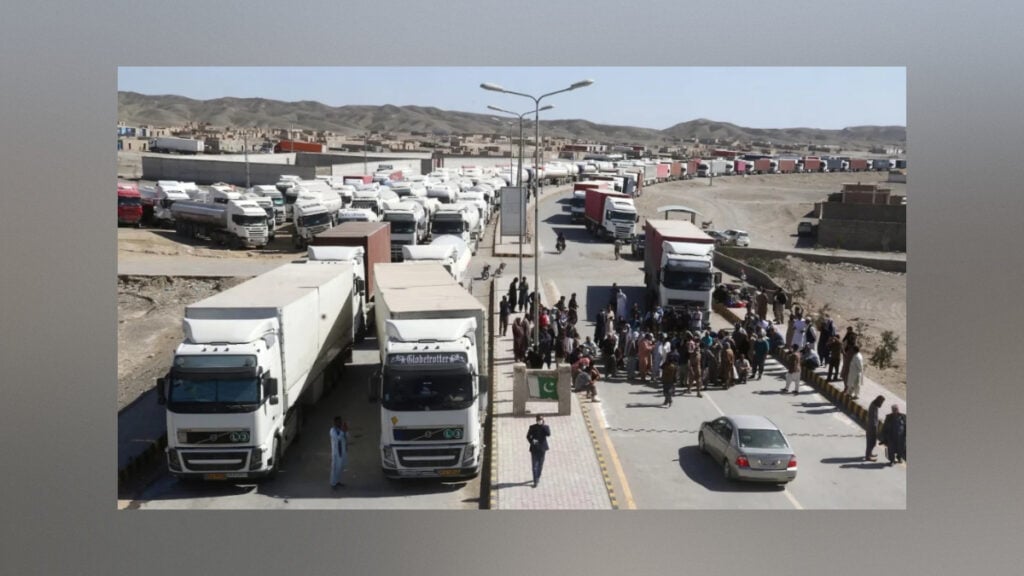
The United States is expanding its pressure on Iran beyond the maritime domain, with a new initiative aimed at restricting the country’s land-based supply routes. Following its naval blockade in the Strait of Hormuz, the US military’s Central Command (CENTCOM) has announced the formation of a task force to prevent Iran from using overland routes to transport advanced weapons and other strategic materials.
In a statement issued on Saturday, 7 November, CENTCOM said the new task force would work to disrupt the movement of military equipment and other restricted goods into and across Iran. The development marks an expansion of Washington’s efforts to limit Tehran’s access to supplies that could support its military capabilities.
CENTCOM commander Admiral Brad Cooper said Task Force Iron Gate would strengthen what he described as the success of the existing maritime blockade against Iran. The initiative is intended to complement operations at sea by monitoring and restricting supply networks operating across land borders and the Caspian Sea.
Based in Tampa, Florida, the task force will coordinate with other US government agencies to prevent the movement of advanced weapons systems, dual-use technologies, sanctioned materials and illicit revenue flows. Dual-use technologies are products or equipment that can serve both civilian and military purposes, making their movement a particular concern for governments seeking to restrict military procurement.
Michael Mulroy, a former US Deputy Assistant Secretary of Defence for the Middle East, told Al Jazeera that the task force would seek to identify the sources of weapons entering Iran, determine how supply networks could be disrupted and examine the routes through which the country transports its fuel.
Mulroy also suggested that the newly identified networks and infrastructure could become targets if US President Donald Trump ordered an escalation of military operations.
Drawing a distinction between the current initiative and Operation Epic Fury, Mulroy said the latter had focused primarily on military targets. He argued that the new approach could place greater emphasis on economic and infrastructure-related targets as part of a broader strategy to weaken the Iranian government’s ability to sustain military operations and finance the conflict.
The announcement came as CENTCOM reported another incident involving a commercial vessel in the Gulf of Oman. The US military said it had disabled a cargo ship as part of its ongoing blockade of Iranian ports.
According to CENTCOM, the vessel’s crew had been instructed to leave the targeted area before a US military aircraft fired precision munitions at the rear section of the St Kitts-flagged commercial ship, identified as the MV Huda. The strike left the vessel unable to continue sailing.
CENTCOM also provided figures on its enforcement activities since July. The command said US forces had redirected 147 commercial vessels after ordering them to comply with the blockade, while five merchant ships had been disabled for refusing to follow instructions.
Meanwhile, reports of explosions emerged from several locations in Iran. The country’s state-run news agency IRNA reported on Saturday that two explosions had been heard on Qeshm Island, which lies in the Strait of Hormuz. The agency also reported several explosions in the cities of Jask, Sirik and Bandar Abbas.
The reports followed Trump’s confirmation a day earlier that fresh strikes had taken place on Qeshm Island. He described the attacks as relatively minor and said Tehran still wanted an agreement, with discussions continuing through Qatari mediation.
Despite the diplomatic efforts, tensions around the strategically important waterway remain high. Iran’s Islamic Revolutionary Guard Corps (IRGC) Navy also claimed on Saturday that two oil tankers had been damaged by naval mines near the Strait of Hormuz.
Iranian state television, citing the IRGC, reported that the two tankers had switched off their navigation systems while passing through what it described as an unsafe section of the strait. The vessels were allegedly struck by maritime mines, sustaining serious damage before coming to a halt.
The latest developments have raised concerns about the security of commercial shipping in one of the world’s most important energy corridors. The Strait of Hormuz connects the Persian Gulf with the Gulf of Oman and serves as a critical route for international oil and gas shipments. Any disruption to traffic through the narrow passage can have consequences for global energy supplies, shipping costs and international markets.
Washington’s decision to extend its blockade strategy to Iran’s land-based supply networks suggests that its campaign is no longer confined to controlling maritime movements. By targeting the routes through which weapons, technology and other strategic materials reach the country, the United States appears to be seeking broader economic and logistical pressure on Tehran.
At the same time, reports of fresh strikes, damage to commercial vessels and alleged mine incidents underline the risks of further escalation. With military operations continuing alongside Qatari-mediated diplomatic efforts, the situation remains uncertain. Whether negotiations can produce an agreement before tensions intensify further is likely to remain a central question in the coming days.