Massive industrial unrest has swept across the major ready-made garment (RMG) hubs of Gazipur and Savar, forcing authorities and management to suspend operations in at least 80 factories. Tensions escalated sharply on Sunday as thousands of garment workers abandoned their sewing lines and took to the streets, demanding a substantial increase in their minimum monthly wage to 30,000 Bangladeshi Taka (BDT) to cope with spiralling living costs.
While factory operations commenced normally earlier in the morning, the situation degraded by midday in Savar’s Ashulia belt. Hundreds of workers from prominent establishments, including Al-Muslim Apparels, Newage Group, and Trouser Line Limited, staged sit-in strikes inside their respective premises. By late morning, demonstrators from multiple units mobilised near the Sharmin Group facility along the vital Abdullahpur–Baipail highway in Narsinghpur, chanting slogans for pay hikes.
Although industrial police persuaded protesters to clear the main carriageway, workers gathered along the roadsides, urging peers from neighbouring factories to join the movement. Anticipating further turmoil, management at Sharmin Group, Ha-Meem Group, and several surrounding units announced emergency shutdowns before noon. Mohammad Mominul Islam Bhuiyan, Superintendent of Police for Ashulia Industrial Police-1, confirmed that over 50 factories in the Savar area ultimately ceased operations for the day to preserve law and order.
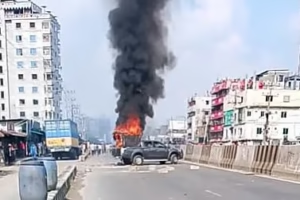
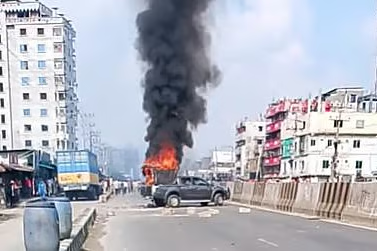
Concurrently, violence erupted in Gazipur’s Kaliakair zone. Disgruntled workers from Karony Knit Composite, Knit Asia, and adjacent factories abstained from work after punching their attendance, assembling instead along the Dhaka–Tangail highway at Sofipur Bazaar. In the Chandra Palli Bidyut area, unidentified crowds set fire to a pickup van and a scrap fabric (jhut) warehouse belonging to Tropical Garments. Firefighters were initially prevented from reaching the blazes due to barricaded roads. Md Torikul Islam, Station Officer at Kaliakair Fire Service, stated that his team faced severe obstruction while attempting to respond. Gazipur Industrial Police Superintendent Amjad Hossain acknowledged that at least 30 factories in his jurisdiction were forced to declare a day off as security forces struggled to contain the spillover.
The escalating unrest highlights a growing communication breakdown between factory management and the workforce. Khairul Mamun Sengupta, Legal Affairs Secretary of the Bangladesh Garment and Sweaters Workers Trade Union Centre, voiced concern over the lack of dialogue. He noted that workers remaining inside halted factories were left entirely in the dark regarding whether owners would entertain their demands. This lack of transparency, he warned, directly fuelled frustration, driving workers onto the highways to rally broader support.
To temper rising hostility, Industrial Police deployed patrolling vehicles equipped with megaphones throughout the manufacturing corridors. Officers broadcast reassurances, appealing for peace while affirming that law enforcement remains committed to safeguarding the legitimate rights and safety of the working class.
Bangladesh’s RMG sector, which accounts for over 80 per cent of the country’s total export earnings and employs nearly four million workers, frequently faces labour strain over wage structures and inflation adjustments. As factory owners work alongside government officials to restore stability, union representatives continue to urge immediate, high-level discussions with worker delegates to address the economic grievances before the disruption spreads further across the national supply chain.