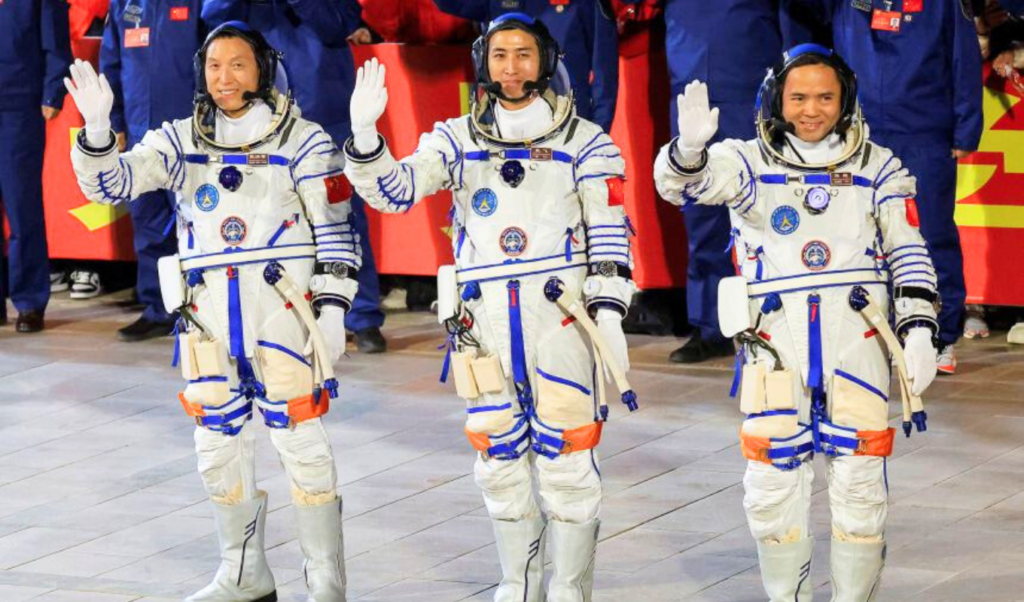
A crew of three Chinese astronauts, including the country’s youngest ever, docked early on Saturday at the Tiangong space station, accompanied by four laboratory mice.
The Shenzhou-21 spacecraft docked at 3:22 am local time (1922 GMT Friday), according to China’s state news agency Xinhua.
This was approximately three and a half hours after the spacecraft lifted off from the Jiuquan Satellite Launch Center in north-west China, propelled by a Long March-2F rocket.
The Tiangong space station, which is continuously crewed by teams of three astronauts rotated every six months, is the crown jewel of China’s space programme. Billions of dollars have been invested in a bid to catch up with the United States and Russia in human spaceflight.
China has ambitious plans to launch a crewed mission to the Moon by the end of the decade, with the eventual goal of establishing a lunar base.
Mission commander and veteran astronaut Zhang Lu is accompanied by 32-year-old flight engineer Wu Fei, China’s youngest astronaut to undertake a space mission, and payload specialist Zhang Hongzhang, 39.
The trio bid farewell to colleagues and family at the remote launch site in the Gobi Desert, while a band played a patriotic song.
Zhang Lu told reporters on Thursday that he was confident his team would “report back to our motherland and its people with complete success”.
Space rookie Wu described himself as feeling “incomparably lucky” during a news conference on Thursday.
Four mice—two male and two female—have been brought along as the subjects of China’s first in-orbit experiments on rodents.
Beijing’s space programme is the third in the world to send humans into orbit, following the United States and the former Soviet Union.
China has accelerated its pursuit of its so-called “space dream” under President Xi Jinping, having successfully landed its Chang’e-4 probe on the far side of the Moon in 2019, the first spacecraft to achieve this feat.
In 2021, China also landed a small robot on Mars, further demonstrating its growing capabilities in space exploration.
On Thursday, the China Manned Space Agency (CMSA) outlined a series of “crucial upcoming tests” in preparation for its 2030 Moon mission goal.
In addition to advancing scientific research, the Shenzhou-21 crew is expected to conduct spacewalks and install anti-debris shields on the exterior of the Tiangong station.
The astronauts will also engage in “popular science education”, according to the CMSA, as Beijing seeks to cultivate future space talent both domestically and internationally.
Since 2011, China has been excluded from the International Space Station after the United States prohibited NASA from collaborating with Beijing.
In response, China has pursued partnerships with other countries, signing an agreement with longstanding ally Pakistan in February to recruit the first foreign “taikonauts”.