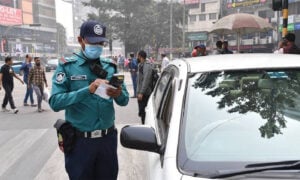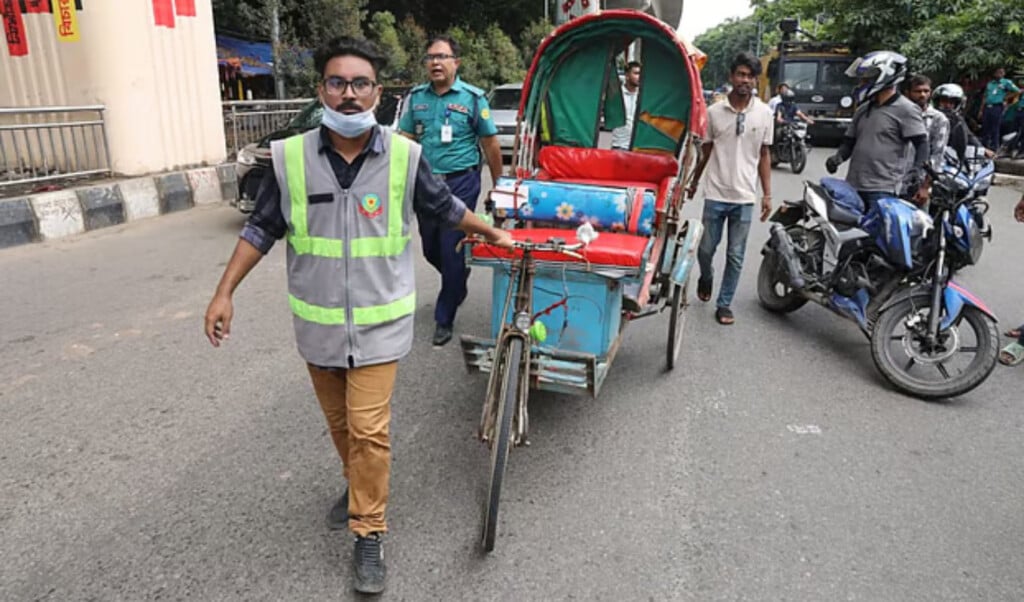
It is 5:30 pm. At the Karwan Bazar intersection in Dhaka, two young traffic assistants run to stop auto-rickshaws and then rush toward oncoming cars. They are trying to restore some order on Dhaka’s chaotic roads, accompanied by a traffic police officer. After the political changes on August 5, 2024, traffic management faced instability. At that time, students volunteered to assist in traffic control. Later, the interim government and Dhaka Metropolitan Police (DMP) jointly appointed students as part-time traffic assistants from December last year.
Part-Time Job, Uncertain Benefits
Students earn 500 taka for a four-hour daily duty. Although payment is scheduled by the 7th of each month, delays are common. Many did not receive their salaries in June and July. Students who left tuition jobs to participate are now under financial pressure. Muhammad Mian, a student of Sonargaon University, said, “Managing traffic in this city is very challenging. One has to stay alert every second. We are not only enforcing the law but also bridging gaps between the police and the public. Controlling auto-rickshaws is the toughest part.” Students received only a week of training and a vest before starting duty. ID cards have not yet been issued. Many joined hoping to gain experience certificates for future employment. However, irregular pay, lack of security, and limited recognition have caused frustration among them.
Responsibility and Challenges
Traffic management work is both exhausting and dangerous. Students endure physical strain due to traffic congestion, sun, dust, and heat. A student on duty at Shahbagh said, “After August 5, when everyone was volunteering, people applauded. Now that respect is gone. Pressure from influential people and safety risks have increased.” Female traffic assistants face even more challenges. A student named Anisha said, “Some look at us with contempt and ask why a girl is responsible for traffic.” She believes female participation adds humanity to traffic management, but societal perceptions remain a barrier.
Health Risks and Educational Disruption
Four-hour duties often extend longer, affecting study, rest, and personal time. Exposure to dust, smoke, and noise pollution has led to dust allergies, back pain, and mental stress. Former traffic assistant Abid Hasan said, “Initially, it was fine. After a month, I developed dust allergies and headaches, which affected my studies, so I quit the job.”
DMP: Traffic Assistants Are Necessary
Currently, about 870 students work as traffic assistants in Dhaka. DMP Joint Commissioner (Traffic) Md. Anichur Rahman said, “Traffic assistants help our work. Keeping them in service is essential. They also raise public awareness and build trust in traffic police. Despite some issues, we are trying to resolve ID card and salary problems quickly.”
Need for University-Based Part-Time Jobs
Experts believe students would benefit more from part-time jobs within universities or colleges. Masud Imran, Professor of Archaeology at Jahangirnagar University, said, “Opportunities as research assistants, teaching assistants, or library and IT jobs would allow students to work safely while gaining practical experience alongside financial benefits.”
Although students’ contributions to Dhaka’s traffic management are commendable, questions remain about the stability and safety of their part-time employment. Fatigue, health risks, uncertainty, and delayed salaries have left many students wondering whether the job truly helps or adds new pressure.
Khaborwala/TSN