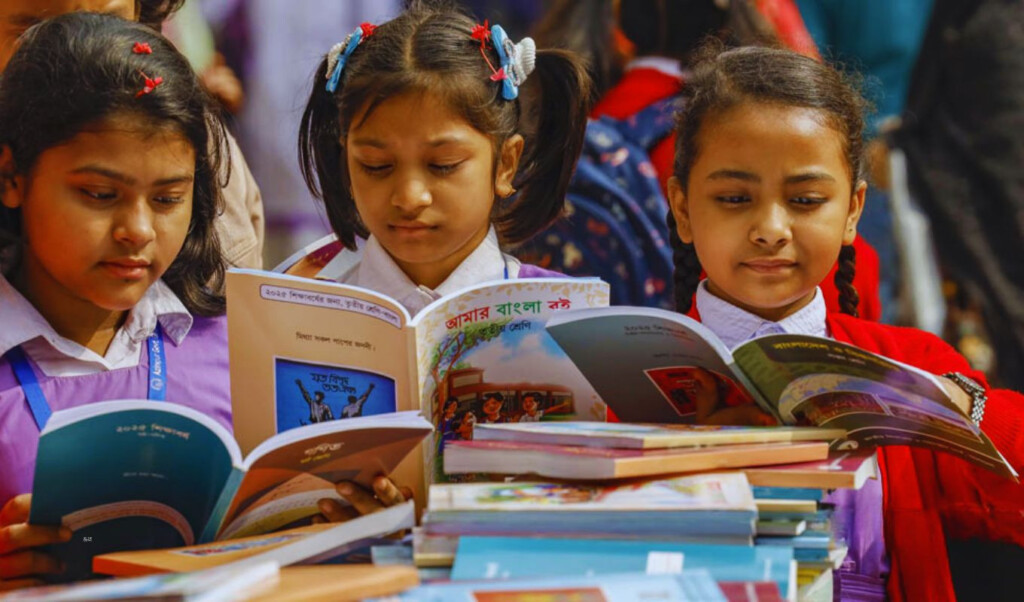
Despite year-long preparations, uncertainty looms over the timely distribution of textbooks to students. For the 2026 academic year, approximately 350 million textbooks are to be printed, including 219 million for secondary level. Among them, around 65 million are for ninth grade. The National Curriculum and Textbook Board (NCTB) had aimed to complete printing by October, but so far only 2 million ninth-grade books have been printed, while printing for grades six to eight—totaling 145 million books—has not yet begun. As a result, more than one crore students may not receive all their textbooks before March, two months into the new academic year.
Last year, delays were attributed to political turmoil, but this time, no one is willing to take responsibility. Press owners blame NCTB officials’ negligence, while NCTB officials accuse the Ministry of Education of withholding approval for printing orders. They claim the ministry canceled tenders for grades six to eight without explanation, causing the delay. However, an official from the Secondary and Higher Education Division said the re-tendering was done to break a long-standing syndicate. Insiders argue that the syndicate remains intact, and the re-tender process only worsened chaos—many presses took printing jobs at unusually low rates, leading to poor-quality paper use.
Reports reveal that while the government’s budget per printing form was Tk 3.15, some presses quoted between Tk 1.80 and Tk 2.09 per form through syndicate manipulation. Allegations suggest that a syndicate led by Rabbani Jabbar (owner of Ananda Printers) and Md. Kabir (owner of Master Cimex Paper Ltd.) was behind this. Their use of substandard paper had also been exposed in previous textbook quality inspections.
Currently, 103 printing presses are involved in printing primary and secondary books, with Rabbani and Kabir’s firms securing over half of the contracts for grades six to eight.
The NCTB began preparations in April to distribute free textbooks at the beginning of the year. Tenders were floated between May and July, targeting completion by October. However, in September, the government’s purchase committee withheld approval, canceling the tenders. Re-tendering delayed the process by another two and a half months. Approval for ninth-grade printing orders was also delayed, and the Notification of Award (NoA) was issued on October 27, giving presses 28 days for contract completion. Printing is unlikely to start before December, and with a 70-day printing period, books may not be ready before February. The NoA for grades six to eight was issued only recently, and printing cannot begin until the contracting process is finalized.
Many attribute this crisis to internal disorder within NCTB. Allegations suggest that officials loyal to the previous government still hold key positions. In a statement, the student wing of a political party demanded the removal of Dr. Riad Chowdhury (Textbook Member) and Acting Chairman Rabiul Kabir Chowdhury, accusing them of protecting the syndicate’s interests.
Despite NCTB supervision, nearly 30 percent of primary textbooks were reportedly printed on substandard paper. Private third-party inspection firms oversee quality control—Infinity Survey and Inspection (BD), owned by Md. Monir, serves as the Pre-Distribution Agent (PDI). He has been accused of extorting money from press owners, allegedly demanding Tk 3 to 10 lakh to certify poor-quality paper as acceptable. One printing official claimed they paid Tk 2 lakh and were asked for Tk 5 lakh more, with approval withheld until payment.
In response, Md. Monir of Infinity Survey and Inspection (BD) stated that several press owners tried to “manage” him, but he refused any offers and assured that there was no compromise on paper quality.
Khaborwala/TSN