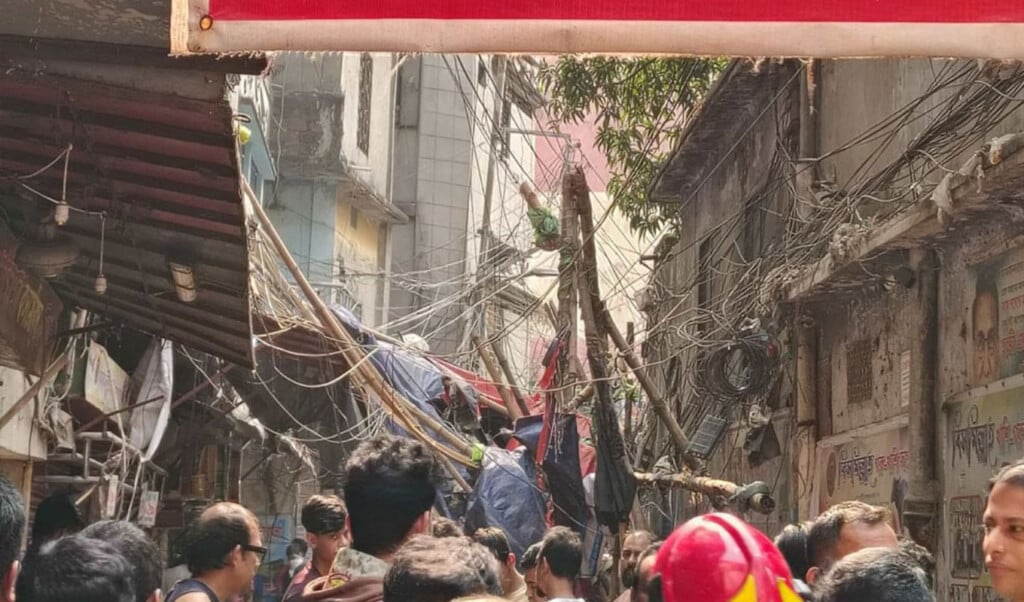
Many buildings in Old Dhaka, Sylhet and Chattogram face the terrifying risk of collapsing into rubble in the event of a major earthquake. In Dhaka alone, six lakh buildings are considered at the highest risk, most of which are located in Old Dhaka. Sylhet also remains one of the country’s most earthquake-prone areas due to the neighbouring Dauki Fault and frequent locally originated tremors. Even a 5.7-magnitude earthquake could turn many of Sylhet’s old buildings into rubble. Similarly, out of 382,111 buildings in Chattogram city, 70 to 75 percent are at risk of collapsing during a strong earthquake.
Experts fear that the region may experience an earthquake ranging from 8.2 to 9 on the Richter scale. The capital is considered the most vulnerable due to its dense population, unplanned urbanisation, violations of building codes, narrow infrastructure and a lack of adequate preparedness.
As a result, even moderate to strong earthquakes could cause massive destruction. Professor Mehedi Ahmed Ansary of the Civil Engineering Department at BUET, who is also an earthquake researcher, stated that ignoring building codes during construction naturally increases the extent of damage. He emphasised the urgent need to identify risky buildings and take action. He warned that unplanned construction in major cities such as Dhaka and Chattogram is heightening the danger.
A correspondent from Sylhet reported that the region has been shaking repeatedly due to frequent earthquakes. Some originate from the Dauki Fault in India’s Meghalaya, while others occur at different locations within Sylhet division. Experts explain that previously inactive local faults have become active, increasing seismic events. As Sylhet lies in a high-risk earthquake zone, the danger is rising further. Experts believe that if the earthquake felt in Dhaka last Friday had struck Sylhet, old buildings would likely have collapsed. Sylhet’s geological structure makes it one of the most vulnerable regions in the country. The Dauki Fault, which caused the devastating “Great Earthquake” of 12 June 1897, had destroyed much of the greater Sylhet region. Though subsequent earthquakes from the fault caused limited damage, it continues to indicate the likelihood of major seismic events.
In May 2021, Sylhet experienced 20 earthquakes in 10 days. Several originated near the Dauki Fault, while the rest originated within Sylhet division. At that time, 22 buildings were declared risky. Professor Dr Zahid Bin Alam of Shahjalal University of Science and Technology considers Dhaka’s recent earthquake a warning sign for Sylhet. He noted that the 5.7-magnitude quake originated from the long-inactive “Madhupur Fault Line,” which has now become active. According to him, a similar 5.7-magnitude earthquake in Sylhet could cause old and non-engineered buildings to collapse. He further said Sylhet has only 30 to 40 percent capacity to deal with a major disaster. The city’s suburban residential areas were developed on filled wetlands and contain many high-rise structures, making them highly vulnerable during a strong earthquake.
From Chattogram, it was reported that the city currently has 382,111 buildings, 70 to 75 percent of which are at risk of earthquake damage. A 7.5 to 8-magnitude earthquake could cause widespread destruction as Chattogram is one of the most earthquake-prone regions in the country. Most buildings lack earthquake-resistant features.
According to Chattogram Development Authority (CDA), the city has 278,005 single-storey buildings, 90,444 two-to-five-storey buildings, 13,135 six-to-ten-storey buildings, 527 buildings above ten storeys and 10 buildings over 20 storeys. Educational institutions, hospitals and clinics are among the most vulnerable. Rescue operations would be extremely difficult due to the absence of necessary equipment and the presence of narrow lanes that cannot accommodate rescue vehicles or ambulances.
On 13 April 2016, a 6.99-magnitude earthquake caused 12 buildings to tilt in Chattogram. On 21 November 1997, a 6.1-magnitude quake caused a five-storey building to collapse, resulting in casualties. CDA’s supervising engineer Kazi Hasan Bin Shams said that as Chattogram is an earthquake-prone region, 70 to 75 percent of its buildings could be damaged in a major quake. Earthquake expert Professor Dr Mohammad Jahangir Alam, former vice chancellor of Chittagong University of Engineering and Technology, said that all three major earthquake sources lie close to Chattogram. Therefore, a 7.5 or stronger earthquake could destroy 75 percent of the city’s buildings and also damage major installations such as the port, Eastern Refinery, Cox’s Bazar and Matarbari. He added that most buildings in the city were constructed without complying with building codes and lack earthquake-resistant measures.
Khaborwala/TSN