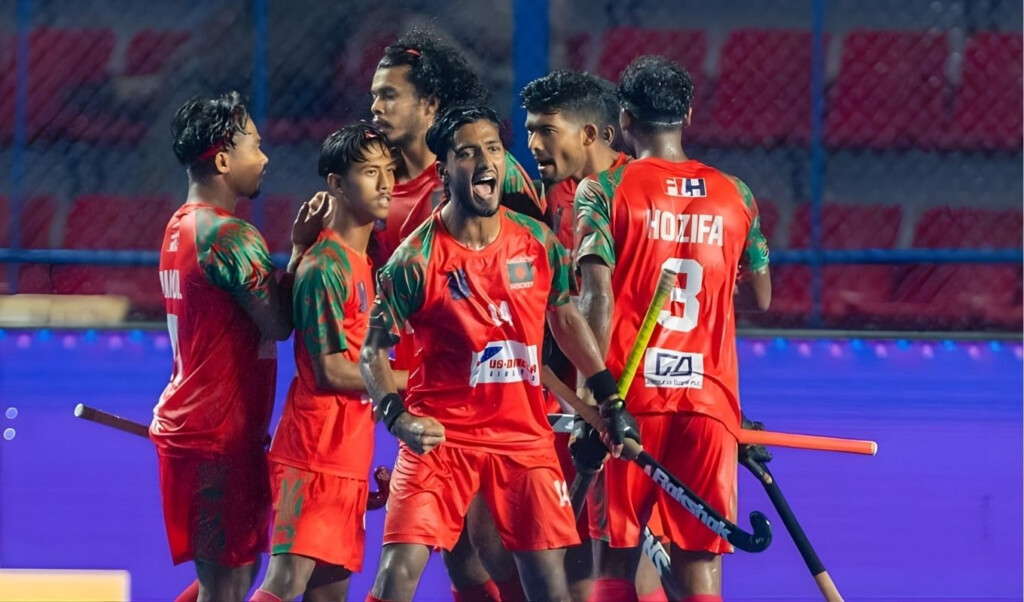
Bangladesh hockey fans might remember this date for years to come: the day their junior national team claimed a sensational 13–0 win against Oman and introduced a true rising talent to the global hockey stage. That talent is Amirul Islam, whose exceptional five-goal performance not only propelled his team to victory but also turned him into one of the most talked-about names at the Junior Hockey World Cup.
Amirul’s performance stood out not simply for the number of goals but for the efficiency with which they came. Demonstrating calm precision, flawless technique, and devastating power in his drag flicks, the youngster converted key penalty corners just when Bangladesh needed control and momentum. His three early strikes in the opening quarter broke Oman’s confidence almost instantly, dismantling any early hopes they had of competing evenly.
However, as impressive as Amirul’s individual brilliance was, Bangladesh’s overall team cohesion deserves equal recognition. Midfield transitions were smooth, defenders maintained discipline, and the forward line displayed creativity, passing accuracy, and aggressive movement. Rakibul Hasan’s hat-trick highlighted the team’s attacking diversity, with his field goals showcasing clever positioning and swift reactions.
Bangladesh’s dominance continued in the third quarter, where Mohammad Abdullah added to the tally alongside Obaidul Hasan. In the final period, Bangladesh refused to slow down, scoring five more goals through Abdullah, Saju, Rakibul, and the unstoppable Amirul. Oman simply watched as Bangladesh played one of the most relentless attacking games seen in this tournament phase.
Yet, beyond the celebration of goals lies a deeper significance. Bangladesh’s hockey scene has often struggled for global recognition despite having dedicated talent pools. With this victory, the U-21 side signalled a transformation in mindset and ambition. Their group-stage resilience—drawing against South Korea and narrowly losing to stronger hockey nations like Australia and France—suggested progress, but this emphatic win solidifies that belief.
Oman, on the other hand, have endured a difficult debut tournament, conceding heavily and struggling to create scoring opportunities. While their defensive discipline needs improvement, the lack of offensive creativity has proved far more costly, leaving them isolated and vulnerable.
For Bangladesh, the road ahead presents a moment of possibility. They now stand in the placement semi-final, with the potential to finish as high as 17th. Whether they achieve it or not, this win serves as a declaration: Bangladesh are no longer spectators at the world stage—they are competitors with intent.