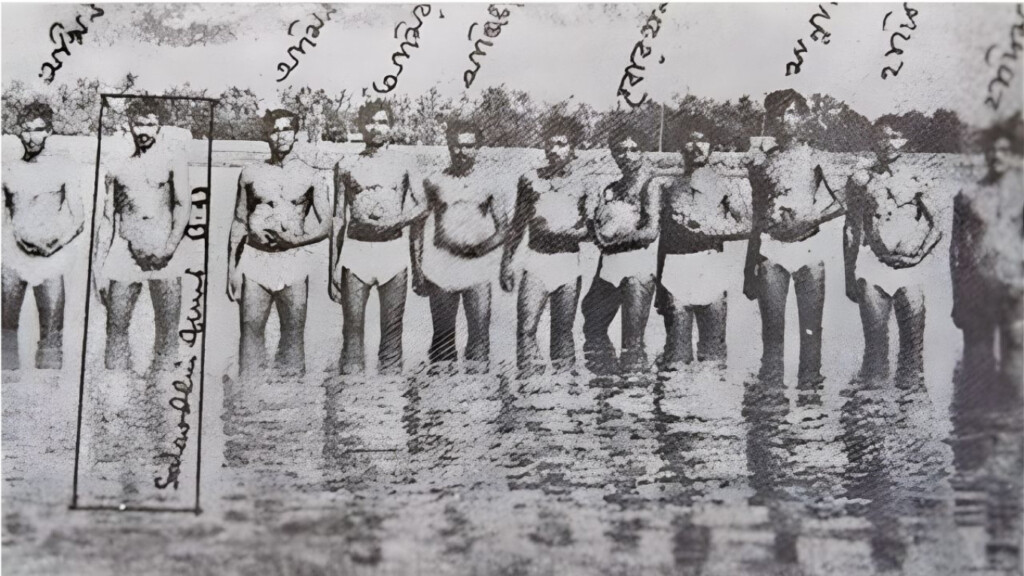
The victory of Bangladesh in the 1971 Liberation War was significantly accelerated by the daring exploits of the Naval Commandos. Operations such as ‘Jackpot’ and ‘Hotpants’ effectively crippled the maritime logistics and naval strength of the Pakistani occupation forces. The genesis of these elite underwater saboteurs lies on the historic banks of the Baghirathi River in Murshidabad, West Bengal—the very site of the Battle of Plassey, where Bengal’s independence had been lost centuries earlier in 1757.
The recruitment process was rigorous. A team of three Indian Navy officers scoured various Mukti Bahini camps, initially selecting 480 freedom fighters. On 11 June 1971, Tajuddin Ahmad, the Prime Minister of the Mujibnagar Government, accompanied by General M.A.G. Osmani, visited the training site to address the recruits. His speech was stark and uncompromising: “The success of the naval operations will determine the duration of this war. Being a naval commando means joining a Suicide Squad; it implies a one-hundred-per-cent chance of death.”
Faced with the reality of certain death, the initial selection pool thinned drastically. Out of the 480 men, 345 chose to withdraw and were sent back to their original camps. The remaining 135 volunteers formed the core of what would become a legendary fighting force. This camp, designated ‘C2P’ (Camp Palashi), was commanded by Lieutenant Commander G.M. Martis of the Indian Navy, assisted by training officers Lieutenant A.K. Das and Lieutenant Kapil.
Core Leadership: The Submariner Defectors
A pivotal moment for the force was the arrival of eight Bengali submariners who had defected from the Pakistani submarine PNS Mangro while training in Toulon, France. Risking execution for desertion, they escaped to India via Madrid to lead the nascent commando unit.
| Name of Submariner | Role/Impact |
|---|---|
| Abdul Wahed Chowdhury | Team Leader of the defectors; later commanded the Padma sector. |
| Abdur Rakib Miah | Essential technical expert in underwater demolition. |
| Syed Mosharraf Hossain | Provided critical tactical knowledge of Pakistani naval assets. |
| Mohammad Rahmatullah | Specialist in high-intensity underwater explosives. |
| Ahsanullah | Key instructor for deep-water endurance training. |
| Aminullah Shekh | Expert in covert navigation and currents. |
| Abdur Rahman | Vital strategist for harbour infiltrations. |
| Badiul Alam | Leading figure in the Moongla Port operations. |
Rigorous Training and Silent Warfare
The recruits were primarily students from Dhaka University’s Iqbal and Jagannath Halls, alongside youths from Chittagong, Sylhet, and Khulna. Accustomed to the powerful currents of East Bengal’s rivers, they possessed extraordinary swimming endurance. Their training schedule was brutal, often lasting 18 hours a day. They practiced swimming for miles in pitch darkness, often using hollowed-out bamboo or papaya stalks as makeshift snorkels to remain submerged.
The daily routine began at dawn with PT and wrestling, followed by the national anthem and a solemn oath at 8:00 am. By 9:00 am, they were in the Baghirathi. For the first hour, they were forbidden from touching the riverbed. They spent hours in neck-deep water, drinking only glucose water for sustenance, before continuing deep-water drills until midday. Combat judo and evening swimming sessions followed, with the training designed to ensure they could attach limpet mines to enemy vessels and retreat to a safe distance before detonation.
Many commandos signed a voluntary “bond paper” stating that the state was not responsible for their deaths. They swam through monsoon floods, dodging venomous snakes and the bodies of war victims floating downstream. This “Suicide Squad” eventually successfully attacked four major ports—Chittagong, Khulna, Moongla, and Narayanganj—simultaneously, delivering a psychological and strategic blow from which the Pakistani Navy never recovered.