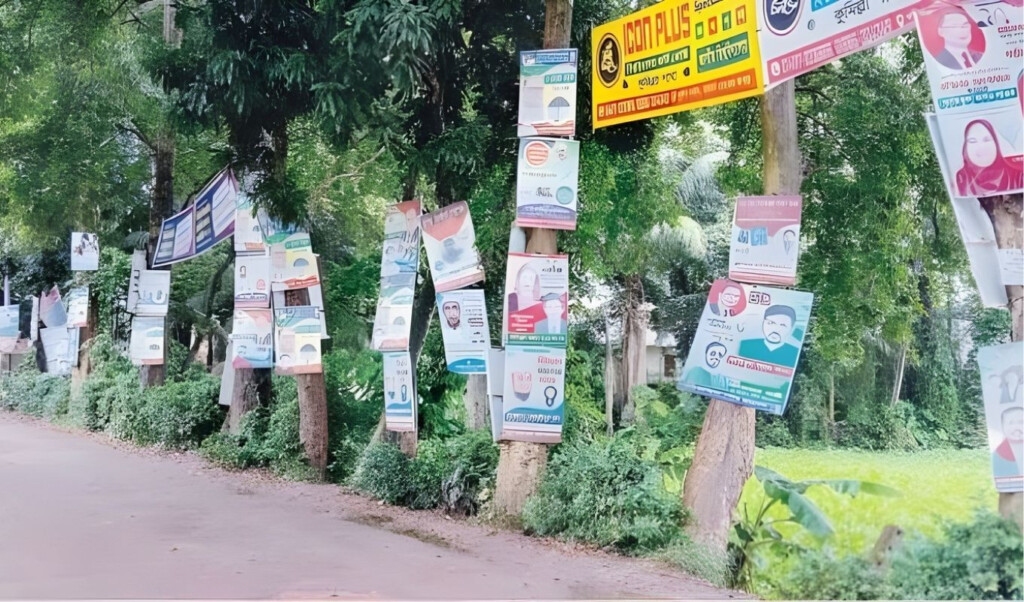
The President of Bangladesh has promulgated the Forest and Tree Conservation Ordinance, 2026, introducing strict penalties for individuals who damage trees using nails or other metallic objects. Under the new ordinance, offenders may face a fine of up to 20,000 Taka.
The official gazette for the ordinance was issued on Tuesday, 6 January 2026, by the Legislative and Parliamentary Affairs Division of the Ministry of Law. The legislation specifically prohibits harming trees through nails or other metallic tools, except for commercial production purposes.
Key Provisions of the Ordinance
| Offence / Activity | Maximum Penalty | Additional Conditions |
|---|---|---|
| Damaging a tree with nails or metal objects (non-commercial) | 20,000 Taka | — |
| Cutting trees listed as protected or declared endangered by the Forest Department | 100,000 Taka | Compulsory compensatory reforestation may apply |
| Cutting trees requiring prior approval but violating procedure | 50,000 Taka | — |
| Organisations committing tree damage through representatives | 300,000 Taka | Responsible director/officer personally liable |
The ordinance also clarifies the rules for tree felling and forest management:
Trees within gazetted forests, unclassified state forests, social forests, government or autonomous institutions, educational institutions, and public spaces may only be felled with prior approval from the designated Tree Conservation Officer under the Forest Act, 1927.
Applications to cut trees must include details of species, number, estimated height, girth at breast height, and the reason for felling. Decisions are to be issued in writing within 30 days of inspection.
In the Chittagong Hill Tracts, the ordinance defers to Rule 41 of the Chittagong Hill Tracts Regulation, 1990.
The ordinance introduces clear guidelines for surveying and recording forest lands. All gazetted forests, regardless of canopy coverage, will be recorded under the Forest Department, while protected and acquired forests will remain registered under district administrators. Any partial or adjacent government land must involve joint surveys before allocation.
Provisions also allow conditional land swaps for industrial development: isolated forest patches under one acre may be exchanged for double the area of adjacent non-forest land, which will then be declared protected forest.
Exceptions to the ordinance include:
Dead, diseased, fallen, or storm-damaged trees
Trees obstructing roadways
Threatening trees requiring immediate removal
Finally, the Forest Department has been tasked with promoting awareness of the prohibition against harming trees, while lists of protected and permission-required species will be published in the gazette within three months of the ordinance taking effect.