Saturday, 22nd August 2026

Khabor Wala Desk
Published: 26th January 2026, 10:28 AM
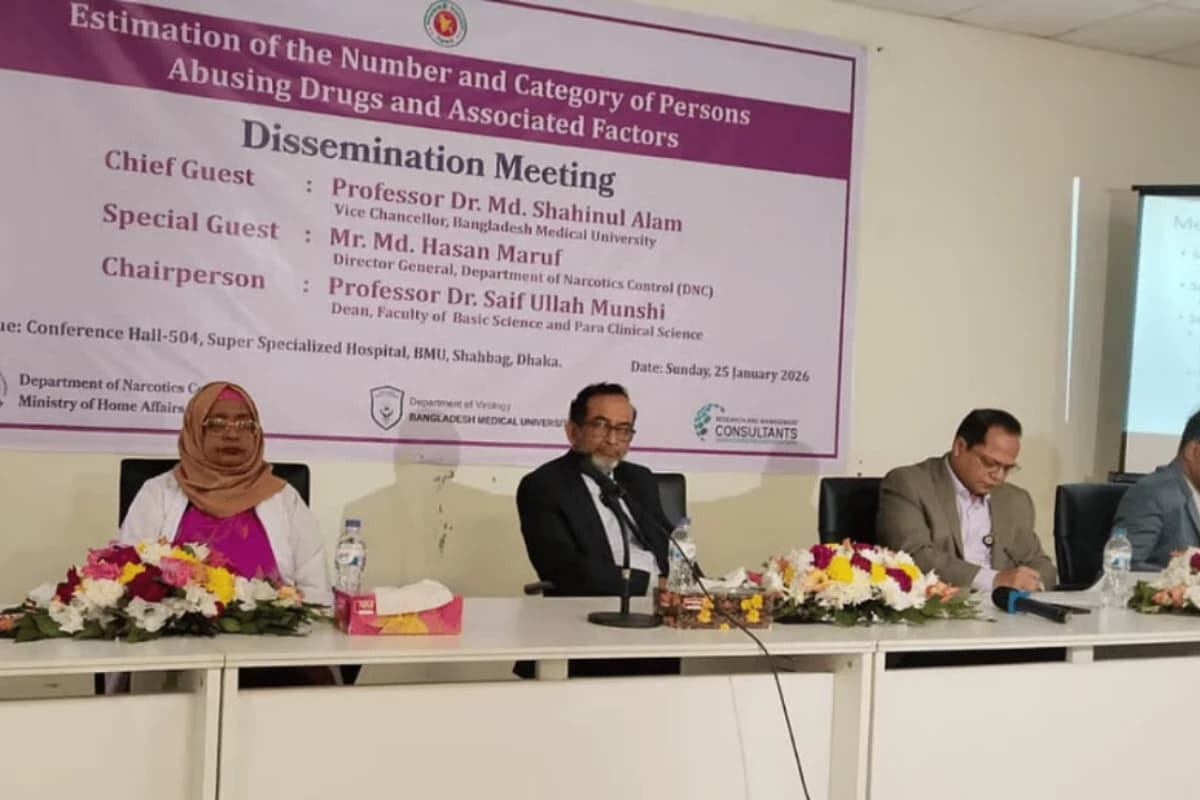
Bangladesh is confronting a growing public health and social crisis as drug use becomes increasingly visible across the country. A recent national study reveals that approximately 8.195 million people, or 4.88 per cent of the population, currently consume some form of illicit drug. Among these, cannabis (marijuana) is the most widely used substance, with around 6.08 million users.
The findings were presented on Sunday, 25 January, at an event organised by Bangladesh Medical University (BMU). The study was conducted under the supervision of the Department of Narcotics Control (DNC) and implemented jointly by BMU and Research and Management Consultants Limited (RMCL). Data collection spanned from February to June 2025, covering eight divisions, 13 districts, and 26 upazilas using the Network Scale-Up Method.
| Division | Prevalence Rate (%) | Estimated Users (millions) |
|---|---|---|
| Dhaka | 5.6 | 2.29 |
| Chattogram | 5.5 | 1.88 |
| Rangpur | 6.0 | 1.08 |
| Mymensingh | 6.02 | 0.735 |
| Khulna | 4.08 | 0.46 |
| Rajshahi | 2.72 | 0.24 |
| Barishal | 4.2 | 0.31 |
| Sylhet | 4.5 | 0.301 |
| Substance | Estimated Users (millions) |
|---|---|
| Cannabis (Marijuana) | 6.08 |
| Methamphetamine / Yaba | 2.3 |
| Alcohol | 2.0 |
| Codeine-based cough syrup | Data not specified |
| Sleeping pills | Data not specified |
| Heroin | Data not specified |
| Injection-based drug users | 0.039 |
The study also highlights worrying patterns of consumption. Injection-based drug users are particularly vulnerable to infectious diseases such as HIV and hepatitis. On average, each drug user spends around BDT 6,000 per month on substances and often consumes multiple types.
Age-wise analysis indicates that 33 per cent of users first tried drugs between 8–17 years, while 59 per cent started between 18–25 years. Key risk factors identified include unemployment, peer pressure, financial uncertainty, family instability, mental stress, and informal employment. Alarmingly, 90 per cent of respondents reported easy access to drugs.
Despite the scale of the crisis, access to treatment and rehabilitation remains limited. Only 13 per cent of users have ever received formal treatment or rehabilitation. Users themselves identified rehabilitation (69 per cent), counselling (62 per cent), and employment support (41 per cent) as critical needs.
BMU Vice-Chancellor Professor Dr. Md. Shahinul Alam emphasised: “Drug users are not ‘others’; we and our children are also at risk. Collective action is essential to confront this threat.”
DNC Director-General Md. Hasan Maruf added: “Drug prevention must start within families. A project to establish 200-bed rehabilitation centres in seven divisions outside Dhaka has already been approved.”
Researchers stress that addressing the drug problem requires more than law enforcement. A comprehensive approach involving prevention, treatment, rehabilitation, mental health services, and social reintegration is essential to curb the rising crisis.


Comments