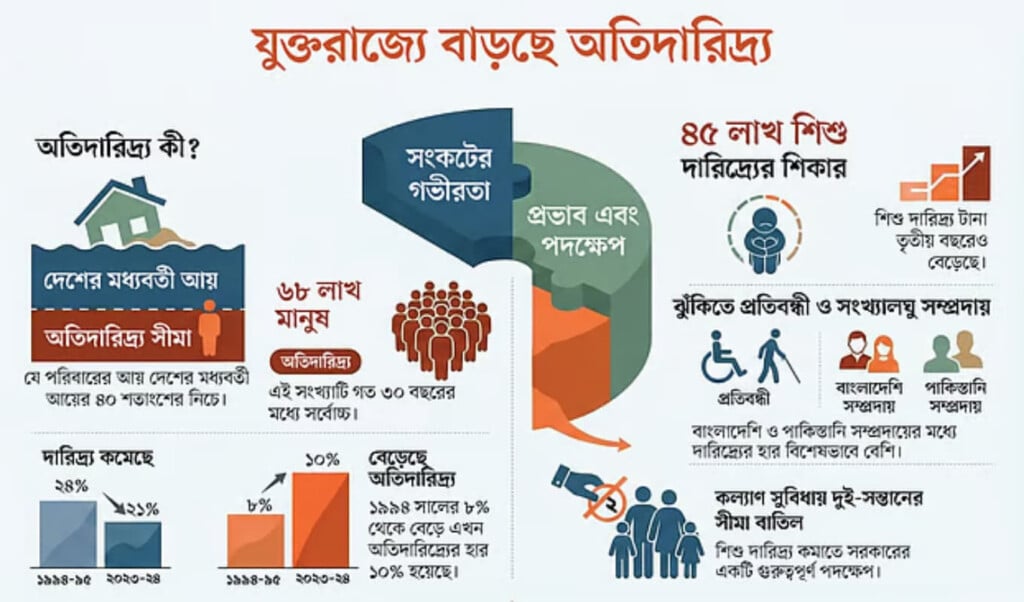
Severe poverty in the United Kingdom has climbed to its highest level in three decades, underscoring deepening social and economic strains despite modest improvements in headline poverty rates. According to a recent study by the independent anti-poverty charity the Joseph Rowntree Foundation (JRF), around 6.8 million people are now living in what researchers classify as “very deep poverty”, a level of deprivation marked by acute financial insecurity and sustained hardship.
The JRF defines extreme poverty as a situation in which a household’s income, after housing and rent costs, falls below 40 per cent of the national median income. By way of illustration, a couple with two dependent children earning less than approximately £16,400 a year would fall beneath this threshold. Life below this line typically entails an inability to afford basic necessities, limited access to healthcare and education, and virtually no resilience against sudden financial shocks such as illness, job loss or unexpected bills.
While the overall poverty rate in Britain has declined slightly over the long term, the proportion of people trapped in the most severe forms of poverty has increased. In the mid-1990s, total poverty affected roughly 24 per cent of the population. By 2023–24, this figure had fallen to 21 per cent. Over the same period, however, the share of people living in extreme poverty rose from 8 per cent to 10 per cent. This means that nearly half of those officially classed as poor are now experiencing the harshest levels of deprivation.
Key poverty indicators in the UK
| Indicator | 1994–95 | 2023–24 |
|---|---|---|
| Overall poverty rate | 24% | 21% |
| Extreme poverty rate | 8% | 10% |
| People in extreme poverty | — | 6.8 million |
| Children living in poverty | — | 4.5 million |
One of the most troubling findings of the report is the sustained rise in child poverty. An estimated 4.5 million children are currently living below the poverty line, with the figure increasing for a third consecutive year. This trend has intensified political pressure on the government to act.
In response, Chancellor of the Exchequer Rachel Reeves has announced that the long-standing two-child limit on certain welfare benefits will be abolished from April. The policy, introduced in 2017 by a previous government, restricted additional financial support for families with a third or subsequent child. Critics have long argued that it disproportionately harmed low-income and larger families, pushing many deeper into poverty. Removing the cap is expected to raise household incomes for thousands of families and contribute to a reduction in child poverty, although it is projected to cost the Treasury around £3.1 billion.
The Joseph Rowntree Foundation has welcomed the decision but cautioned that it must form part of a broader programme of long-term structural reform. Without sustained policy action, the charity warns, progress on reducing child poverty could stall or even reverse. The report also highlights that children, disabled people, and individuals from Bangladeshi and Pakistani backgrounds face a particularly high risk of extreme poverty.
Social analysts stress that the rise in deep poverty represents not only a humanitarian crisis but also a serious threat to Britain’s future social cohesion and economic stability. Addressing it, they argue, will require coordinated action on incomes, housing, employment and social security, rather than short-term fixes alone.