Ahead of the upcoming national elections, the Ganasakkharta Abhiyan (Mass Literacy Campaign) has outlined a comprehensive set of expectations for the future government, emphasising immediate and long-term reforms in the education sector. Key demands include the formation of a dedicated education taskforce to implement a five-year strategic plan, allocating at least 20% of the national budget or 4–6% of GDP to education, raising monthly student stipends to a minimum of 500 BDT, and consolidating all levels of education under a single ministry.
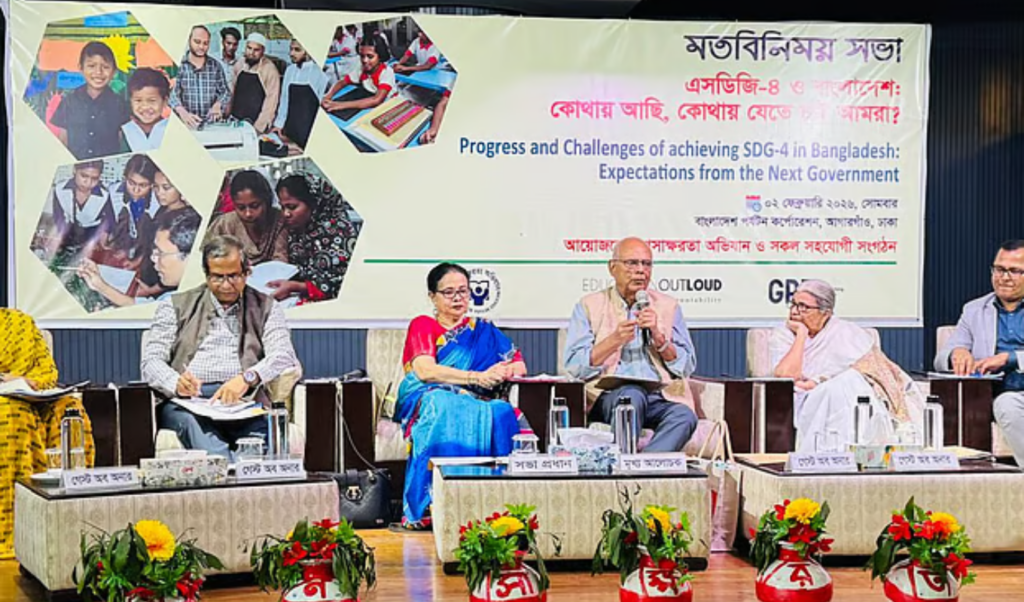
The recommendations were presented at an event in Agargaon, Dhaka, on Monday, titled “SDG-4 and Bangladesh: Where We Are, Where We Aim to Go.” The event assessed the current status of Sustainable Development Goal 4 (quality education) implementation in the country, highlighting both achievements and ongoing challenges.
The session was chaired by Rasheda K. Chowdhury, Executive Director of Ganasakkharta Abhiyan. The keynote speaker, Professor Manzur Ahmed, Emeritus Professor at BRAC University and Chair of the Advisory Committee on Primary, Non-formal, and Secondary Education, stressed the importance of a taskforce composed of experienced and committed professionals.
Professor Ahmed stated, “There is a justified demand for a permanent Education Commission. Legislation should formalise this body. If a taskforce is initiated now, it could evolve into a permanent commission over time. Education policy must be holistic rather than fragmented and should incorporate decentralised approaches. Universalising secondary education should be a phased priority.” He further lamented that despite advisory reports being submitted nearly a year ago, little substantive action has been taken to implement their recommendations.
Abdur Rouf, Programme Manager at Ganasakkharta Abhiyan, presented a detailed analysis of the sector. He noted that primary school dropout rates have risen to 16.25% in 2024, up from 13.15% in 2023, while secondary school dropout rates remain high at 35.40%, indicating persistent systemic challenges.
Dropout Rates by Education Level
| Education Level | Dropout Rate (%) | Change from Previous Year | Comment |
|---|---|---|---|
| Primary | 16.25 | +3.10 | Slight increase, action required |
| Secondary | 35.40 | – | High; urgent policy intervention |
| Tertiary | Data unavailable | – | Needs policy and funding focus |
The event also featured insights from prominent figures including Khandakar Golam Moazzem (Director of Research, Centre for Policy Dialogue), Fauzia Moslem (President, Bangladesh Mahila Parishad), Mohammad Golam Kibria (Co-chair, Education Local Consultative Group), Nahreen Ahmed (Overseas Physician), and Tapan Kumar Das (Deputy Director, Ganasakkharta Abhiyan). Additionally, representatives from civil society organisations and students from across the country shared their perspectives and recommendations.
The campaign emphasised that immediate, medium-term, and long-term interventions are crucial for improving educational outcomes and meeting SDG-4 targets. The overarching call was for a strategic, well-funded, and coordinated approach to ensure inclusive, equitable, and quality education for all Bangladeshi children and youth.