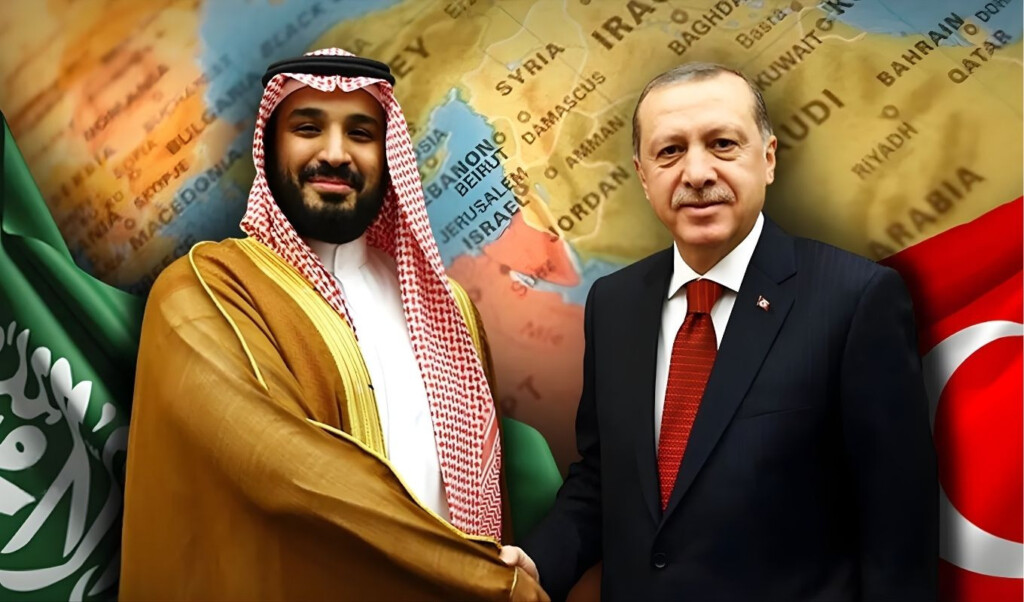
In a rapidly shifting Middle Eastern landscape, Saudi Arabia and Turkey are moving decisively to repair and deepen their once-strained relationship. The recent visit to Riyadh by Turkish President Recep Tayyip Erdoğan signals more than diplomatic courtesy; it points towards the emergence of a renewed strategic partnership between two of the region’s most influential powers.
Analysts argue that Saudi Crown Prince Mohammed bin Salman is seeking reliable regional allies as Riyadh recalibrates its foreign policy. Saudi Arabia’s re-engagement comes after a period of relative caution following the 2018 killing of journalist Jamal Khashoggi, an episode that strained the Kingdom’s international standing and complicated its ties with Ankara in particular.
During the intervening years, Riyadh focused heavily on domestic reforms and economic diversification under Vision 2030. The Kingdom has sought to reduce its reliance on oil revenues, expand non-oil sectors such as tourism and technology, and create employment opportunities for its predominantly young population. As these ambitions mature, Saudi Arabia requires stable regional partnerships to safeguard trade routes, manage security risks, and attract investment.
Turkey, for its part, has recalibrated its regional diplomacy amid economic pressures at home and evolving geopolitical dynamics. Cooperation with Saudi Arabia offers Ankara financial opportunities, trade prospects, and strategic alignment on shared concerns.
Key Drivers of Rapprochement
| Strategic Area | Saudi Interests | Turkish Interests | Joint Position |
|---|---|---|---|
| Gaza conflict | Regional stability, diplomatic leverage | Mediation role, regional influence | Support for ceasefire and humanitarian relief |
| Yemen | Conflict de-escalation, security | Diplomatic engagement | Support for negotiated settlement |
| Horn of Africa (incl. Somalia) | Red Sea security, trade routes | Expanding diplomatic footprint | Support for Somalia’s territorial integrity |
| Sudan & Syria | Stability, limiting external interference | Regional balancing | Coordinated diplomatic engagement |
Recent joint statements following President Erdoğan’s visit emphasised cooperation on Gaza, Sudan, Syria and the territorial integrity of Somalia. Both governments underscored the importance of stability in the Red Sea corridor—vital for global trade and energy transit.
Speculation has also grown over potential trilateral or broader security arrangements that could include Pakistan, hinting at the possible formation of a new axis of cooperation in the Muslim world. While no formal military bloc has been announced, discussions of defence collaboration indicate growing strategic convergence.
For Ankara, closer ties with Riyadh also serve to balance its relations with the United Arab Emirates and other Gulf states. Turkey appears intent on maintaining equilibrium rather than reviving the competitive rivalries that characterised the previous decade.
Whether this rapprochement will prove durable remains uncertain. Past tensions—ideological differences, divergent policies during the Arab Spring, and the fallout from Khashoggi’s murder—demonstrate how swiftly regional alliances can shift. Nevertheless, in a Middle East increasingly defined by pragmatic diplomacy over ideological confrontation, the Saudi–Turkish thaw could significantly reshape the regional balance of power.
If sustained, this partnership may mark a pivotal moment in the evolution of Middle Eastern geopolitics.