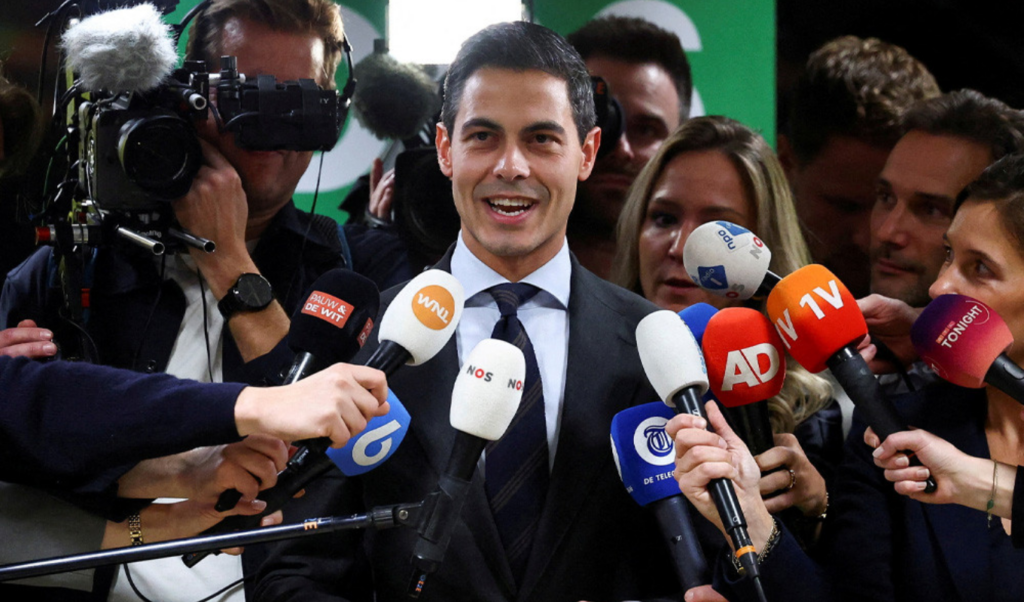
On Monday, the Netherlands inaugurated a new government, with 38-year-old centrist leader Rob Jetten taking office as the country’s youngest ever and first openly gay Prime Minister. His ascension marks a historic milestone in Dutch politics, reflecting both generational change and growing social inclusivity.
Jetten achieved a remarkable victory in the October national elections, narrowly defeating the far-right, anti-Islam Freedom Party (PVV) led by the polarising politician Geert Wilders. The election was called early after the previous coalition government, the most right-leaning in recent Dutch history, collapsed after just 11 months in power.
Jetten’s Democrats 66 (D66) party has now formed a coalition with the centre-right Christian Democratic Appeal (CDA) and the liberal People’s Party for Freedom and Democracy (VVD). Despite holding 66 seats, the coalition falls nine seats short of an absolute majority in the 150-seat House of Representatives. However, coalition negotiations were completed in just 117 days—a significant improvement compared to the 223 days required to form the previous government.
The election outcomes and parliamentary composition are summarised below:
| Party | Political Orientation | Seats Won | Role in Coalition |
|---|---|---|---|
| D66 | Centrist | 66 | Leading party |
| CDA | Centre-right | 15 | Coalition partner |
| VVD | Liberal | 12 | Coalition partner |
| PVV | Far-right | 66 | Main opposition |
Following his election victory, Jetten stated: “By campaigning with a positive message for our country, populist movements can be defeated.” During the campaign, he emphasised his vision of returning the Netherlands to the heart of Europe, asserting: “Without European cooperation, we are nothing.”
The coalition’s January manifesto pledges full support for Ukraine and a firm commitment to meeting NATO spending obligations. While the new government is less far-right than its predecessor, some “right-wing imprints” remain, according to Sara de Lange, Professor of Political Science at Leiden University. She noted that the coalition has opted for budgetary cuts rather than increased investment and has maintained continuity in immigration policy compared to the previous administration.
The coalition has also promised stricter regulations on family reunification and an intensified approach to immigration control. Analysts suggest that these measures reflect a pragmatic blend of progressive governance with conservative fiscal and security priorities.
Rob Jetten’s premiership signals a new chapter in Dutch politics: one combining youthful leadership, social inclusivity, and a commitment to both European engagement and domestic stability. Observers will be watching closely to see how this historic government balances these priorities while navigating a complex and often polarised political landscape.