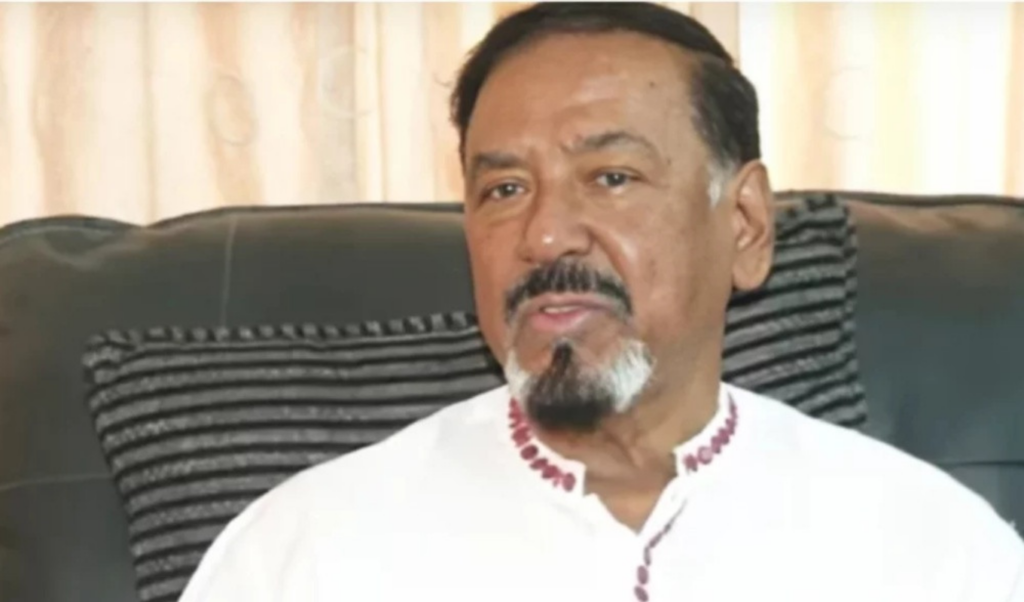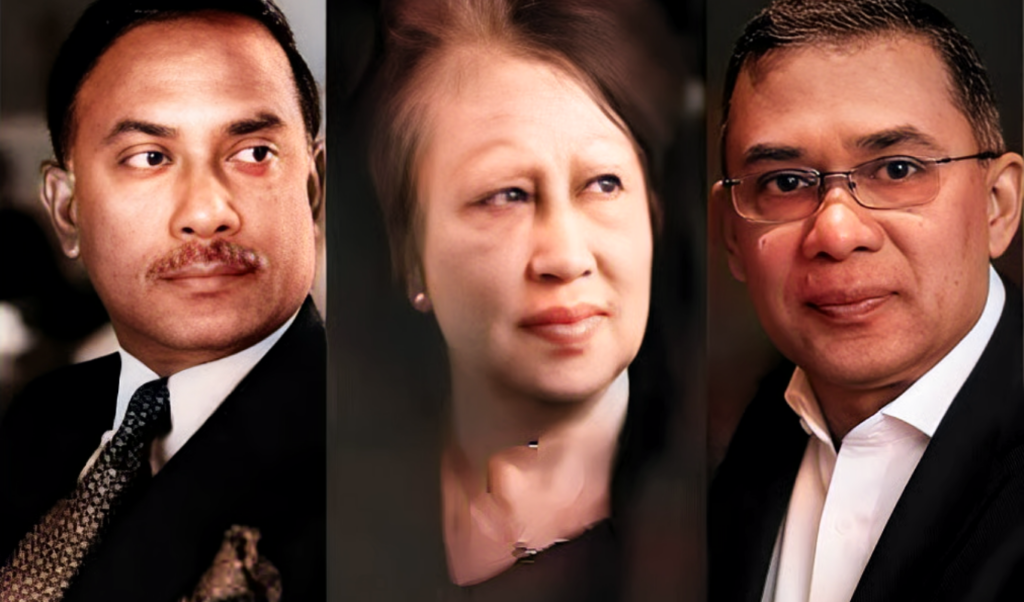
With the Bangladesh Nationalist Party (BNP) securing an absolute majority in the recent national elections, a new government is set to take office tomorrow, Tuesday, 17 February. If all proceeds as planned, the party chairman, Tarique Rahman, will assume the role of Prime Minister. This transition will mark a historic milestone for the Zia family, adding another chapter to its political legacy.
Globally, only a handful of families have produced three successive members who have held the highest office in their country. With Tarique Rahman poised to take the helm of Bangladesh, the Zia family will join this exclusive club, following his father, Ziaur Rahman, and mother, Khaleda Zia.
The Zia Family of Bangladesh
The political journey of the Zia family began with General Ziaur Rahman, a decorated freedom fighter, who rose to power on 7 November 1975 following a military coup. Initially appointed Chief Martial Law Administrator, he was elected President of Bangladesh on 21 April 1977 after President A. S. M. Sayeem resigned.
In September 1978, Ziaur Rahman founded the Bangladesh Nationalist Party (BNP) as its chairman. Under his leadership, the BNP emerged as one of Bangladesh’s major political forces. On 30 May 1981, Ziaur Rahman was assassinated by rogue army officers at the Chittagong Circuit House.
Following her husband’s death, Khaleda Zia, initially a housewife, took over the reins of BNP and led the party in the pro-democracy movement against military ruler Hussain Muhammad Ershad. She went on to become Bangladesh’s first female Prime Minister in 1991 and served three terms, maintaining an unbroken record of electoral victories across multiple constituencies.
After Khaleda Zia’s passing on 30 December, 2024, Tarique Rahman assumed the chairmanship of BNP. Having led the party to an overwhelming parliamentary majority in the 12 February election, he is now set to take charge of the government, completing the Zia family’s unprecedented three-generation leadership.
Other Global Examples of Three-Generation Leaders
While the Zia family joins a rare global club, similar political dynasties exist worldwide. Below are some notable examples:
| Country | Family | First Generation | Second Generation | Third Generation | Key Notes |
|---|---|---|---|---|---|
| Bangladesh | Zia | Ziaur Rahman (President, 1977–1981) | Khaleda Zia (PM, 1991–2006) | Tarique Rahman (PM, 2026–) | Three generations in highest office; BNP leadership continuity |
| India | Nehru-Gandhi | Jawaharlal Nehru (PM, 1947–1964) | Indira Gandhi (PM, 1966–1977, 1980–1984) | Rajiv Gandhi (PM, 1984–1989) | Indira Gandhi was India’s first female PM; Rajiv youngest PM at 40 |
| Pakistan | Bhutto | Zulfikar Ali Bhutto (President/PM, 1971–1977) | Benazir Bhutto (PM, 1988–1990, 1993–1996) | Bilawal Bhutto Zardari (PPP Chairman, 2024–) | Benazir first female PM in Muslim world; Bilawal currently party leader |
| Sri Lanka | Bandaranaike | S. W. R. D. Bandaranaike (PM, 1956–1959) | Sirimavo Bandaranaike (PM, 1960–1965, 1970–1977, 1994) | Chandrika Kumaratunga (President/PM, 1994–2005) | Chandrika served as both PM and President |
| Thailand | Shinawatra | Thaksin Shinawatra (PM, 2001–2006) | Yingluck Shinawatra (PM, 2011–2014) | Petangtharn Shinawatra (PM, 2024–2025) | Yingluck first female PM; Petangtharn youngest PM at 37 |
| North Korea | Kim | Kim Il-sung (1948–1994) | Kim Jong-il (1994–2011) | Kim Jong-un (2011–present) | Authoritarian dynasty; Kim Jong-un’s daughter considered potential successor |
| Greece | Papandreou | Georgios Papandreou (PM, 1944–1945, 1963–1965) | Andreas Papandreou (PM, 1981–1989, 1993–1996) | George Papandreou (PM, 2009–2011) | Three consecutive generations as PM |
| Nicaragua | Somoza | Anastasio Somoza García (President, 1937–1947, 1950–1956) | Luis Somoza Debayle (President, 1956–1963) | Anastasio Somoza Debayle (President, 1967–1979) | Political dynasty ended with revolution |
| Peru | Prado | Mariano Ignacio Prado (President, 1865–1868, 1876–1879) | Manuel Prado Ugarteche (President, 1939–1945, 1956–1962) | Javier Prado Ugarteche (PM, 1910) | Family produced both presidents and prime ministers |
Additional Notable Political Families with Two Leaders
Several families have produced two successive leaders rather than three:
United States: George H. W. Bush (President) and George W. Bush (President) – father and son.
Bangladesh: Sheikh Mujibur Rahman (President) and Sheikh Hasina (Prime Minister) – father and daughter.
Singapore: Lee Kuan Yew (PM) and Lee Hsien Loong (PM) – father and son.
Canada: Pierre Trudeau (PM) and Justin Trudeau (PM) – father and son.
Indonesia: Sukarno (President) and Megawati Sukarnoputri (President) – father and daughter.
Syria: Hafez al-Assad (President) and Bashar al-Assad (President) – father and son.
Lebanon: Rafik Hariri (PM) and Saad Hariri (PM) – father and son.
Philippines: Ferdinand Marcos (President) and Ferdinand “Bongbong” Marcos Jr. (President) – father and son.
Sri Lanka: Gotabaya Rajapaksa (President) and Mahinda Rajapaksa (President/PM) – brothers.
Japan: Takeo Fukuda (PM) and Yasuo Fukuda (PM) – father and son.
Historical Context and Global Trends
Political dynasties, while often criticised for concentrating power, remain a significant feature of global governance. In modern republics, dynasties have frequently provided continuity, institutional memory, and, at times, political stability, although they have also been associated with allegations of nepotism.
In South Asia, the Nehru-Gandhi family has profoundly shaped India’s post-independence trajectory. Jawaharlal Nehru led the nation through its formative years, steering India’s non-aligned policy during the Cold War. Indira Gandhi, his daughter, enacted pivotal reforms and took controversial measures, such as declaring the Emergency in 1975. Rajiv Gandhi later modernised the administration and played a mediating role in regional conflicts before his assassination in 1991.
Similarly, Pakistan’s Bhutto family has influenced decades of political discourse, alternating between periods of democratic governance and military intervention. Benazir Bhutto’s tenure represented a landmark in Muslim-majority politics as the first female Prime Minister.
In South East Asia, Thailand’s Shinawatra family illustrates the volatile intersection of dynastic politics and judicial intervention, with members frequently ascending to the premiership only to face removal or exile.
North Korea, by contrast, demonstrates a hereditary autocracy spanning three generations, with Kim Il-sung, Kim Jong-il, and Kim Jong-un maintaining absolute control since 1948.
Europe and Latin America also provide examples of dynastic politics, as seen with Greece’s Papandreou family, Nicaragua’s Somoza family, and Peru’s Prado family, demonstrating that political inheritance is not limited to Asia.
Conclusion
The assumption of the Prime Ministership by Tarique Rahman will mark a historic moment for Bangladesh, placing the Zia family alongside a select number of global dynasties where three successive generations have assumed the highest office. Across continents, these families illustrate both the enduring influence of political heritage and the complex interplay of democracy, charisma, and legacy in modern governance.
As Bangladesh prepares for this transition, the world will be watching to see how the Zia family’s third generation navigates the challenges of leadership in the twenty-first century—a continuation of a global narrative of dynastic politics that spans continents and decades.