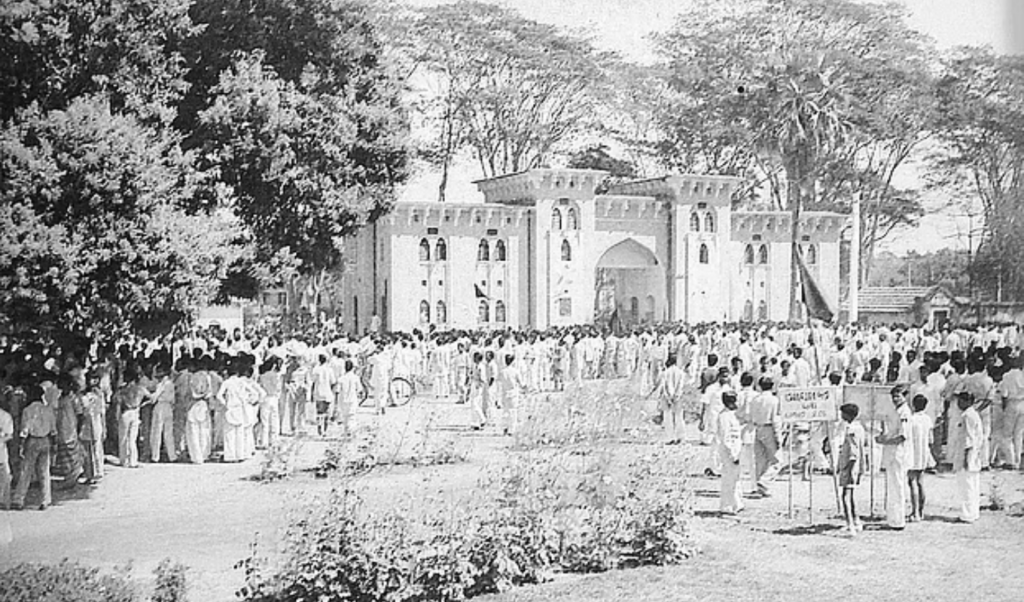
In the closing pages of Another Falgun by Zahir Raihan, a striking scene unfolds. Set against the backdrop of the observance of 21 February 1955, the novel portrays young demonstrators being herded into prison cells. Exhausted and exasperated, the deputy jailer fumes that there is no space left in an already overcrowded gaol. A detained activist responds defiantly: “Are you alarmed already? Come next spring, we shall be twice as many.” With that declaration, the novel concludes—yet the sentiment it captures has echoed across Bangladesh’s political history for decades.
That single line has transcended fiction. It has appeared on protest walls, in political speeches, and in the collective imagination of successive generations. Whenever state repression has intensified, so too has the resolve of protesters. The promise of becoming “twice as many” has served as both warning and prophecy—a reminder that popular resistance often grows in proportion to attempts to suppress it.
National identity, far from being an immutable inheritance, is constructed through shared experiences and collective remembrance. In Bangladesh, few events have shaped that shared memory more profoundly than 21 February 1952, when students sacrificed their lives demanding recognition of Bangla as a state language. The Language Movement did not merely settle a linguistic dispute; it forged the moral foundation of a nation.
Although some historians argue that Bangladesh’s story must be traced further back to avoid isolating 1952 as an abrupt beginning, there is broad agreement that Ekushey—21 February—occupies the symbolic centre of the country’s modern history. Even attempts during authoritarian periods to reinterpret or selectively appropriate the events of 1952 underscore how powerful and contested this memory remains.
The influence of Ekushey soon extended beyond language politics. In 1954, as the United Front prepared for provincial elections in East Bengal, Abul Mansur Ahmed famously devised a “21-point programme”, consciously drawing inspiration from the symbolic weight of the number. Proposals circulating at the time included the construction of a Shaheed Minar, the declaration of 21 February as a public holiday, and the transformation of Bardhaman House into a centre for Bangla language and culture. The number 21, he reasoned, could become permanently etched in public consciousness. The resulting manifesto became a rallying cry for students and citizens alike.
Over the decades, Ekushey has resurfaced at pivotal political junctures. The following table summarises several key moments when 21 February served as catalyst or inspiration:
| Year | Political Context | Role of Ekushey |
|---|---|---|
| 1952 | Language Movement | Martyrdom for linguistic recognition |
| 1954 | United Front Election | Inspiration for the 21-point manifesto |
| 1969 | Mass Uprising against Ayub | Protest art and slogans at Shaheed Minar |
| 1971 | Prelude to Liberation War | Oaths sworn in martyrs’ names |
| 1989 | Anti-Ershad Movement | Calls for resistance to autocracy |
| 2024 | Mass Uprising | Revival of “We shall be twice as many” slogan |
During the 1969 mass uprising against President Ayub Khan’s regime, the vicinity of the Shaheed Minar became a canvas of dissent. Wall murals depicted Rabindranath Tagore, Bangla letters, and democracy ensnared in barbed wire. Slogans condemned imperialism, militarism, and economic exploitation. Ekushey had evolved into a stage upon which grievances were publicly dramatised.
The revolutionary atmosphere of February 1971 was even more charged. Within weeks, the Liberation War would erupt. Sheikh Mujibur Rahman invoked the martyrs of 1952 while pledging to secure Bengali autonomy, even at the cost of blood. Newspapers of the time described thunderous oaths taken before vast crowds. After independence, editorials proclaimed that the conviction of Ekushey had spread throughout Bengal.
In independent Bangladesh, governments of differing political persuasions have formally commemorated 21 February. Yet its power has never belonged solely to officialdom. Rather, it has been felt most acutely in moments of popular unrest—when citizens gather at the Shaheed Minar to protest injustice or to swear collective vows.
During the anti-autocracy movement of the late 1980s, activists invoked Ekushey to legitimise resistance against General Ershad’s rule. In 1989, student leaders called for united opposition to authoritarianism and communalism on 21 February itself. Prominent political figures publicly pledged to restore democracy before the martyrs’ monument.
More recently, during the July 2024 mass uprising, familiar refrains resurfaced: “We did not see ’52, but we have seen ’24,” and “Come next spring, we shall be twice as many.” Protest songs drew direct parallels between past and present sacrifices. At the height of mobilisation, the Shaheed Minar once again functioned as the epicentre of rallies, marches, and declarations.
Across seventy years, Ekushey has thus become a durable metaphor. It embodies defiance against injustice, resistance to repression, and the renewal of civic courage. When rights appear threatened, the memory of the martyrs supplies both language and legitimacy to dissent.
As Bangladesh stands at another political crossroads, emerging from a prolonged period of turbulence and aspiring towards democratic consolidation, Ekushey’s resonance endures. It reminds citizens that state authority is accountable to the people, and that attempts to curtail fundamental freedoms may provoke renewed mobilisation.
The song that asks, “Can I forget the twenty-first of February, stained with my brothers’ blood?” remains more than a lament. It is a declaration that memory itself can be an instrument of power. And if history is any guide, whenever repression intensifies, the spirit of Ekushey may yet ensure that, come another spring, the ranks of those who stand for justice will indeed be twice as many.