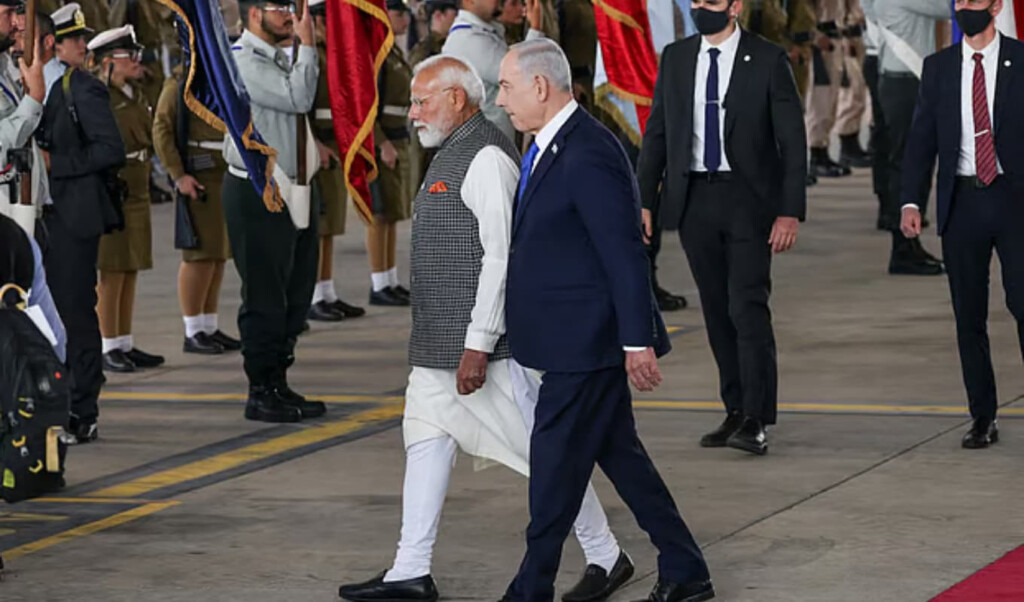
Indian Prime Minister Narendra Modi arrived in Israel on Wednesday for his second official visit, following his inaugural trip in 2017. Modi’s arrival underscores the continuity of India’s steadily deepening strategic partnership with Israel. Israeli Prime Minister Benjamin Netanyahu accorded Modi full ceremonial honours, signalling the significance Israel places on its friendly ties with India. Notably, Netanyahu has prioritised this bilateral relationship despite facing international criticism, including an outstanding arrest warrant from the International Criminal Court and condemnation over military operations in Gaza. Modi’s visit proceeded unhindered by these controversies.
Just days prior to Modi’s arrival, Netanyahu announced the formation of the so-called “Hexagon Bloc,” positioning India as a central actor in a new regional architecture. The bloc reportedly includes Greece, Cyprus, and select countries from the Arab, African, and Asian regions. According to Netanyahu, the Hexagon Bloc aims to confront extremist networks, particularly in light of the weakened Shia axis and the potential resurgence of Sunni militant organisations.
The current geopolitical landscape remains highly complex. Turkish President Recep Tayyip Erdoğan continues to be a vocal critic of Israel. Meanwhile, Pakistan and Saudi Arabia signed a strategic defence agreement in September 2025, prompting analysts to suggest that the emergence of a Sunni-oriented regional coalition may generate concerns in Israel while indirectly affecting Pakistan’s security calculus. India-Israel rapprochement thus carries direct implications for Islamabad’s strategic planning.
Expansion of Defence and Technology Cooperation
Since 2017, India-Israel relations have strengthened significantly, with India emerging as one of Israel’s principal defence clients. Modi’s current visit has placed particular emphasis on cooperation in defence, artificial intelligence, quantum computing, and cybersecurity. Potential technology transfers include Israel’s advanced Iron Beam laser system and Iron Dome missile defence technology.
| Sector | Key Developments | Strategic Implications for Pakistan |
|---|---|---|
| Defence | Arms purchases, technology transfer | Heightened security concerns |
| Artificial Intelligence | Joint R&D | Enhanced cyber and defence capabilities |
| Quantum Computing | Technology exchanges | Intelligence and data advantages |
| Cybersecurity | Collaborative threat response | Strengthened national security frameworks |
Experts argue that deepening intelligence and military cooperation between India and Israel has complicated Pakistan’s strategic environment. Former Pakistani diplomats Masood Khalid and Masood Khan have highlighted that the long-standing bilateral military and intelligence relationship poses serious concerns for Islamabad.
While the full composition of the Hexagon Bloc remains uncertain, its strategic gaze appears focused on Islamic states, particularly Turkey and Pakistan. Even though Pakistan is not a direct adversary, it faces potential indirect strategic challenges. Analysts advise Islamabad to strengthen ties with Central Asia, Turkey, Iran, and Russia to offset emerging pressures.
Modi’s visit, coupled with Netanyahu’s strategic initiatives, heralds new security challenges for Pakistan. International observers contend that India-Israel rapprochement will have tangible effects on Pakistan’s military, intelligence, and strategic planning in the coming year.