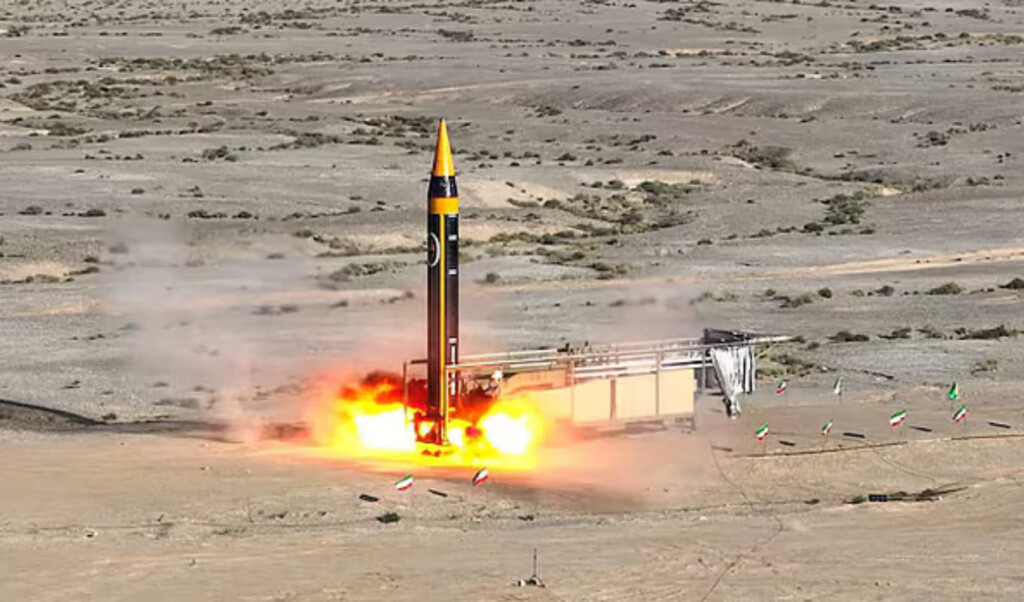
The Islamic Revolutionary Guard Corps (IRGC) of Iran has reportedly launched a missile attack on an Israeli target using a Sejil solid-fuel missile, according to Iran’s semi-official Tasnim News Agency. The announcement was made on Sunday, marking what Iranian sources describe as a significant escalation in Tehran’s strategic missile capabilities.
Tasnim News reported that this is the first operational use of the Sejil missile by Iran since the escalation of US–Israel military actions that began on 28 February. The missile, described as strategically significant, underscores Iran’s growing emphasis on long-range, high-speed weaponry.
According to Al Jazeera, the Sejil missile has an estimated range of 2,000 to 2,500 kilometres, and travels at a speed approximately thirteen times faster than the speed of sound, classifying it as a hypersonic weapon. Such velocity significantly complicates interception by conventional missile defence systems, raising concerns among regional and global security analysts.
The National Interest magazine has noted that the missile is capable of striking a wide range of targets, potentially covering areas from the Indian Ocean to the Mediterranean Sea, demonstrating Iran’s ability to project power across vast regions.
Sejil Missile Key Specifications
| Feature | Specification |
|---|---|
| Type | Solid-fuel ballistic missile |
| Operational Range | 2,000–2,500 km |
| Speed | ~13 Mach (13 times speed of sound) |
| Deployment History | First use since February 28 escalation |
| Potential Strike Region | Indian Ocean to Mediterranean Sea |
| Launching Authority | Islamic Revolutionary Guard Corps (IRGC) |
Security experts warn that the missile’s combination of speed, range, and precision represents a significant shift in the strategic balance in the Middle East. While Iran frames the strike as a defensive measure against US–Israel provocations, the deployment of hypersonic weaponry is likely to intensify regional tensions.
The incident comes amid rising concerns over missile proliferation and the potential for miscalculations between regional powers. Analysts emphasise that monitoring such capabilities is critical, as the Sejil missile could reach distant maritime and land-based targets within minutes, leaving minimal reaction time for the affected nations.