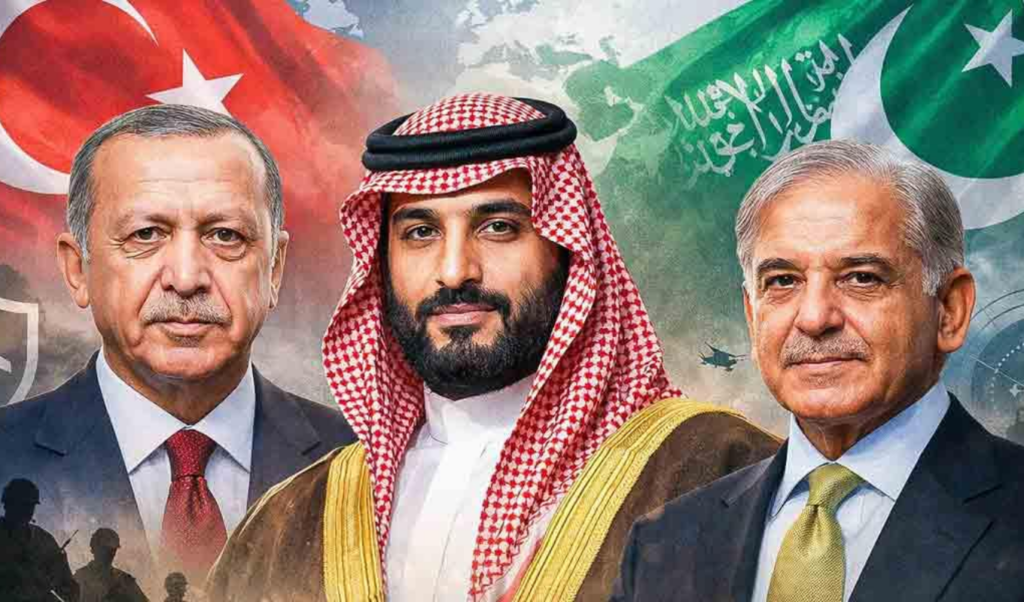
Foreign ministers from Turkey, Saudi Arabia, Egypt, and Pakistan convened on Thursday in Riyadh, Saudi Arabia, for a high-level meeting aimed at exploring enhanced defence collaboration among these Islamic nations. The meeting, held on the sidelines of a broader Islamic conference, marked the first time the four countries discussed mechanisms to integrate their defence capabilities and coordinate on security matters.
Background and Objectives
Turkey has been pursuing a formal defence cooperation agreement with Pakistan and Saudi Arabia since last year. Earlier in 2026, a Pakistani minister noted that discussions on such a pact had been ongoing for nearly twelve months. According to Turkish sources cited by Middle East Eye, Ankara is also seeking to bring Egypt into the framework.
Officials have clarified that the proposed arrangement is not intended to replicate NATO-style mutual defence obligations. Instead, it is envisioned as a “security platform” focused on industrial collaboration, joint military research, technology exchange, and broader defence cooperation.
“This initiative seeks to leverage each nation’s unique military and technological strengths for collective security without formalised alliance commitments,” a Turkish source told regional media.
Defence Capabilities of the Participants
Each country brings distinct strategic advantages to the potential collaboration:
| Country | Strategic Strength | Key Assets / Capabilities |
|---|---|---|
| Turkey | Advanced defence industry | Indigenous drones, missiles, fighter jets; significant investment in R&D |
| Pakistan | Nuclear arsenal | Credible deterrence capability, conventional and strategic weapons |
| Saudi Arabia | Emerging tech hub | Access to advanced technology, strong procurement potential, growing industrial base |
| Egypt | Regional military power | Largest Arab population, substantial conventional forces, strategic geographic position |
Turkey’s recent military exports highlight its leadership in defence technology. During President Recep Tayyip Erdoğan’s February visit to Cairo, Ankara and Egypt signed a bilateral military cooperation agreement aimed at strengthening security ties. Under the deal, Turkey’s state-owned Mechanical and Chemical Industry Corporation (MKEK) signed a $350 million export agreement with Egypt’s Ministry of Defence, encompassing ammunition sales and the establishment of manufacturing facilities within Egypt.
Strategic Implications
Analysts suggest that this emerging cooperation platform could serve multiple purposes:
- Enhanced regional security coordination – enabling joint planning and rapid response to emerging threats.
- Technology transfer and industrial development – boosting domestic defence production capabilities across member states.
- Balancing regional power dynamics – particularly in the context of evolving Middle Eastern security challenges.
The meeting in Riyadh indicates a shift towards greater multilateral defence collaboration among major Muslim-majority nations, without formal treaty obligations that could constrain their strategic autonomy. Observers note that such a platform could complement existing bilateral agreements while promoting defence diplomacy in a volatile region.
Next Steps
Officials are expected to continue consultations to formalise operational guidelines, technology-sharing protocols, and potential joint exercises. While no formal treaty has yet been announced, the dialogue represents a significant step towards coordinated Islamic defence cooperation.