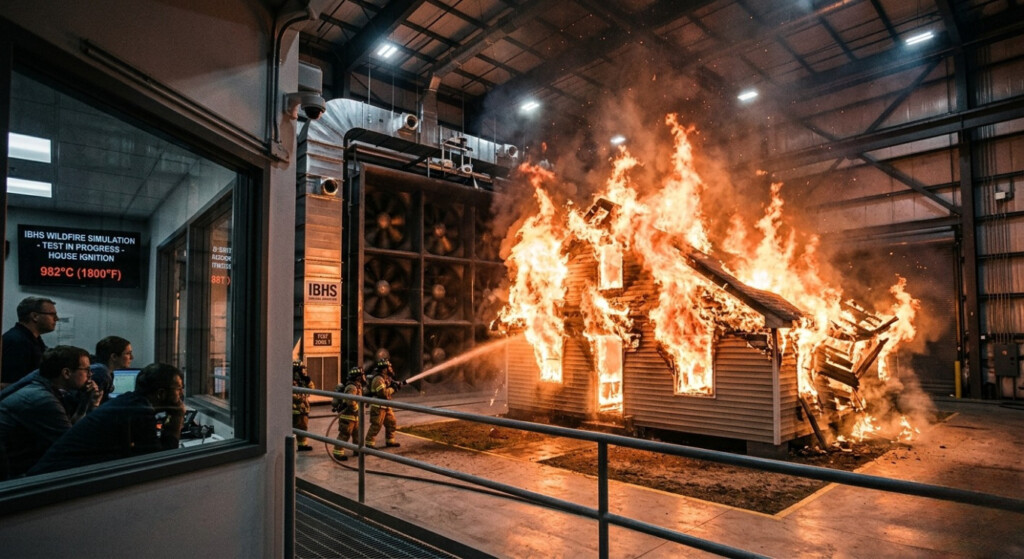
A groundbreaking disaster simulation facility in the United States is transforming the way homes are designed, built, and insured, as climate-related hazards place unprecedented strain on the housing sector—particularly in wildfire-prone regions such as California.
At the forefront of this initiative is the Insurance Institute for Business & Home Safety (IBHS), which operates a state-of-the-art full-scale “disaster laboratory” in South Carolina. Conceived in the aftermath of Hurricane Katrina, the facility enables scientists and engineers to replicate extreme natural events with remarkable precision, including hurricane-strength winds, intense hailstorms, and fast-moving wildfires.
One of the most compelling demonstrations involves subjecting a standard wooden house to simulated wildfire conditions. Within minutes, controlled flames—fuelled by high-velocity winds generated by a vast wind tunnel—can engulf the structure. Temperatures frequently exceed 980°C, illustrating with stark clarity how rapidly fire can spread from embers to full structural collapse. Observers, stationed at a safe distance, witness entire rooms being consumed in a matter of moments.
Yet the purpose of the laboratory extends far beyond dramatic visual evidence. Its primary mission is to identify practical, scalable solutions to improve residential resilience. Through rigorous testing, researchers have validated a range of innovations, including ember-resistant ventilation systems, non-combustible cladding, and reinforced roofing materials. These measures can significantly delay ignition and slow fire progression, offering critical time for evacuation and emergency response.
However, experts emphasise that isolated upgrades to individual homes are insufficient. The concept of “collective resilience” has gained prominence, highlighting the need for coordinated, neighbourhood-wide strategies. Without such alignment, even well-fortified properties remain vulnerable if surrounding structures fail.
The implications for the insurance industry are profound. As climate change intensifies the frequency and severity of disasters, insurers face mounting financial exposure. In response, premiums have risen sharply, with average home insurance costs in the United States increasing by approximately 64 per cent since 2019. Simultaneously, many insurers have scaled back operations in high-risk areas.
California exemplifies this trend. Several major insurers have reduced or withdrawn coverage in wildfire-exposed regions, citing unsustainable losses. This has led to a widening protection gap, leaving a growing number of homeowners underinsured—or entirely without cover.
Key Trends in U.S. Home Insurance
Indicator Recent Data Implication
Premium increase +64% since 2019 Escalating financial burden on households
Uninsured homes 14.1% in 2025 Rising exposure to catastrophic loss
Major risk factor Wildfires, storms Intensifying climate-related threats
Market response Insurer withdrawal Reduced access to affordable coverage
The consequences extend into the broader property market. Mortgage providers typically require comprehensive insurance, meaning reduced availability can disrupt home sales and suppress property values. For many households, whose primary asset is their home, this creates a precarious financial outlook.
IBHS researchers hope their findings will inform stricter building codes and more resilient urban planning policies. By promoting construction standards that can withstand extreme conditions, they aim to mitigate losses and stabilise insurance markets over time. Nevertheless, a critical barrier remains: insurers have been slow to reward resilience improvements with meaningful premium reductions, limiting homeowners’ incentives to invest in safer designs.
As climate risks continue to escalate, the work conducted within this disaster laboratory offers both a warning and a pathway forward. It underscores a fundamental reality—future housing security will depend not only on location, but on the capacity of homes and communities to endure increasingly volatile natural forces.