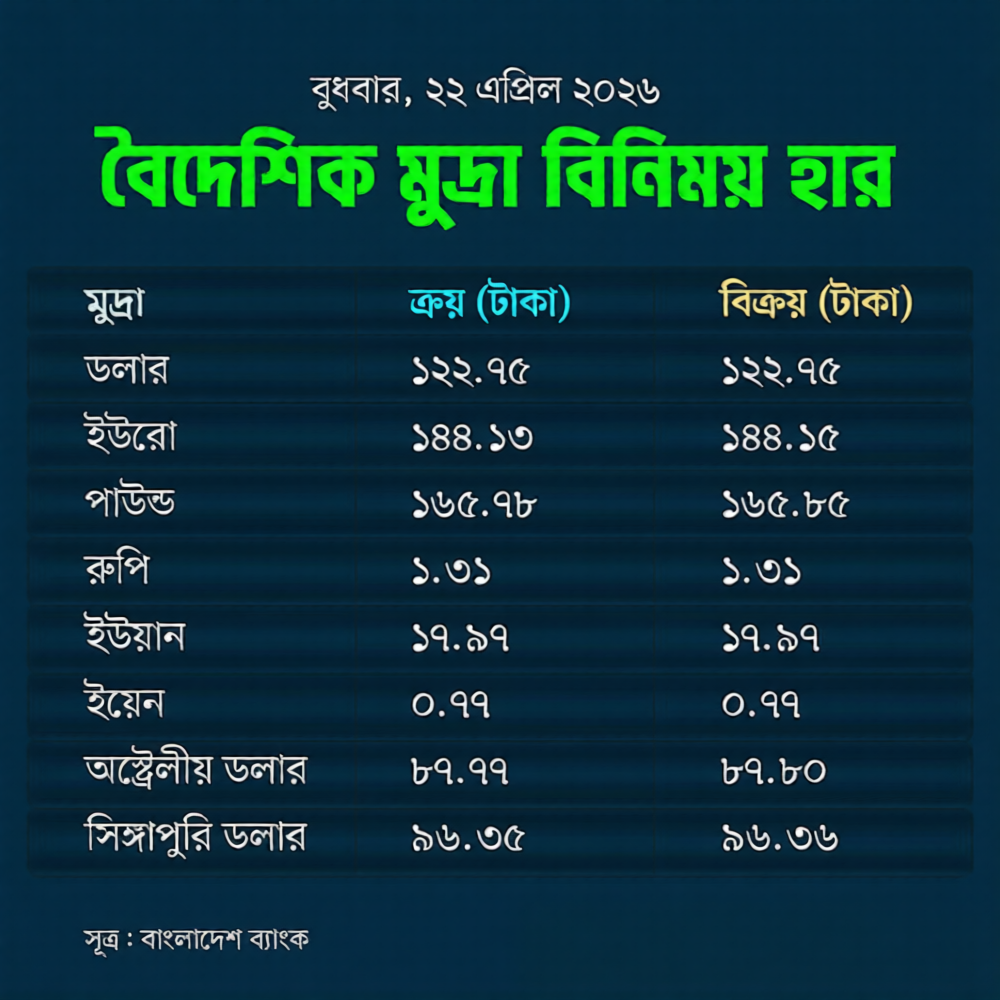
Foreign currency trading in Bangladesh’s money market continued to fluctuate on Wednesday, with most major currencies recording marginal declines amid ongoing global economic uncertainty. Market analysts point to continued pressure stemming from geopolitical tensions in the Middle East and broader external imbalances, which have contributed to volatility in exchange rates over recent days.
According to data released by Bangladesh Bank, the average exchange rate of the United States dollar stood at BDT 122.75 today. The dollar has been experiencing a pattern of fluctuations for several months, although a mild upward drift has been observed over the past month. This gradual increase has been closely watched by importers and businesses dependent on foreign payments.
In today’s trading session, most foreign currencies registered a decline against the Bangladeshi Taka. These included the Euro, British Pound Sterling, Australian Dollar, Singapore Dollar, and Chinese Yuan. However, not all currencies moved in the same direction. The Indian Rupee and Japanese Yen remained stable, showing no change compared to previous trading sessions.
Market observers note that exchange rates in the open market tend to be slightly higher than the official rates published by the central bank. This gap is a common feature of the country’s foreign exchange system, reflecting supply-demand imbalances and informal market pressures.
Fluctuations in foreign exchange rates have a direct impact on the cost structure of trade and commerce in Bangladesh. Import-dependent sectors, particularly fuel, machinery, and essential commodities, are especially sensitive to changes in the dollar rate. Conversely, exporters may experience mixed effects depending on contract structures and settlement currencies.
Selected Exchange Rates (Indicative)
| Currency | Rate (BDT) | Movement Today |
|---|---|---|
| US Dollar (USD) | 122.75 (average) | Slight increase trend over month |
| Euro (EUR) | Not specified | Decreased |
| British Pound (GBP) | Not specified | Decreased |
| Australian Dollar | Not specified | Decreased |
| Singapore Dollar | Not specified | Decreased |
| Chinese Yuan (CNY) | Not specified | Decreased |
| Indian Rupee (INR) | Not specified | Unchanged |
| Japanese Yen (JPY) | Not specified | Unchanged |
The central bank continues to monitor the foreign exchange market closely, with interventions aimed at maintaining stability and preventing excessive volatility. However, analysts suggest that global economic conditions will remain a key driver of future currency movements, particularly in emerging markets such as Bangladesh.
As import bills remain elevated and external pressures persist, market participants are expected to remain cautious in the coming weeks.