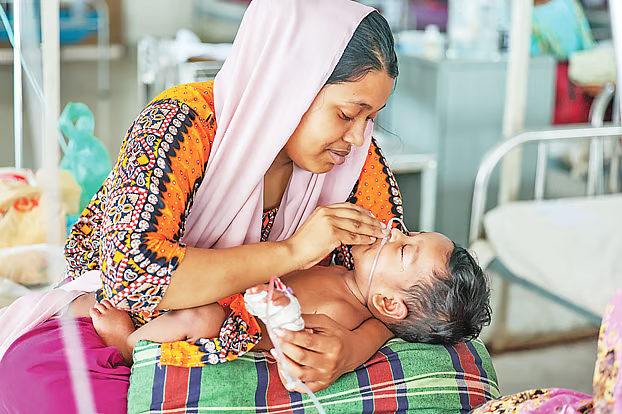
A growing debate over measles-related child deaths has highlighted inconsistencies in how fatalities are being classified in Bangladesh, with public health experts warning that the current distinction between “confirmed” and “suspected” cases is creating confusion and undermining public trust.
Health specialists argue that any child showing clinical symptoms of measles should be regarded as a measles-related death, even if laboratory confirmation is unavailable. They say the presence of typical symptoms is sufficient for classification during an outbreak, particularly when testing capacity is limited.
The controversy intensified after the Directorate General of Health Services (DGHS) began separating deaths into two categories: laboratory-confirmed measles deaths and suspected measles deaths. Officials say this distinction is necessary because not all cases can be verified through laboratory testing.
However, epidemiologists and members of national advisory bodies have challenged this approach, saying it risks distorting the true scale of the outbreak and confusing both the media and the public.
Conflicting figures reported
Reports from different stages of the outbreak illustrate the inconsistency in classification:
| Source / Period | Category | Number of deaths |
|---|---|---|
| Infectious Disease Hospital (earlier report) | Total measles deaths | 22 |
| Subsequent hospital update | Suspected measles deaths | 32 |
| Same update | Confirmed measles deaths | 2 |
| DGHS (latest report) | Suspected measles deaths | 194 |
| DGHS (latest report) | Confirmed measles deaths | 39 |
| DGHS (latest report) | Total reported deaths | 233 |
The shifting figures have contributed to public uncertainty, especially as different institutions have provided varying updates over time.
Expert concerns over classification
At a joint meeting held on 12 April by the National Immunisation and Technical Advisory Group (NITAG) and the National Verification Committee (NVC), experts discussed the issue in detail. NITAG is the country’s highest technical advisory body on immunisation, while the NVC assesses the quality and reliability of disease surveillance and verification systems.
Participants included senior officials from the Ministry of Health, the Directorate General of Health Services, and representatives from UNICEF and the World Health Organization, along with leading public health experts.
Experts at the meeting reportedly agreed that children presenting with measles-like symptoms and admitted to hospitals should generally be considered measles cases, particularly in outbreak conditions.
One public health specialist present at the meeting stated that clinical symptoms alone are often sufficient for classification when laboratory confirmation is not feasible.
Official position and ongoing debate
An additional director-general of health services acknowledged the limitations in testing capacity, noting that not all suspected cases can be laboratory confirmed. However, he cautioned that it would be scientifically inaccurate to classify all deaths as measles-related without verification, suggesting that a small proportion of cases may have other underlying causes.
Conversely, public health experts such as former chief scientific officers of national disease control institutions argue that separating deaths into “suspected” and “confirmed” categories may create unnecessary doubt among the public. They warn that such ambiguity can lead to mistrust in official reporting and hinder outbreak control efforts.
One epidemiologist emphasised that transparent and consistent communication is essential during epidemics, adding that unclear messaging can fuel speculation and reduce compliance with public health measures.
Growing concern over public perception
Health professionals have also raised concerns that inconsistent terminology may lead communities to believe that authorities are underreporting the severity of the outbreak. According to them, this perception can weaken public confidence and potentially slow down immunisation and response efforts.
As the measles outbreak continues, experts are calling for a unified classification system that reflects both clinical reality and epidemiological standards, ensuring clearer communication and more effective public health response.