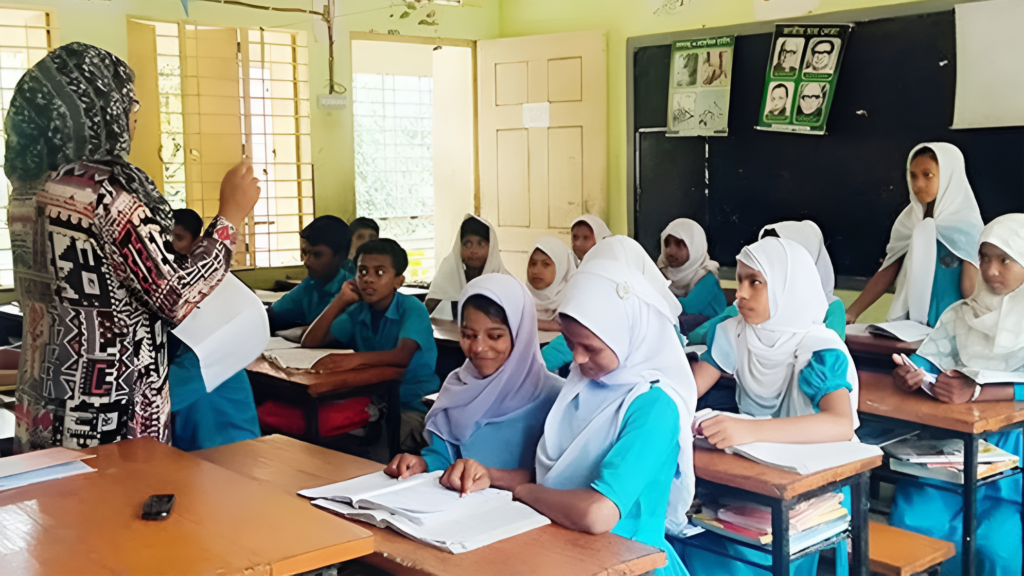
Bangladesh has recorded the lowest proportion of minimally qualified teachers among South Asian countries, according to the latest UNESCO Global Education Statistics. The findings present a comparatively weak position for the country in terms of teacher preparedness at the secondary education level.
The data indicate that, on average, only 55 per cent of secondary school teachers in Bangladesh meet the minimum required competency standards. These standards are assessed on two key criteria: whether teachers possess the necessary training for the level they teach, and whether their academic qualifications are appropriate for that level of instruction.
At the disaggregated level, Bangladesh shows a similar pattern across sub-sectors. In lower secondary education, 54.7 per cent of teachers meet the minimum competency benchmark, while in upper secondary education the figure is marginally higher at 55.2 per cent.
Within the South Asian region, Bangladesh ranks at the bottom of the index. Maldives leads the region with a reported 98.5 per cent of teachers meeting minimum competency standards. Other South Asian countries, including Bhutan, Nepal, India, Sri Lanka, and Pakistan, are reported to have higher proportions of qualified teachers than Bangladesh, although the precise percentages for these countries were not specified in the available data.
Teacher competency comparison in South Asia
| Country | Share of minimally qualified teachers (secondary level) | Regional position |
|---|---|---|
| Maldives | 98.5% | 1st |
| Bhutan | Not specified | Higher than Bangladesh |
| Nepal | Not specified | Higher than Bangladesh |
| India | Not specified | Higher than Bangladesh |
| Sri Lanka | Not specified | Higher than Bangladesh |
| Pakistan | Not specified | Higher than Bangladesh |
| Bangladesh | ~55% | Lowest |
The UNESCO framework used in the assessment evaluates teacher competency based on both formal qualification and subject-level teaching readiness. The aim is to measure whether educators are adequately prepared to deliver curriculum content effectively at their assigned teaching level.
In addition to the UNESCO findings, data from the Bangladesh Bureau of Educational Information and Statistics (BANBEIS) for 2024 provides further insight into subject-specific qualifications. At the secondary level, only 16.99 per cent of English teachers hold a bachelor’s or master’s degree in English. In mathematics, the proportion is even lower, at 14.66 per cent. These figures highlight a significant gap between subject requirements and teacher specialisation in core academic areas.
Taken together, the data from UNESCO and BANBEIS point to structural challenges in teacher training and subject-specific qualification within Bangladesh’s secondary education system.