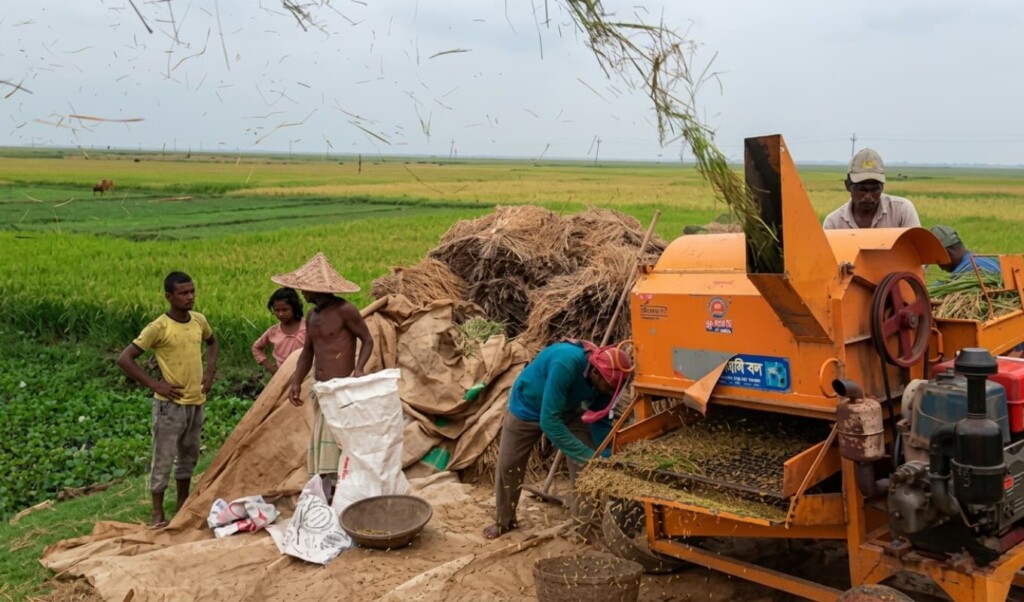
In the haor wetlands, farmers harvesting Boro paddy have been hit by a combination of unseasonal heavy rainfall and upstream water surges, which have inundated thousands of hectares of cropland. While some farmers managed to complete harvesting, they are now confronted with further difficulties: a shortage of drying space, weak market demand, and stringent conditions attached to government procurement. As a result, even harvested paddy has become a financial burden.
In several haor regions, the price of paddy has fallen sharply to between 500 and 600 taka per maund. Farmers report that continuous rainfall and overcast conditions have prevented proper drying. Traditional drying yards have been submerged, and in many cases, harvested paddy has begun to germinate in the field or storage areas, rendering it unsuitable for sale at standard market rates. Consequently, many farmers are compelled to sell at heavily reduced prices.
Although government procurement of paddy has begun in six haor districts—Sunamganj, Sylhet, Habiganj, Moulvibazar, Netrokona and Kishoreganj—farmers have largely been unable to participate. Official procurement requires compliance with strict quality standards, including moisture levels and grading requirements. Due to adverse weather conditions, most paddy does not meet these criteria.
Farmers also cite procedural complexities such as mandatory bank account registration, inclusion in beneficiary lists, transportation to procurement centres, and verification processes. These requirements have effectively excluded many smallholders from government purchasing schemes.
Under current policy, a farmer may sell up to 75 maunds of paddy to the government, with payment made directly through the banking system. While authorities state that this ensures transparency, farmers argue that it does not reflect field realities.
Paddy price trend and procurement overview
| Category | Details |
|---|---|
| Early-season farmgate price | 750–1,100 taka per maund |
| Current farmgate price | 400–600 taka per maund (in many areas) |
| Government procurement price | 1,440 taka per maund (36 taka/kg) |
| Maximum sale per farmer | 75 maunds |
| Government procurement target | 500,000 tonnes |
| Boro production (2021–22) | 21 million tonnes |
| Boro production (latest estimate) | 21.3 million tonnes |
| Current target production | 22.4 million tonnes |
Middlemen and local traders have taken advantage of the situation, purchasing wet or germinated paddy at 600–800 taka per maund. Farmers burdened by informal credit arrangements are often forced into distress sales.
Boro paddy accounts for approximately 55 per cent of Bangladesh’s total rice production. Although production has steadily increased, farmers report rising input costs for diesel, irrigation, fertilisers, seeds and labour. Government procurement prices, unchanged from previous years, have therefore been met with dissatisfaction.
Field conditions remain challenging. In Netrokona’s Kalmakanda, farmers report a decline in prices from 750 to 600 taka per maund within days, driven by drying difficulties. In Sunamganj’s Jalilpur, farmers describe widespread spoilage and germination of stored paddy due to persistent moisture.
In Kishoreganj’s Karimganj upazila, many farmers report limited awareness of government procurement schemes. Large quantities of harvested paddy have either been submerged or damaged, forcing sales at 400–600 taka per maund.
Officials state that procurement targets include 500,000 tonnes nationwide, but field-level uptake remains minimal due to quality constraints. Authorities have indicated that drying facilities may be provided at storage centres, although the 14 per cent moisture limit remains strictly enforced.
Agricultural economists suggest that government purchase of wet paddy with subsequent drying support could reduce farmer losses. Meanwhile, officials maintain that quality standards are necessary for long-term storage and food security.
The Ministry of Agriculture has indicated that awareness campaigns will be expanded and procurement processes may be simplified. The Ministry of Food has also stated that direct payments to farmers will be strengthened and intermediary involvement eliminated where possible.