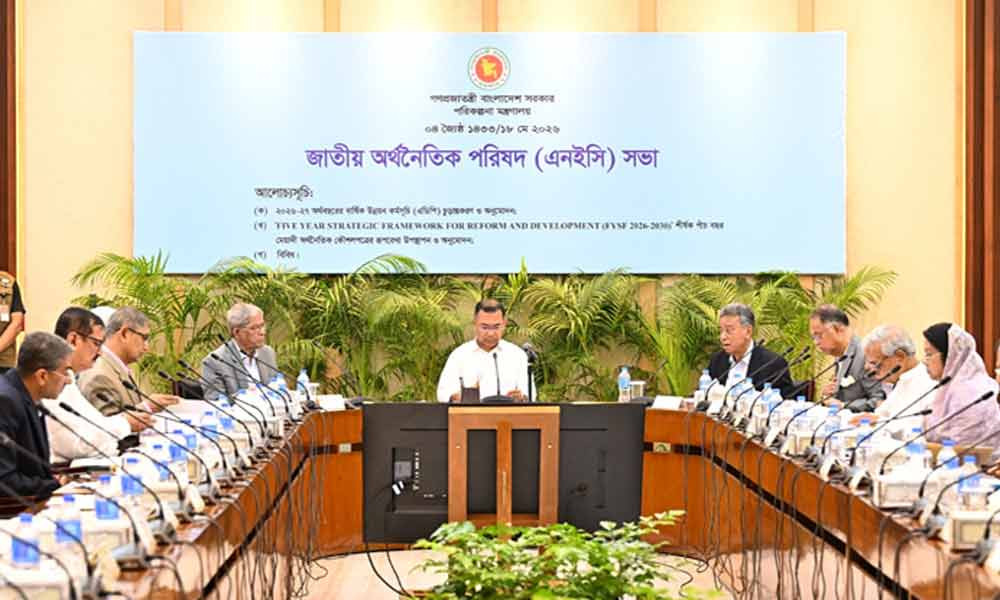
The National Economic Council has approved a record-sized Annual Development Programme (ADP) for the 2026–27 financial year, amounting to nearly three lakh crore taka. The decision was taken at a meeting held on Monday in Agargaon, Dhaka, chaired by Prime Minister Tarique Rahman. The session placed strong emphasis on national development priorities, economic restructuring, social protection, and reducing regional disparities.
According to proposals from the Planning Commission, the total size of the new development programme stands at over 3.08 lakh crore taka. Of this, 1.90 lakh crore taka will come from domestic government financing, while 1.10 lakh crore taka is expected from foreign loans and grants. An additional 8,900 crore taka will be contributed by autonomous bodies and state-owned corporations.
Financing Structure of ADP 2026–27
| Source of Finance | Amount (crore taka) |
|---|---|
| Government funds | 190,000 |
| Foreign loans & grants | 110,000 |
| Autonomous bodies & corporations | 8,900 |
| Total | 308,900+ |
The development framework has been designed under a five-year strategic planning structure. It is built on five core pillars: state institutional reform, equitable development, economic restructuring, balanced regional growth, and enhanced social and cultural cohesion.
Institutional reforms include digitisation of administrative processes, strengthening the judiciary, modernising public investment management, and improving the capacity of law enforcement agencies. These reforms are intended to improve governance efficiency and service delivery.
Sectoral Allocation Overview
Transport and communication remain the largest recipient of funds, reflecting the government’s continued focus on infrastructure expansion. Education and health also receive substantial allocations, alongside energy and housing development.
| Sector | Allocation (crore taka) |
|---|---|
| Transport & communication | 50,092 |
| Education | 47,591 |
| Health | 35,535 |
| Power & energy | 32,691 |
| Housing & community facilities | 20,361 |
At the ministry level, the Local Government Division has received the highest allocation of over 33,700 crore taka. The Roads and Highways Division follows with approximately 30,700 crore taka. Significant funding has also been directed towards health, education, and energy-related ministries.
A notable feature of this year’s ADP is the sharp rise in block allocations, which total nearly 1.18 lakh crore taka. A substantial portion of this amount remains unassigned to specific projects at the time of approval, raising discussions around prioritisation and implementation transparency.
Social Protection Initiatives
Social safety net programmes have been given increased attention. The Family Card programme has been allocated over 1,400 crore taka, while a similar amount has been earmarked for the Farmer Card scheme. More than 1,100 crore taka has been set aside as honorarium support for individuals serving in religious institutions.
The new ADP includes more than 1,100 ongoing development projects, covering investment schemes, technical assistance initiatives, and autonomous institutional projects. In addition, over 1,000 new projects are awaiting phased approval.
However, concerns persist regarding implementation capacity. During the first nine months of the current fiscal year, ADP implementation stood at just under 36 per cent. Analysts suggest that effective execution of such a large-scale development plan will require stronger administrative efficiency, improved project monitoring, and enhanced financial discipline.
The meeting also instructed ministries to accelerate project execution, ensure fiscal discipline, and complete ongoing projects within stipulated timelines. The government expects that the programme will play a significant role in strengthening infrastructure, developing human capital, and promoting balanced regional development across the country.